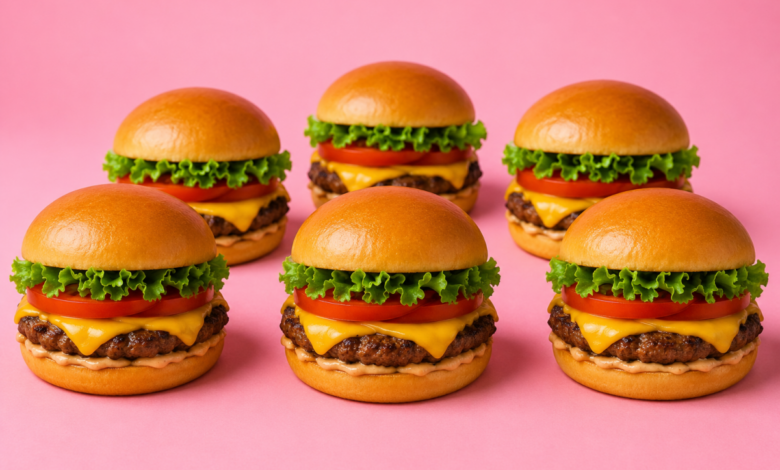
When you first encounter it, you might question your sanity. Walking into a cafe, you glance at a menu full of bagel sandwiches, but the pictures appear unnervingly perfect and symmetrical, triggering a gut feeling that something isn’t quite right. You could assume you’re being paranoid, but you’re not hallucinating. The rise of generative AI in restaurant menus, created from models designed on a specific, “pleasing” aesthetic, disrupts our perception even if we can’t pinpoint the reason.
Sometimes these images are absurdly artificial, resembling a burrito with cheese so exaggeratedly melted that it looks like an artwork rather than food. More frequently, they resemble typical dishes, only revealing their peculiar nature upon closer inspection.
“It’s as if an alien tried to replicate a pizza without grasping its essentials,” said Alex Lisle, Chief Technology Officer at Reality Defender, in a statement. (Reality Defender is part of a growing sector focused on AI detection and content verification tools, partly prompted by these kinds of challenges.)
Lisle further explains that the construction of these models reveals why their visuals often display a narrow aesthetic, characterized by perfect ice cream scoops and shrimp that seem bizarrely altered, leading to what he terms “Lovecraftian food horrors.”
Generative AI relies on large language models (LLMs) and diffusion models to create its outputs, having been trained on extensive datasets. These models discern patterns in the data to generate content requested by users, such as, “Create a burger restaurant menu.”
“A lot of this output resembles a Chili’s menu from 2015, which is no coincidence,” Lisle noted. “That’s where the model derived its structure.”
Image Credits:ChatGPT Image 2.0
Companies developing AI models highly value new training data; Amazon, for instance, has been found procuring rare books to include in its training data, subsequently destroying the originals. Consequently, AI-generated content may increasingly flood these extensive datasets. However, if models continuously train on their own outputs, they risk instability.
“Model collapse is like a form of disease; when you repeatedly feed a model’s outputs back into itself, the process eventually degrades, similar to inbreeding,” Lisle elucidated. “What we’re observing here is convergence, which is less severe but still compromises the quality of outputs.”
If an AI is prompted to produce a fast-food menu, it will likely reference those from Wendy’s, Burger King, or McDonald’s, thus adhering to a similar style. This creates a feedback loop where AI-generated menus reinforce existing styles if they re-enter training data.
Food advertisements will always appear more appealing than actual dishes, akin to a Big Mac in a commercial where each layer is meticulously arranged to increase visual appeal. In the case of AI outputs, this discrepancy can become even more pronounced.
“Data set optimization focuses on visual appeal and avoids anything offensive, leading to a form of homogenization,” commented Lee Rainie, Director of the Imagining the Digital Future Center at Elon University. “AI tends to smooth out the rough edges in both images and language.”
On a smaller scale, this smoothing effect is evident when an AI image generator creates a menu and receives numerous modifications. A user on X, known as Labtec, demonstrated the phenomenon by editing a ChatGPT-generated menu 100 times, resulting in increasingly distorted food images. (The outcome was similarly replicated in our tests.)
“The final product genuinely unsettled me,” Labtec remarked.
Businesses may be inadvertently exacerbating this issue by revising AI-generated menus and tweaking minor details, causing the food visuals to become gradually rounder and smoother with each alteration.
“People often possess an inexplicable ability to discern AI-generated content from authentic images,” Rainie noted. “This intuition can be difficult to express, yet it plays a significant role in explaining the strong backlash observed against AI menu implementations.”
Scientific research from the University of Duisburg-Essen in Germany has identified an “uncanny valley” effect in AI-generated food visuals, positing that images striking a near-realistic appearance can provoke more discomfort and disgust than blatantly fake ones. This discomfort is intensified by prevailing cultural sentiments surrounding AI.
If public reactions to AI-generated images are predominantly negative, it may be reason enough for restaurants to reconsider their use of AI for menu creation. Nevertheless, the challenges connected to our desire for flawlessly presented hamburger buns extend far beyond culinary spaces.
“Historically, seeing and hearing has been synonymous with belief, culminating in our legal systems prioritizing taped confessions and video evidence,” Lisle stated. “This paradigm is no longer reliable. The nature of evidence itself has shifted fundamentally, for better or worse.”