Meta Implements Fees for Government and Nonprofit Pages Posting Links on Facebook

Daniel Starks, the communications manager for Greenville, Texas—a city with a population of around 35,000—manages multiple Facebook pages for the city. Recently, he received a notice indicating that the library’s page could only share two links each month.
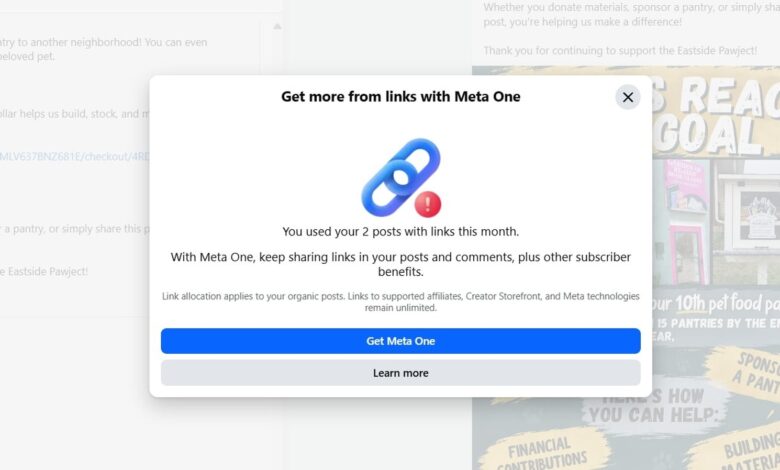
According to the notification, “You can add links to 2 posts per month, and you’ve used them all.” To share more, the page would need to subscribe to Meta One, which starts at $50 monthly.
Starks is among many experiencing Meta’s trial aimed at charging various entities for posting links on Facebook. While Meta claims this trial shouldn’t impact nonprofit or government pages, nonprofit leaders disagree based on their experiences. Many have pages designated as nonprofits and use Meta’s fundraising tools, which require a verification process. These organizations are now reassessing their strategies on the platform.
“A significant portion of our city’s communications involves linking back to information on our website,” Starks explained. “It’s concerning because we’re not clear on how to adapt.” Fearing that restrictions could soon affect other city pages, he instructed his team to refrain from posting links altogether on Facebook. Instead, he created a post informing followers that important URLs would be shared in the comments section. He expressed frustration over the changes, which Meta asserts shouldn’t apply to government-related pages, including the library’s verified account.
“When a public entity needs to disseminate crucial information, being forced to pay to post a link is problematic,” he argued.
Similarly, nonprofit organizations are feeling the effects of this test. Bethany English, co-president of a small nonprofit that operates pet food pantries in Indianapolis, found herself unable to post a link to her organization’s website while promoting an event on Facebook because she had exhausted her link quota for the month.
Like Starks, she was encouraged to upgrade to a Meta One subscription. An “expert” plan, allowing for 20 monthly links, would cost $150 each month.
English noted that social media has been essential for her organization, the East Side Pawject, which she co-founded last year. With nearly 1,000 followers on Facebook, the page plays a vital role in helping people locate food pantries and learn how to make donations. However, the expense of $150 monthly just for link-sharing seems excessive. “We’re a very small nonprofit aspiring to make a broader impact, but such costs pose a significant challenge,” she shared.
She’s brainstorming alternatives, such as creating more scheduled Facebook events instead of regular posts and considering asking board members to share links via their personal profiles, which are not subject to the same restrictions. “I’m uncertain about the solution,” she stated. “The long-term consequences could be substantial if we cannot utilize the platform as we have in the past.”
In response to concerns, a Meta spokesperson did not specifically address why nonprofits are facing link-sharing limitations. “We’ve been testing whether link sharing on Facebook should be part of the Meta One subscription,” the spokesperson mentioned, adding that improvements will be made based on user feedback.
Meta’s paid linking trial has been active for nearly a year. Initially included within Meta Verified subscriptions, linking is now marketed as a key advantage of the new AI-focused Meta One plans. The least expensive plan at $14.99 per month doesn’t offer added link-sharing privileges, while the $49.99 option provides eight links monthly, and the $149.99 tier allows 20. The top-tier $499.99 plan offers “unlimited” links.
“Fifty dollars for eight links per month is outrageous,” stated Jeff Bannister, marketing manager for SparkPoint, a small nonprofit in North Carolina. “The ROI seems almost non-existent,” he added.
SparkPoint, which promotes public health and social relationships in Transylvania County, has also been impacted by Facebook’s link-sharing restrictions. Bannister is exploring collaborative ways to share information with other local nonprofits to reduce their reliance on Facebook. “The majority of the community still uses Facebook; finding an easy alternative for outreach isn’t straightforward,” he noted.
Most individuals who shared feedback expressed confusion regarding Meta’s new regulations. Some reported they were still able to share links in comments, while others were not. Furthermore, Meta’s official communications about its plans do not clearly indicate that link restrictions are experimental. The company advertised its Meta One plans as offering “more specialized capabilities,” yet adding URLs is a basic function not reliant on AI. For many, the connection between this established feature and its subscription service feels more like a monetization effort.
“Limiting nonprofits to only two links per month severely restricts our capacity to raise awareness, seek support, and recruit volunteers,” stated David Diskin, president of California Freethought Day, which promotes civic engagement through an annual event in Sacramento. He learned about the link-sharing limitations just before the event. Although he was offered reduced rates of $40 monthly for eight links or $119 monthly for 20 links, he was relieved when the restrictions were lifted this week, though he still felt frustrated with Meta: “These changes were resolved only after our major fundraising event had concluded.”