While MagSafe offers safety and simplicity, USB-C brings its own set of advantages.
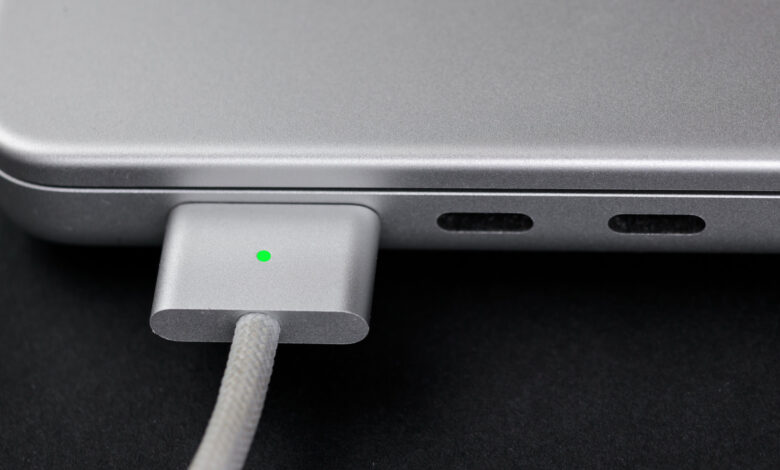
The latest MacBooks showcase Apple’s innovative charging solution, MagSafe, which is a key selling point for many users. This magnetic charger easily disconnects if pulled sharply, thus preventing potential accidents when someone trips over the cable. Moreover, MacBooks can also be powered through USB-C, a widely adopted charging standard. Though you cannot use both simultaneously, each has its strengths depending on the situation.
It’s important to distinguish between the MacBook’s MagSafe charger and the iPhone’s MagSafe, as they operate on different technologies. The iPhone’s version is based on the Qi standard, while the MacBook’s MagSafe employs a proprietary, more compact connector. Both serve a similar purpose—magnetically connecting a charger instead of utilizing a standard USB connection.
MagSafe has evolved over time, with MagSafe 3 currently being the standard. While each version maintains its primary function, variations in size and power capacity mean they are not interchangeable.
Comparing MagSafe and USB-C

Both MagSafe and USB-C offer unique benefits and drawbacks for charging your MacBook. MagSafe’s primary advantage is its ability to safeguard your laptop; should someone trip over the cable or pull it too hard, it is likely to simply disconnect without dragging the MacBook down with it.
Conversely, USB-C requires proper insertion into the laptop’s port. In the event of an accident, there’s a higher chance that the MacBook will travel along with the cable, potentially leading to damage.
Charging power also differs significantly between the two. MagSafe is designed to facilitate quicker charging. Recent models like the 2021 MacBook Pro and the later 2022 MacBook Air can support up to 140W charging with the appropriate power adapter. An Apple adapter priced at $99 enables this fast charging, providing a 50% charge in just half an hour.
On the other hand, USB-C typically supports a maximum of 60W, which is significantly less than MagSafe’s output. Although some cables can theoretically accommodate higher wattages—up to 100W or even 240W—this is not common, highlighting the importance of selecting the right cable for fast charging needs.
Optimal Use of USB-C

As previously mentioned, MagSafe is generally the preferable option due to its safety features, capability for rapid charging, and ability to keep USB-C ports available for other devices. Using MagSafe simplifies the process because there is no need to deal with various charging specifications. Just pair it with the appropriate Apple adapter, and you are set.
However, USB-C also presents its conveniences. Primarily, it allows a single cable to fulfill multiple roles, making it ideal for traveling. A robust USB-C charger can power not just your MacBook, but also your iPhone or iPad, along with any other compatible device. MagSafe, in contrast, is primarily tailored for Macs.
Additionally, if you own a MacBook Pro model released after November 2023, you can benefit from charging speeds of up to 240W using USB-C, provided you have the right accessories. This illustrates yet another advantage of USB-C if ultra-fast charging is a priority for you. Ultimately, your choice should reflect your individual needs, and keeping both cables on hand gives you the flexibility to adapt as necessary.