Vogue Unveils Robotic Models at Vogue World, but Audience Reaction Falls Flat

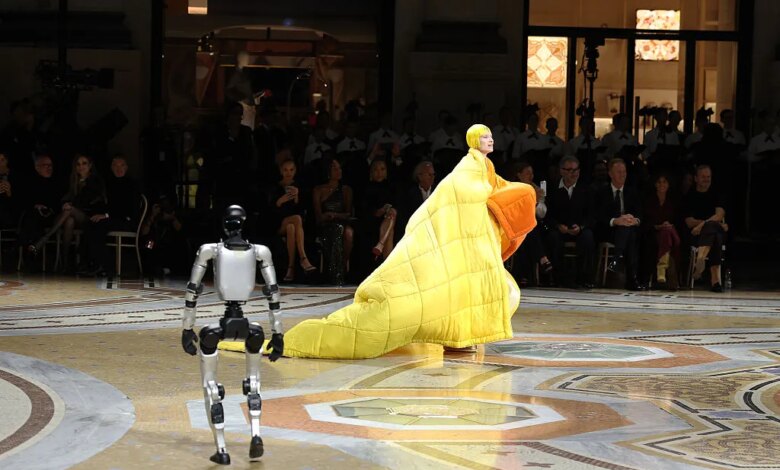
This week marked the conclusion of Vogue World’s Milan edition, featuring an intriguing display of robots—a possible hint at the future as the event prepares to take place in San Francisco next year.
Vogue World serves as the magazine’s annual showcase, now in its fifth iteration. Combining elements of a fashion show, star-studded appearance, entertainment segment, and marketing opportunity, this event travels to a new city each year. It has previously taken place in New York, London, Paris, and Hollywood. This year’s Milan version aimed to celebrate Italian craftsmanship and the importance of “the human touch” amidst technological advancement, making the subsequent performance rather surprising.
During the piece titled The Age of Intelligence, humanoid robots from the Chinese company Unitree made their entrance into the Galleria to the tune of Gigi D’Agostino’s “L’Amour Toujours.” The robots waved enthusiastically to encourage applause, with one even performing a lasso trick, all while unclothed. The distressed expression of Valentino’s creative director, Alessandro Michele, quickly became a viral sensation.
Rather than discussing the actual fashion presented at Vogue World Milan, the conversation has centered around the robots. These robots have already gained attention globally for their dance performances, and their occasional mishaps on stage. A similar robotic display has even appeared at London Fashion Week, currently taking place.
Earlier this year, Vogue piqued interest by announcing that the next edition would be hosted in San Francisco—often considered one of the least fashionable cities in the U.S. This decision is not without intention; Anna Wintour has increasingly aligned Vogue with the tech elite, and the Milan event was partially funded by companies like Meta and OpenAI.
This situation reflects how technology is often insulated from real-world implications, with growing discontent about the swift integration of tech into society and Vogue’s embrace of its wealthiest proponents during a time of financial difficulty for many. Issues like AI, mass surveillance, workforce displacement, and the energy crisis only add to these tensions. For some, the sight of a robot on a runway is indicative of broader societal missteps.
“I’m frustrated with the celebrities cheering it on,” one tech entrepreneur shared via Instagram. “It’s troubling. People are genuinely losing jobs because of these advancements. We should not be normalizing this trend.”
A fashion journalist I spoke to declined to comment beyond saying “No,” regarding the robots and the future of Vogue World in San Francisco. Meanwhile, Jason Johnson, founder of a cultural impact agency, noted Vogue’s push to connect with Silicon Valley extends back a decade, citing Jony Ive’s co-hosting of the Met Gala in 2015. Thus, the appearance of dancing robots in Milan, along with future events like Vogue World in San Francisco and a Vogue wedding cover featuring Jeff Bezos and Lauren Sanchez, seemed inevitable.
“Media outlets are seeking novel revenue streams, and technology has the funding,” he explained. “Vogue holds significant cultural sway, which tech leaders seek.” He believes both sides benefit from this partnership.
Yet, there’s something about Vogue’s approach that feels forced.
Muna Ikedionwu, founder of a startup strategy firm, expressed that the robots fail to capture the true innovation occurring at the intersection of technology and fashion. “There are remarkable advancements in engineering and AI that impact design and creative expression,” she noted, emphasizing that robotic performances fall short of what’s actually transpiring in these fields.
She referenced the creator duo AA Murakami, who designed a bubble dress for Olympian Eileen Gu at this year’s Met Gala. As designers and engineers, they are pioneering what she calls “ephemeral technology,” which merges artistry, innovation, and the transient aspects of human experience.
In comparison to such innovation, the robotic display appears rather mundane. When I think of the fusion of fashion and technology, I recall the Spring 2024 Schiaparelli collection, which featured a robot baby adorned with Swarovski crystals alongside a gown made from vintage tech elements like microchips.
Ikedionwu speculated that the performance might have aimed to ease the public’s acceptance of fashion-tech convergence, which has long been evolving behind closed doors. If that was the intention, it didn’t succeed. However, there’s hope that Vogue World might unveil more innovative elements in San Francisco.
When you purchase through links in our articles, we may earn a small commission. This doesn’t affect our editorial independence.