Today marks a significant milestone for Tesla.
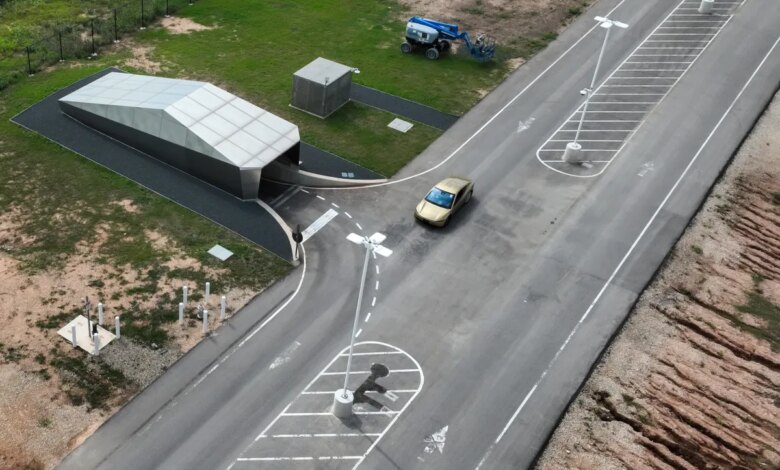
In just a few hours, Tesla plans to unveil the Cybercab — a compact, gold two-seater vehicle that operates without a steering wheel or pedals, utilizing cameras and AI for navigation — in its base city of Austin, Texas.
Details regarding the launch remain unclear. It may involve just a handful of vehicles providing rides within a limited downtown area, or it could turn into a much larger event.
Tesla certainly aims to create excitement around the latter scenario.
In anticipation of the launch, Tesla has repositioned numerous Cybercabs in Austin and across various U.S. cities. According to the state’s automated vehicle tracker, there are currently 420 registered autonomous vehicles in Texas.
Ashok Elluswamy, who leads Tesla’s AI efforts, previously stated on X that “the streets won’t be the same anymore.” When someone suggested that Tesla is set to “flood Austin,” CEO Elon Musk simply responded, “Yes.” Musk also shared an AI-generated image of the Cybercab taking over the city amid a massive dust storm.
“A Storm of Cybercabs,” Musk captioned another post.
These bold proclamations signal a shift from the company’s previously cautious tone leading up to the event. In recent months, Musk and other Tesla leaders expressed a commitment to proceed with caution regarding robotaxi technologies, often prioritizing safety over public perception of potential failings.
Nonetheless, Tesla’s launch approach may ultimately pale in comparison to the actual results. Successfully creating a robotaxi network with the Cybercab would represent a significant step for Tesla, potentially establishing it as more than just a traditional automaker.
Musk often employs the metaphor of a “fork in the road,” an analogy he used in a 2022 email to Twitter staff which offered them a choice to stay or leave. He referenced it again in early 2025 while discussing job transitions at DOGE.
His fondness for this metaphor led him to commission a 30-foot structure of a literal fork to showcase at Burning Man in 2022, later relocating it to a Tesla facility.
The Cybercab signifies Tesla’s pivotal moment. It could either revolutionize urban transportation or reveal that, despite its innovations, Tesla remains primarily an automaker.
Robot Taxis
Musk first introduced the Cybercab in 2024 at a Hollywood studio, but the concept has deeper roots.
For over a decade, Musk has promised fully autonomous Tesla vehicles, aiming for the establishment of a robotaxi network. In 2016, he even claimed that every vehicle produced had the potential for full autonomy through software updates.
However, he was mistaken. Tesla has undergone multiple hardware revisions since that promise, and Musk recently acknowledged that many vehicles will require hardware modifications to achieve autonomy.
Despite these setbacks, Tesla continued to enhance its autonomous driving software, refining the Full Self-Driving (Supervised) feature. Nevertheless, this functionality still requires driver oversight, keeping liability with the human operator.
The Cybercab aims to change this paradigm, emerging from Tesla’s initiative to create a next-generation EV platform that is less expensive to manufacture.
The objective was to leverage lessons learned from the Model 3 and Model Y to create a new platform that would allow for producing more affordable electric vehicles.
Reports suggest that Musk was so committed to achieving full autonomy that he opted not to design a vehicle capable of manual driving on this platform. Instead, he directed resources entirely toward developing the two-seater robotaxi now referred to as the Cybercab.
In April 2024, months prior to the Cybercab’s unveiling, he approved significant layoffs at Tesla to emphasize the company’s focus on autonomy, which he deemed an obvious strategy.
Slowly, Then Quickly?
Tesla began testing its Robotaxi program last June in Austin using modified Model Y vehicles. Initially, a company employee sat in the front seat, ready to intervene if necessary.
While there have been incidents, they were mostly minor, involving collisions with stationary objects, along with some involving remote operation at low speeds.
The company has since expanded this Model Y system into several other cities in Texas and Florida. However, over the past year, the growth of the network didn’t match the lofty expectations set at its launch.
Tesla has disclosed that the mileage driven for paid rides has even decreased.
Despite these challenges, Tesla believes scaling its robotaxi network hinges on the Cybercab.
Constructed with cost effectiveness in mind, the Cybercab is designed to be smaller, lighter, and equipped with a less powerful battery. Reduced material requirements, particularly for batteries, make its production more economical, enabling Tesla to potentially achieve profitability faster once operational.
This financial model has energized Tesla’s most dedicated supporters. Many draw comparisons between Tesla’s capacity to produce multiple Cybercabs at a significantly lower cost compared to Waymo’s investment in fewer vehicles as evidence of Tesla’s superiority in the robotaxi competition.
Musk seems to support this viewpoint. In response to a graphical representation of this argument, he noted that it “doesn’t even consider the operational efficiency of Cybercab.”
However, several important factors must be acknowledged. Tesla’s robotaxi network currently operates only within designated geofenced areas in each city. Although these areas can vary in size, the concept itself has limitations. Musk himself previously remarked, “If you need a geofenced area, you don’t have real self-driving.”
Additionally, challenges remain regarding scaling the network.
Currently, Tesla benefits from a smaller network limited to a few locations, reducing the number of complex scenarios its self-driving software must navigate. This contrasts with Waymo’s far larger fleet operating thousands of vehicles. Fewer operational trips also minimize the opportunity for issues to be highlighted by users or reported on.
Moreover, Tesla’s fleet has mainly consisted of Model Y SUVs, which tend to blend in on the streets more easily than vehicles like the visually distinct modified Jaguar I-Pace from Waymo. This situation will change with the introduction of the Cybercabs; any shortcomings in Tesla’s software are likely to attract more attention when occurring in striking gold vehicles.