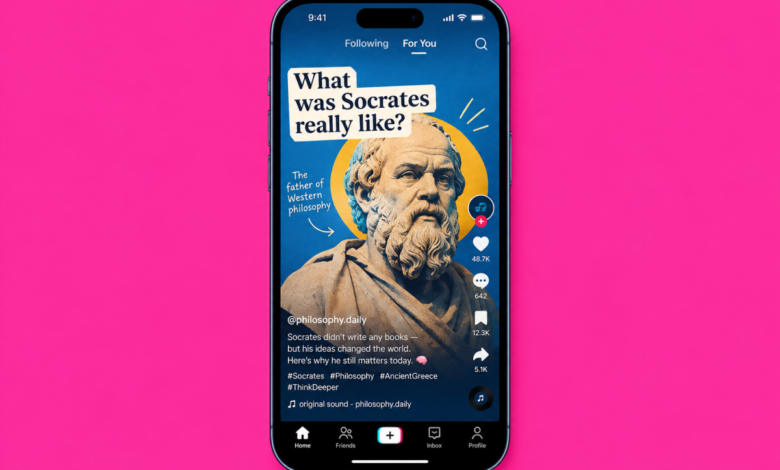
Amid concerns about our distracted minds and fleeting attention spans attributed to endless scrolling, there’s a possibility that the answer lies not in halting the scrolling but in reconsidering its content.
This is the premise being explored by a startup named ScrollEd, which is participating in the TechCrunch Disrupt Startup Battlefield 200 competition. The innovative concept suggests that if students are reluctant to read traditional textbooks, those textbooks should instead adapt to their preferred format—much like a social media scroll.
ScrollEd has developed an application that transforms any text file, including standard PDFs or textbooks, into a scrolling feed reminiscent of platforms like Instagram Reels or TikTok. As users scroll through, the material is presented as AI-generated video, audio, text, or interactive quizzes. Swiping up reveals new topics, while swiping sideways allows users to dive deeper into the current subject, culminating in a quiz.
“The younger generation is increasingly gravitating towards short-form, vertical feeds (particularly among the 18-year-olds we’ve consulted!), which creates challenges for media that requires deeper engagement,” said Utsav Gupta, the co-founder of ScrollEd, in an email. “We aim to engage them where they are…We just need to use this format consciously and avoid simply chasing engagement metrics.”
“A brief video can spark curiosity; that curiosity may lead to seeking further explanations or exiting the app,” Gupta added. “We wanted the process of exploring further to be as seamless as transitioning to the next video.”
Gupta co-founded ScrollEd this year with his wife, Rebecca Neff, after both experienced a sense of dissatisfaction from doomscrolling before sleeping. The duo are students—Gupta specializes in AI and human purpose at Stanford, while Neff studies computer science at the University of Pennsylvania.
The startup is primarily targeting educational institutions, corporate training programs, and individuals seeking a more enriching scrolling experience, according to Gupta.
ScrollEd operates on a freemium model, offering a free basic feed alongside a paid ScrollEd Pro subscription and annual licenses for institutions. Educational entities pay to utilize the platform for their materials, receiving detailed reports on engagement, progress, and other relevant metrics in return.
In the upcoming months, ScrollEd plans to concentrate on launching its consumer platform, expanding its lesson library, refining its source-checking processes, and initiating pilot programs for institutions. Notably, the company intends to unveil its consumer services at Disrupt, humorously quipping about their goal to “disrupt” traditional social media formats, according to Gupta.
Furthermore, the startup is establishing a framework aimed at enabling educators to assess individual learners and tailor content to their specific needs.
“Our aspiration is to create a social network that truly benefits its users,” Gupta concluded.