Hold on to Your Echo Dot: The Open Source Community Unveils Innovative Ways to Repurpose It!

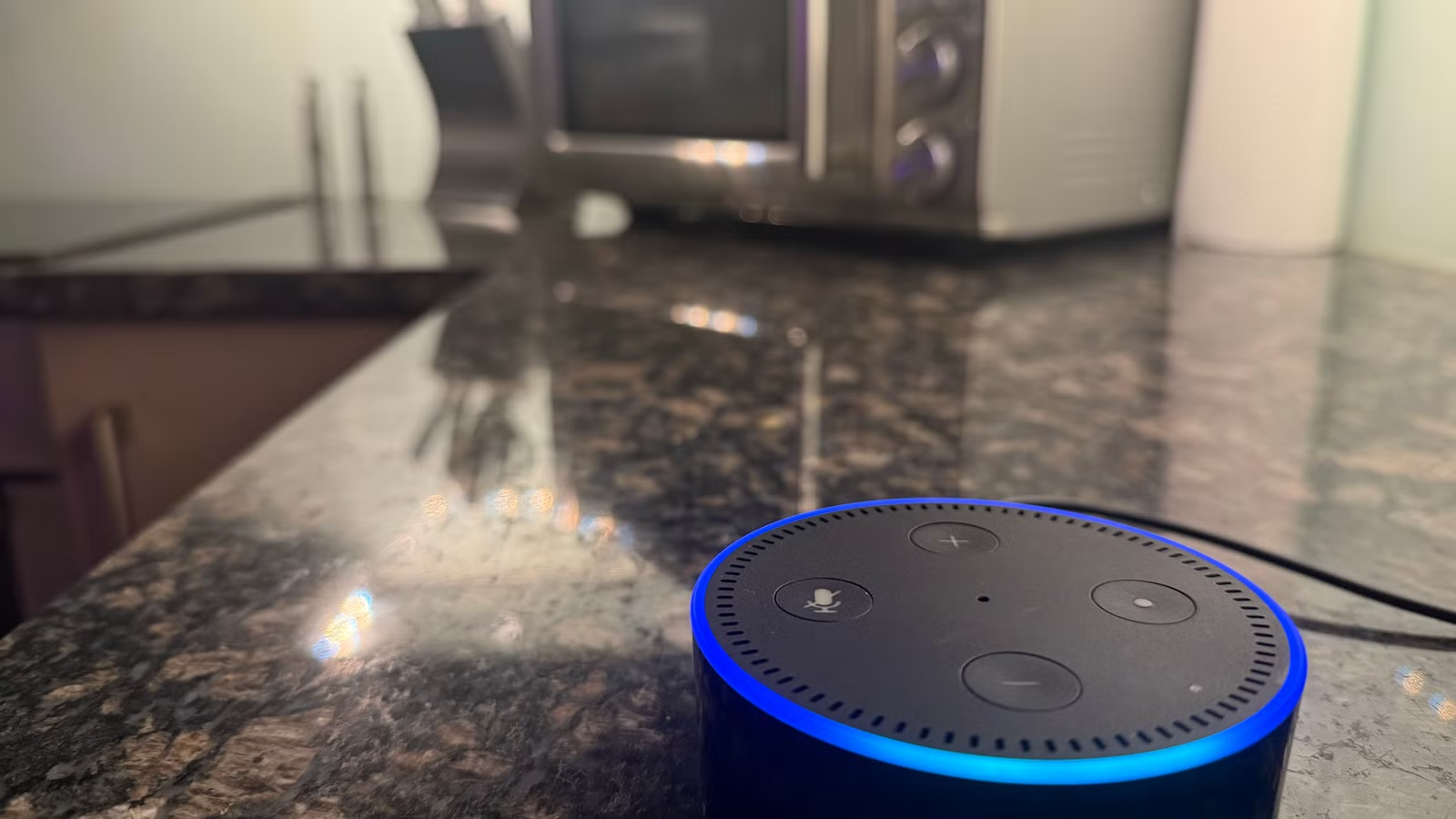
The second-generation Echo Dot marked the beginning of my journey into smart speakers, but it ultimately left me dissatisfied. While the hardware itself was decent, the real issue lay with Amazon’s software. However, there are ways to hack an old Echo Dot to get completely away from Amazon’s ecosystem.
Old Amazon Echo Devices Feature Impressive Hardware
Not Much to Look At, But Plenty of Power Inside
Released in 2016, the second-generation Echo Dot sports a design that resembles a small, unassuming hockey puck. Nevertheless, it has frequently been sold at discounted rates, making it an affordable option for many. Despite its simplistic appearance, it packs a punch with competent hardware, including a seven-microphone array designed for voice recognition across a room. It features a built-in speaker, Bluetooth, Wi-Fi, physical buttons, and the classic Echo light ring, all powered by a quad-core processor running Fire OS, an Amazon version of Android.
Even after nearly a decade, the potential of this hardware remains largely untapped due to Amazon’s restrictive software. Fortunately, some resourceful individuals have discovered methods to bypass these limitations.
A Home Assistant User Hacks and Revamps an Echo Dot 2
A Script That Disables Many Features of Amazon’s Software
A Reddit user named Alberto Zurini has showcased a hacked Echo Dot 2 that can respond to the “Alexa” wake word while executing custom code without connecting to Amazon’s cloud services. The major breakthrough was achieving root access to the device, a process detailed on tech forums. With this access, Zurini was able to remove software dependencies on Amazon. His GitHub repository offers a debloat script for others interested in undertaking a similar transformation.
After deconstructing the wake word server, he replaced the default engine with a custom one. This allows the Echo Dot to continue recognizing “Alexa” while processing the wake word entirely on the device itself, rendering it functional without relying on the cloud.
The Most Impressive Feature: Running AI Directly on the Echo Dot
Replacing Alexa with a Local Voice Assistant
This project isn’t singular; similar efforts like EchoLocal and EchoMuse allow users to repurpose the Echo Dot as a local voice assistant. However, the distinction with the Echo Dot 2 Playground project lies in the fact that it runs all processes on the Echo Dot itself. Utilizing 512 MB of RAM and a maximum memory bandwidth of 5 GB/s, Zurini managed to implement a small local language model that can execute straightforward tasks such as turning on lights or responding to simple prompts.
Old Hardware Doesn’t Have to Go to Waste
The Hardware Remains Dependable
The transformation does not render your old Echo Dot a fully functioning smart speaker capable of replicating all of Alexa’s features. Its local language model has slower response times and limited capabilities. Nevertheless, as a proof-of-concept, it demonstrates significant potential.
If you aim to maximize your Echo Dot’s utility, exploring other projects to use it as a voice assistant may be more productive. This grants you the ability to operate locally on more powerful hardware than what is available within the Echo Dot.
Repurposing the Echo Dot as an interface for Home Assistant is genuinely beneficial, transforming outdated tech into something functional rather than discarding it, which is a positive outcome.
Amazon’s Devices Hold Real Value
The Echo Dot 2 isn’t the only Amazon product that can be liberated from the confines of Amazon’s ecosystem. I’ve successfully jailbroken my Echo Show 5 to function as a dashboard for Home Assistant, and my modified Kindle 4 has been used for applications ranging from streaming my video doorbell to serving as a second monitor. Exploring the potential of old technology before discarding it is certainly worth the effort.