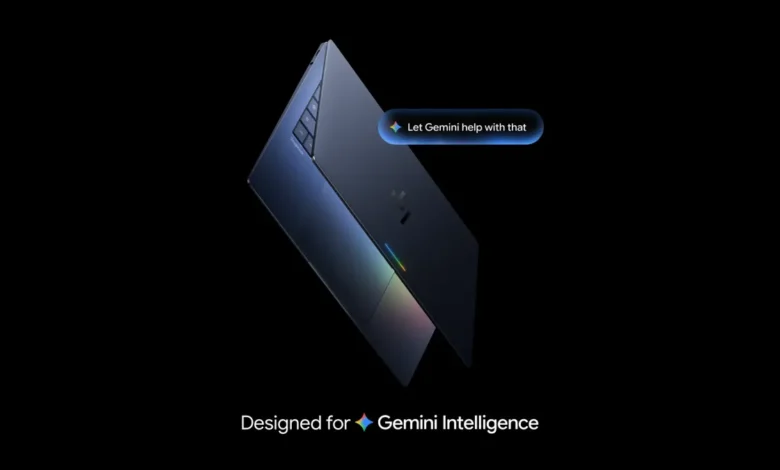
Following its initial announcement in May, Google has revealed that its new AI-driven laptop, named Googlebook, is now available for pre-order at a price of $899.
Designed to enhance the traditional Chromebook experience, Googlebook operates on Android OS and incorporates a desktop version of the Chrome browser, along with other familiar features from ChromeOS. The standout aspect of this new device is its integration of the latest capabilities from Gemini, presented in a laptop format.
Google aims to introduce innovative functionalities such as an AI-powered cursor, vibe-coded widgets, and advanced dictation support through a feature called Rambler. This feature transforms chaotic, unstructured thoughts into clear, coherent text.
With this strategy, Google seeks to attract customers to buy a laptop that incorporates AI, rather than relying on traditional desktop applications. There is potential for these devices to gradually replace Chromebooks, appealing to many former Chromebook users with Gemini AI.
The Googlebook attempts to transform the traditional computing experience by incorporating AI within the “point-and-click” framework: the cursor connects to Gemini. Users can utilize this by highlighting content online for Gemini to assist, checking the security of an email your cursor is positioned over, or selecting images to visualize them collectively.
This feature bears resemblance to Android’s “Circle to Search,” allowing users to interact with Google Search through gestures. However, while it creatively taps into mobile usage habits, Circle to Search did not trigger a significant switch to Android.
Similarly, the AI cursor—known as Magic Cursor—may not be a major selling point for Googlebook, particularly with the availability of AI agents capable of managing tasks across computers and browsers.
However, Rambler stands out as one of the more useful AI features, addressing a common need. Still, it might not be compelling enough for users to invest in a new device, as it appears more of a valuable enhancement rather than a must-have capability.
Vibe-coded widgets represent a minor addition, and features like Gemini Spark and Gemini Live do not necessitate new hardware.
What’s particularly noteworthy about the Googlebook is its strategic alignment with Google’s ambition to capture a significant share of the K-12 market, currently dominated by Chromebooks, and transition them towards Gemini AI. There are approximately 50 million Chromebooks in educational institutions, utilized by students and educators alike, according to Google.
Back in May, the company indicated that current Chromebooks would continue to receive support, with many possibly upgrading to the Googlebook experience in the future.
Priced at $899, the device will include a one-year subscription to Google AI Pro, providing 5TB of cloud storage, advanced Gemini tools, and three months of YouTube Premium, Adobe Photoshop, and more. Google confirmed that devices would receive consistent updates for up to a decade.
Pre-orders for the Googlebook are now live on the Google Store, Best Buy, and other retailers. The devices are set to officially launch on October 4 in the U.S., and on October 5 in Canada, the U.K., Ireland, France, Germany, and Australia.
Leading manufacturers such as Acer, ASUS, Dell, HP, and Lenovo are producing the flagship devices, using materials like aluminum, magnesium alloy, and carbon fiber. These include features like up to 2.8K OLED displays, haptic glass trackpads, and backlit keyboards. They will be powered by Intel and Qualcomm processors, supplemented with dedicated NPUs, and are expected to offer battery life of up to 14 hours.