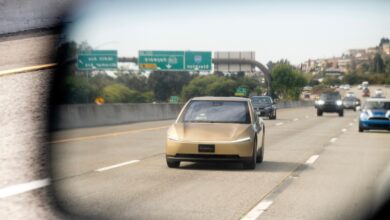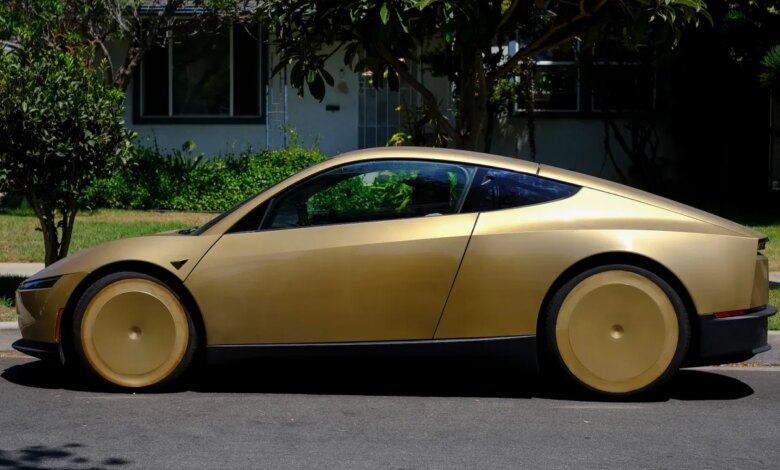
The leading automotive safety authority in the United States has initiated an investigation following Tesla’s rollout of its new Cybercab, which does not have a steering wheel or traditional pedals.
On Friday morning, the National Highway Traffic Safety Administration (NHTSA) disclosed that this inquiry commenced just hours after the first Cybercabs were deployed on the streets of Austin, Texas. Current federal vehicle safety regulations mandate the presence of manual controls such as brake pedals, although the Department of Transportation has recently suggested eliminating this requirement for vehicles meant to be driven autonomously.
According to NHTSA, Tesla informed the agency that it had self-certified the Cybercab as compliant with all Federal Motor Vehicle Safety Standards (FMVSS). It is standard practice for automakers to self-validate that their vehicles meet FMVSS criteria.
The agency stated that the investigation aims to “review the procedures and technical information that Tesla used in certifying the Cybercab,” along with related considerations. NHTSA will evaluate the extent to which Tesla’s certification was based on its claims that certain federal motor standards do not apply to the Cybercab.
There is a precedent for NHTSA’s investigation. In 2022, Zoox, a company owned by Amazon, self-certified its unique robotaxi, which also lacks conventional controls like a steering wheel and pedals. NHTSA subsequently launched what it termed a “special order” to obtain more details from Zoox and began an audit inquiry — a process similar to that currently applied to Tesla — the following year.
While Zoox was still deep in testing at that time, this investigation delayed its timeline for commercialization. Zoox consistently argued that self-certification was adequate, and in 2025, the agency granted the company an exemption to demonstrate its technology, but not to operate commercially. Zoox then pursued and submitted a request for a temporary Part 555 exemption from eight Federal Motor Vehicle Safety Standards, seeking regulatory approval to charge for robotaxi rides.
In July 2026, Zoox received final approval for this exemption, removing one of the final regulatory barriers necessary for launching its commercial robotaxi service. However, the exemption came with limitations; under it, Zoox was permitted to add 2,500 vehicles annually to its commercial fleet over the following two years. Several weeks later, Zoox commenced its commercial operations, charging for rides in Las Vegas.
It remains uncertain if Tesla will encounter a similarly prolonged regulatory journey. Zoox navigated through the regulatory landscape during both the Biden and Trump administrations.