XDOF Emerges from Stealth Mode, Pursuing Series B Funding at a $1.2 Billion Valuation Just Three Months In

After just a few months in the spotlight, XDOF, a startup focused on gathering teleoperation data for training versatile robots, is negotiating a Series B funding round at a valuation nearing $1.2 billion, backed by 8VC and others informed about the situation.
Founded in 2024 by UC Berkeley researchers Philipp Wu (CEO) and Fred Shentu (CTO), XDOF raised $70 million in a Series A round in June, with support from notable investors such as Thrive Capital and Andreessen Horowitz. Although the company wasn’t expected to seek additional funds so soon, its impressive growth, with projected annual revenues nearing $50 million, attracted interest from venture capitalists.
Details on the total funds being raised or whether the valuation takes into account the new capital remain undisclosed. The agreement is not yet finalized and is subject to modification.
Requests for comments from both XDOF and 8VC went unanswered.
The startup aspires to create essential data infrastructure, collection mechanisms, and annotation systems that advanced AI labs and robotics firms struggle to develop independently, effectively serving as an outsourced data source for the robotics sector.
During his time as a PhD student, Wu was focused on methods for robots to learn from extensive datasets. He identified a significant hurdle in his research: the scarcity of “large-scale data.”
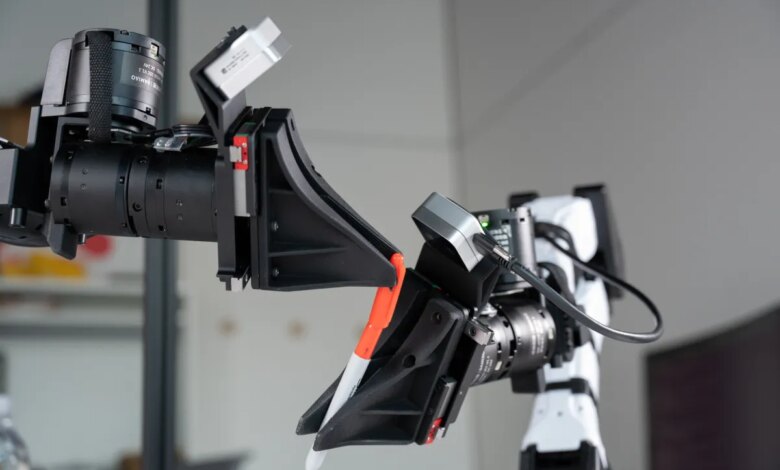
Collaborating with Shentu, he developed GELLO, an affordable teleoperation solution allowing human operators to remotely control robotic arms for generating training data, which resulted in a notable publication in the robotics field.
This research laid the groundwork for XDOF, which investors liken to Scale AI and Mercor in the realm of physical robotics, referencing the data-labeling companies that have significantly impacted the AI landscape. Unlike language models, which can rely on vast portions of the internet for training, physical robots lack corresponding large-scale datasets, making data collection a pivotal challenge in developing universal machines.
XDOF is collaborating with UC Berkeley’s AI Research lab to unveil what it considers the most extensive collection of high-quality training data for robots, referred to as ABC.
To amass this data, XDOF integrates remote robot teleoperation with human data collectors equipped with sensors to log daily activities like folding laundry and flattening boxes.
Additionally, the startup plans to recruit and train data collection teams globally, including teleoperators who guide robots remotely and operatives wearing body sensors to track movement data.
XDOF has communicated plans to work with approximately 20 clients, including several leading AI research labs.
Other companies in the field of real-world data collection for robot training include Mecka AI, alongside human-data platforms that are branching out from LLMs, like Scale AI and Micro1.