Typically, I begin my mornings by reviewing several RSS feeds that align with my interests and professional tasks. If I discover any feeds pertinent to my work projects, I incorporate the links into a document for later reference.
I was recently introduced to a compelling feature in Gemini Notebook (previously known as NotebookLM) that could enhance my efficiency in skimming those RSS feeds after copying them. However, I usually prefer not to utilize cloud-based AI solutions when I have alternative options.
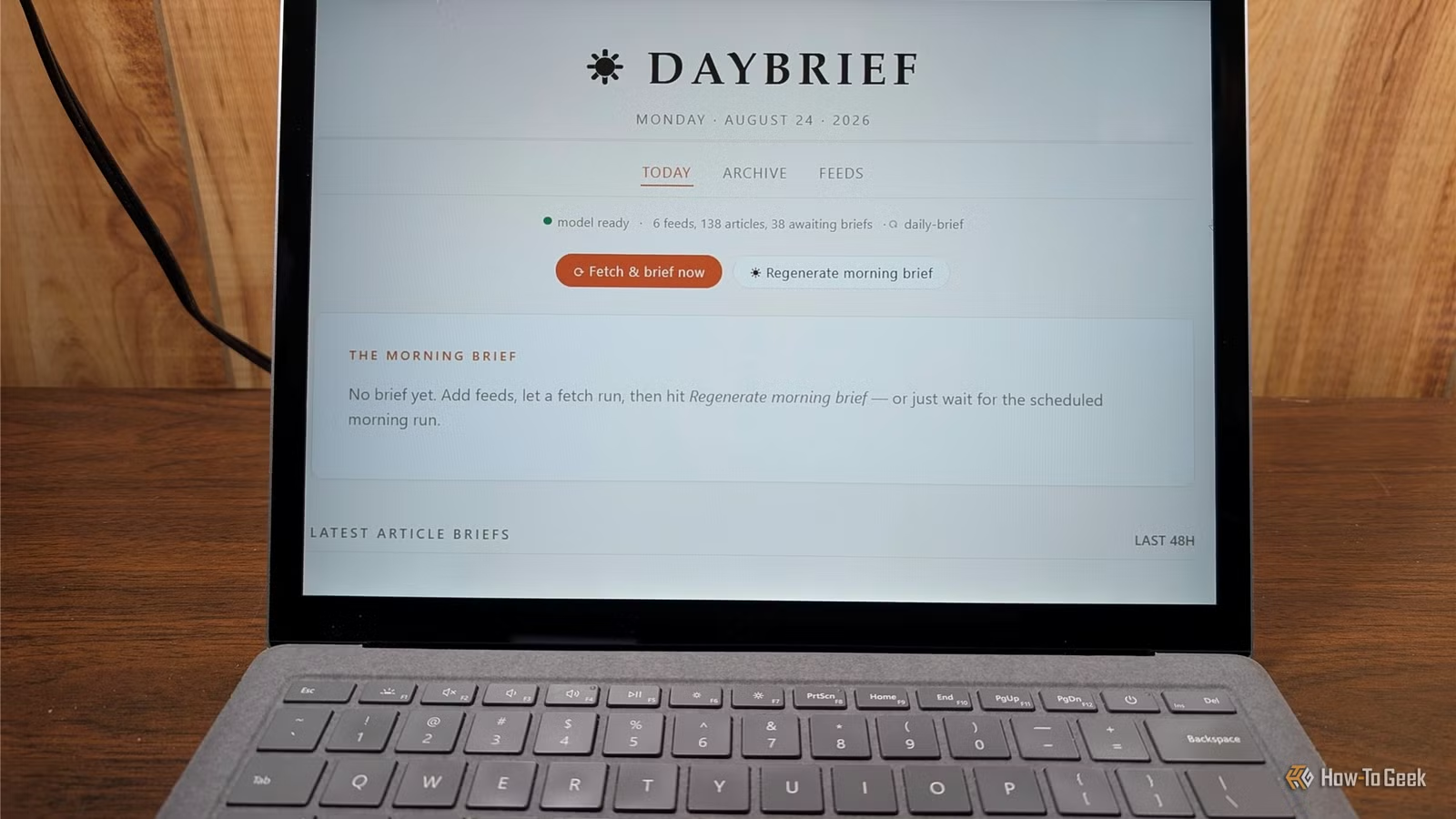
This prompted me to integrate AI directly into an RSS reader, allowing for an entirely local operation without the need for manual copying and pasting. While it does not possess all the features of NotebookLM, it does include the functions I find most useful.
NotebookLM Is Good, but Local Solutions Are Better
No Restrictions, No Manual Work, and No Privacy Concerns
My primary concern with any cloud-based AI, including NotebookLM, is that data is processed through Google’s servers. Google clarifies that they do not train their AI on any uploads unless users opt in. However, this data is still stored and processed on their servers.
In my case, the risk is relatively limited, as I primarily use it for non-sensitive research. Still, it’s a practice I would rather avoid in more sensitive scenarios. Conversely, I can take all necessary measures to protect any data stored on my local machine.
For RSS feeds specifically, the lack of automation can also be frustrating. NotebookLM doesn’t provide the option to automatically refresh RSS feeds on a set schedule.
Finally, the free tier comes with its limitations. There are daily caps on report-based generation and chat inquiries, and each notebook has a maximum of 50 sources. This is acceptable for focusing on a single topic but doesn’t work when I need a broad overview in the morning and require updates throughout the day. An RSS setup can easily comprise over 50 sources across various categories.
With these constraints in mind, I aimed to create a solution more aligned with my needs.
How It Works
To develop this solution, I established three key requirements:
- It had to operate locally using open-weight models.
- It needed to generate morning summary digests and facilitate ongoing briefings throughout the day.
- It should accommodate as many sources as I wish to include.
Instead of attaching an existing open-source RSS reader to an AI (which was inefficient), I quickly built an application that manages RSS feeds natively. Adding a new feed is as simple as it would be on any traditional RSS reader.
The application runs on Gemma 4 12B with Ollama, balancing quality with memory use. I wanted to ensure that the process doesn’t overload my PC, allowing me to multitask effectively.
Surprisingly, the project functioned well from the start. After adding an RSS feed, it took a few minutes for Gemma to process it, yielding my summary. A few adjustments to the output tone made it to my liking.
Local Solutions Have Their Trade-Offs
A 12-Billion-Parameter Model Lacks Advanced Intelligence
The primary disadvantage of local models is their intelligence. No consumer-level hardware can match the reasoning and knowledge of cutting-edge models equipped with terabytes of VRAM.
To achieve satisfactory results, I found that the smallest effective model had around 7 billion parameters and could run on 8GB of memory. It could even work on older hardware, though performance would be sluggish.
Integration with My Discord Bot and Voice Assistant
Recently, I’ve been operating an AI Discord bot and a voice assistant that can engage in conversation. With some adjustments, I plan to merge these projects with the RSS Digest application, creating something significantly more engaging. I could activate it to read the morning briefing generated for me, and because both the bot and voice assistant can analyze files, I can pose specific questions as well.
With further refinements, I might even enable it to “break through” and spontaneously share information that it knows will pique my interest.