If you’ve been involved in the smartglasses sector for as long as I have, you’re likely familiar with the recurring inquiry: “Why do they appear that way?” Despite significant progress in the past few years, many smartglasses still have bulkier frames compared to traditional eyewear.
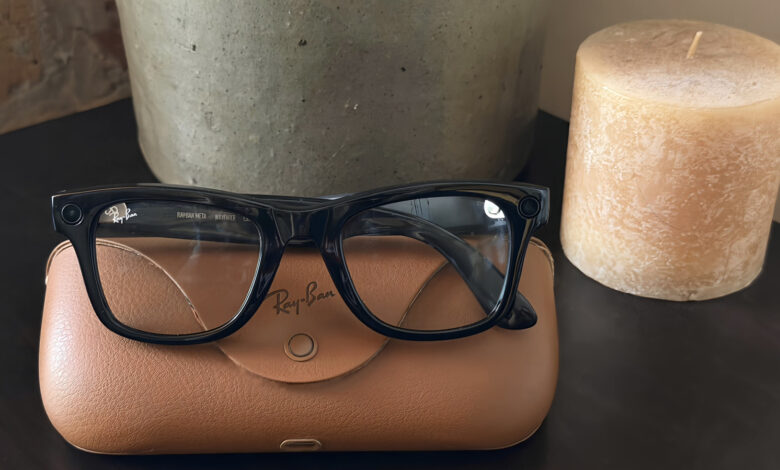
However, innovations in wireless charging could provide designers with the flexibility needed to create sleeker models. At the recent Augmented World Expo (AWE), NuCurrent, a wireless charging firm, showcased modified Ray-Ban Meta glasses that can charge wirelessly through NFC when placed in their case.
Typically, smartglasses from Meta and various manufacturers utilize pogo pins embedded in the nosebridge for charging. This design necessitates firmly pressing the frames into the case to establish a connection. According to NuCurrent CEO Jacob Babcock, these components are a significant reason why Meta’s current eyewear lineup has a similar appearance.
In NuCurrent’s prototype, the Ray-Ban Meta glasses employ a small coil located in the arms of the frames, which connects to a transmitter within the charging case. The company claims this prototype can achieve a 50 percent charge in just 20 minutes, which aligns with the charging time of the current Meta glasses. NuCurrent argues that this prototype demonstrates the potential for more innovative designs, though it may take time for the entire industry to adopt such advancements.
While pogo pins contribute to the thicker nosepieces seen in many smartglasses, the coils required for NFC charging are “measured in tenths of millimeters,” Babcock explains, allowing for the utilization of space that was previously restricted. “Every cubic millimeter is extremely valuable in smartglasses,” he adds.
The introduction of NFC-based charging might also pave the way for universal chargers applicable to smartglasses and various other wearables, similar to how Qi standards have revolutionized wireless smartphone charging. However, Babcock notes that achieving this for eyewear and AI-enhanced devices may still be several years away.
Babcock mentions that eyewear manufacturers are actively seeking methods to enhance and diversify their offerings. NuCurrent has already collaborated with Essilor Luxottica, the parent company of Ray-Ban, on their Nuance Audio glasses, and Babcock believes there are compelling reasons for other eyewear brands to consider similar partnerships.
“Companies are beginning to realize that technology worn on the face needs to be more stylish and offer a broader range of choices than previous generations of personal tech,” Babcock states. “To achieve scalability, it’s crucial to eliminate these technological constraints.”