Add Android Authority on Google:
Synopsis
- Anthropic has unveiled Claude Opus 5.5, an AI model that enhances performance, accuracy, and safety features.
- The new model operates over 30% faster and incurs approximately 40% lower operational costs compared to its predecessor, Opus 5.
- Usage limits for Pro, Max, Team, and Enterprise users are being increased.
For AI enthusiasts, key factors such as performance, accuracy, and cost play a significant role. The previous model, Claude Opus 5, achieved notable advancements in these areas, albeit at a higher cost. The newly launched model aims to alleviate these concerns significantly.
Today, Anthropic introduced Claude Opus 5.5, highlighting improvements in functionality, precision, and a roughly 40% decrease in operational costs compared to Opus 5.
The company claims this model is their most powerful effort yet, and they are addressing the potential challenges with new safety features.
One significant enhancement is its communication capabilities, which were a concern for users of Opus 5.
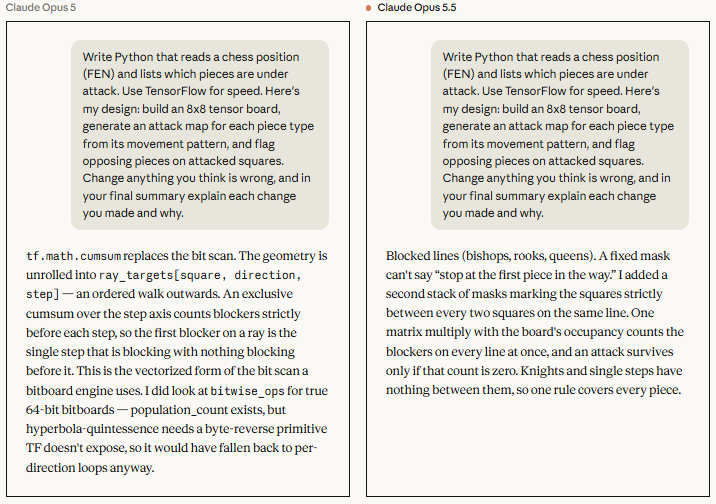
Early feedback from testers indicates that Opus 5.5 offers a more natural communication style with writing that is clearer and easier to understand. Users reported that this improves productivity during extended work sessions. One software engineer noted the improvement: “Verbose and confusing outputs were my main issue with earlier models, but Claude Opus 5.5 addresses this effectively. It communicates like a reliable colleague.” Another engineer remarked on the model’s clarity and coherence in writing compared to Opus 5.
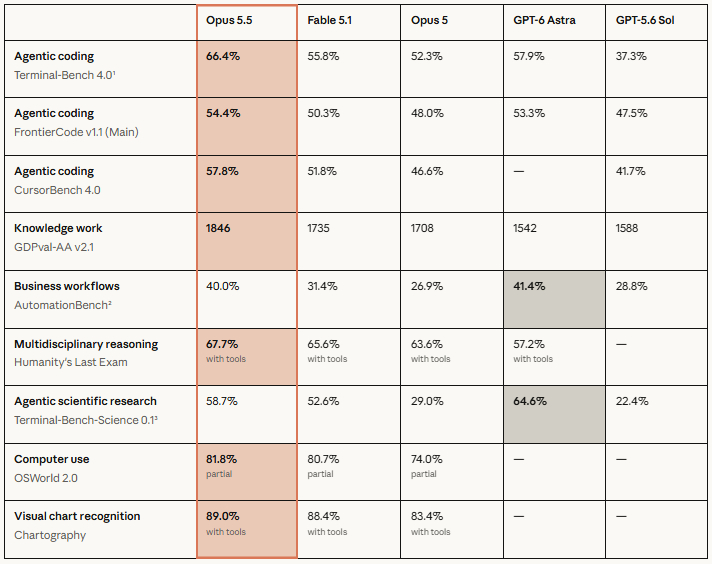
In terms of performance, Opus 5.5 surpasses competitors such as Fable 5.1, Opus 5, GPT-6 Astra, and GPT-5.6 Sol in various benchmarks including coding tasks, knowledge applications, complex reasoning, computer interactions, and reading visual data. In areas like business process and scientific tasks, it came second, trailing only GPT-6 Astra, while producing results 30% faster than Opus 5.
Benchmarks are informative, but real-world applications are equally crucial. One early user managed to review and correct a 200,000-line codebase in under three hours; the same task took over 20 hours with Opus 5, using 2.5 times the tokens. In another scenario, when converting software from C to Rust, Opus 5.5 required 9.5 hours, whereas Fable 5.1 took 12 hours.
Further insights came from testers at GitHub, Clio, and Spotify, who noted that Opus 5.5 delivered more efficient task completion than Opus 5 in fewer steps. For instance, a tester from GitHub acknowledged that this model managed to solve more terminal-related tasks in significantly less time.
Anthropic also emphasized Opus 5.5’s embedded classifier, which pre-screens actions before they execute. Compared to earlier models, it reportedly has better security features, effectively reducing the risk of prompt injection attacks. It reportedly tied with Fable 5.1 for the lowest success rate in prompt injection attacks in various contexts.
Notably, Anthropic isn’t raising prices despite these advancements. The cost for API usage has dropped from $5 to $4 per million input tokens. Similarly, output token pricing has decreased from $25 to $20 per million. Costs for cache reads and writes have also been reduced. Overall, running Opus 5.5 is expected to be around 40% cheaper than Opus 5 in typical use cases.
Importantly, access to Claude Opus 5.5 isn’t limited to developers or API users; it’s also available to general users, albeit with specific usage limits on various subscription plans. More details, including testimonials from early users, can be found on Anthropic’s official site.
Thank you for participating in our community. Please review our guidelines before posting comments.