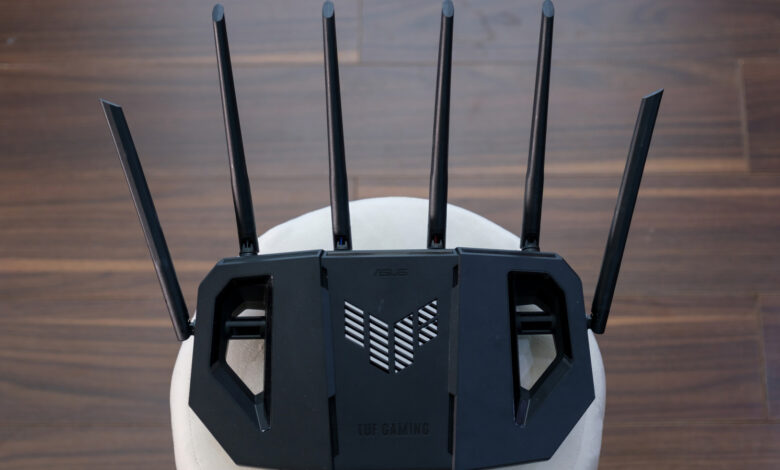
The number you need varies based on your home and usage patterns.
In the past, most Wi-Fi routers were equipped with a single antenna capable of supporting one wireless data stream. However, as Wi-Fi technology advanced, internet speeds increased, and the number of connected devices in households grew, routers evolved too. Nowadays, you can find routers featuring as many as eight antennas.
While it may seem that multiple antennas are just a marketing strategy, there’s a valid reason why routers moved beyond the single-antenna model. Imagine an antenna as a one-lane road. In a quiet area, this lane suffices, but as traffic increases in a bustling city, congestion quickly becomes an issue. In the early internet days, when activities were limited to emails, a single antenna was sufficient, but as demand grew, manufacturers opted to produce routers that could handle multiple data streams concurrently using a technique known as MIMO (multiple-input, multiple-output). This technology makes the presence of multiple antennas beneficial; without MIMO, simply adding antennas can lead to greater issues than solutions.
What are the benefits of multiple antennas?
MIMO technology allows routers with multiple antennas to transmit more data through a technique called spatial multiplexing. While more antennas create potential for additional data lanes, the internal hardware must also support this capability to function correctly.
Another significant advantage of multiple antennas is beamforming. This technique enables the router to locate your device and concentrate its signal towards it, improving performance. By having more antennas, the router can fine-tune the signals more effectively, similar to several individuals tossing pebbles into a pond simultaneously, creating a stronger ripple effect at a designated spot. A single antenna lacks the ability to coordinate signals in this way.
Additional reasons for the use of multiple antennas include enhanced signal diversity and reliability. In a typical home, Wi-Fi signals can reflect off various surfaces, which can lead to inconsistent reception. Having multiple antennas placed apart ensures that at least one antenna can receive a strong signal even if others are obstructed. Multiple antennas are also crucial for enabling MU-MIMO (Multi-User Multiple-Input Multiple-Output), allowing the router to communicate with several devices at the same time rather than sequentially.
Is there such a thing as too many antennas?

For most users, a router with eight antennas is excessive; typically, a good router with two to four antennas suffices. It’s essential to note that while antenna quantity matters, Wi-Fi standards and software also significantly influence a router’s overall efficiency. If your main concern is coverage, a router with more antennas may help, but setting up a mesh network often provides a more dependable solution than simply increasing antenna numbers.
In commercial settings, a high-capacity router with additional antennas can be valuable, especially in environments where many devices connect simultaneously. However, similar to home use, the effectiveness of the network hinges on the Wi-Fi standard and software. Additionally, a modern-looking router with numerous antennas does not automatically translate to faster internet speeds; your maximum speed is still dictated by your internet service plan, and an upgraded router won’t exceed that limitation.