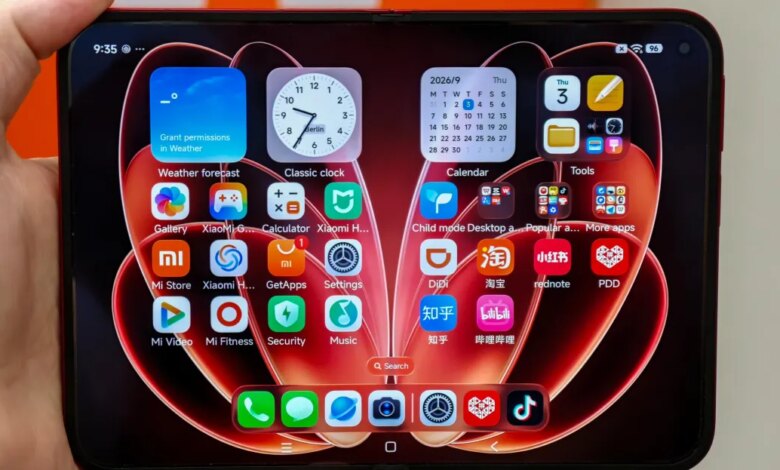
Xiaomi has unveiled its new foldable phone, the 18 Fold, just as anticipation builds for Apple’s own entry into this segment. I had an exclusive hands-on experience with the device at IFA last week. While it shares some design traits with Samsung’s Galaxy Z Fold 8, its enhanced specifications may make it the device many have been hoping Samsung would create.
The 18 Fold marks Xiaomi’s return to the book-style foldable design after the Mix Fold 4 released in 2024. Unlike its competitors Huawei and Samsung, Xiaomi has opted for a broader and shorter design. The phone features a 1.4:1 aspect ratio on both its 7.58-inch inner display and 5.38-inch outer display, closely aligning with international paper sizes and IMAX formats. This could potentially make it the ideal device for watching content like The Odyssey without any letterboxing.


In everyday use, the 18 Fold bears a resemblance to the Z Fold 8. It’s compact and easy to carry when closed, and the cover display is convenient for one-handed operation. However, like other foldables, it may struggle with some applications due to its unique screen dimensions. When opened, it’s well-suited for streaming videos or reading, though it may be a bit less effective for multitasking. Xiaomi has included features for split-screen viewing and floating windows for multitasking purposes.
While Xiaomi’s stylish options—available in black, white, red, and a limited-edition pink ceramic—are appealing, the phone is slightly heavier and thicker than the Z Fold 8, and it lacks any declared IP rating for water and dust resistance. Additionally, the spending crease feels more noticeable compared to current Samsung models. To date, Oppo has managed to nearly eliminate the crease in its Find N6 foldable, and the forthcoming Apple device will be interesting to compare against this standard.


Conversing about specifications, the 18 Fold shines with its debut use of the Xring O3 chipset, which competes with Snapdragon 8 Elite in performance. It also introduces the Mali G2-Ultra NX GPU, which supports mobile-first graphics advancements inspired by Arm’s DLSS technology.
It boasts a large 6,000mAh silicon-carbon battery, notably exceeding the Z Fold 8’s 4,800mAh, while supporting 67W wired and 50W wireless charging. The OLED displays offer impressive peak brightness of up to 4,000 nits. On the camera front, it carries a robust triple rear camera system, built in collaboration with Leica, featuring a 200-megapixel main lens, a 50-megapixel periscope telephoto lens, and a 50-megapixel ultra-wide lens.
Having previously appreciated the Galaxy Z Fold 8, my main concern was its missing triple camera setup, which is essential for a premium device. By addressing this and enhancing battery and display features, Xiaomi may have produced a compelling contender in the foldable market. Nevertheless, the absence of an IP rating raises some concerns.

The foldable phone market is poised for significant evolution, especially with Apple expected to reveal its foldable iPhone soon. Meanwhile, Xiaomi is positioning itself strongly in China with the 18 Fold, which can be preordered for ¥10,999 (approximately $1,600), with sales commencing on September 10. However, confirmation of an international rollout remains elusive.