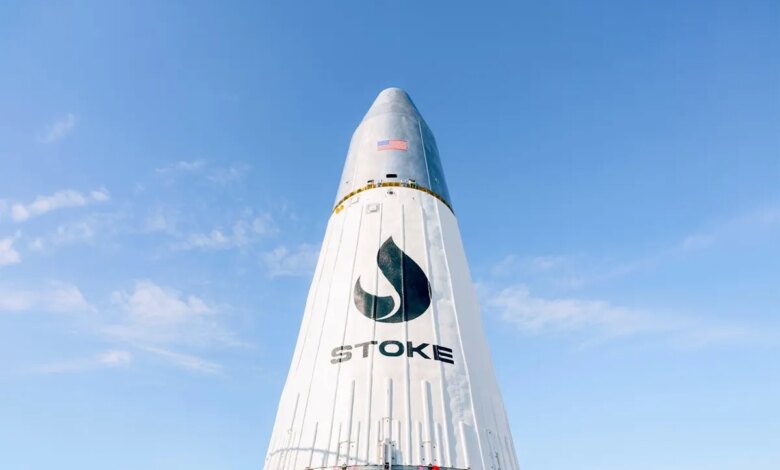
Stoke Space Technologies is fueling its ambitions with a substantial financing boost, completing the initial phase of a $1 billion Series E funding round designed to facilitate its journey to space and the development of a larger rocket.
“This funding is crucial for scaling up operations,” stated CEO Andy Lapsa. “It will allow us to build infrastructure, increase production capabilities, and importantly, support the development of our next-generation rocket.”
The funding initiative attracted major investments from Point72 Ventures, led by billionaire Steve Cohen, alongside participants like Spark Capital, General Innovation, Glade Brook Capital, US Innovation Technology, Washington Harbour Partners, Woven Capital, and Y Combinator.
Stoke is positioning itself as a competitor to SpaceX in the realm of affordable space launch services. SpaceX has centered its operations around the Falcon 9, which features a reusable booster, while also working on its fully reusable Starship.
Unlike competitors such as Rocket Lab and Relativity Space, Stoke focuses on achieving the ambitious goal of creating a rocket that can recover both the booster and the payload stage for reuse. This feat has never been accomplished.
Such high aspirations come with significant financial implications. SpaceX has invested over $10 billion into Starship over the last decade, with the vehicle yet to achieve orbit, though a forthcoming flight may change that. To date, Stoke has secured a total of $2.3 billion in funding.
In addressing the challenges SpaceX has faced with materials and structures needed to shield the second stage during reentry, Stoke leverages a distinctive active cooling system that circulates super-cooled liquid hydrogen through its thermal protection, a method that Lapsa asserts has been thoroughly tested on land.
“We can circulate excess coolant, exceeding our needs to ensure surface temperatures remain controlled during initial flights,” he noted.
Lapsa anticipates that Stoke’s first vehicle, the Nova Pathfinder, will take to the skies in early 2027. He expresses confidence in this timeline following successful structural and operational tests conducted at the company’s facility in Moses Lake. Upcoming milestones include testing each rocket stage on the ground to ensure readiness for launch.
“The ground systems have been validated to the best extent possible without the rocket, and vice versa,” Lapsa explained. “The next step is to integrate the two for testing.”
The startup has already secured launch contracts for the Pathfinder, which can transport three metric tons to low-Earth orbit—potentially the largest inaugural vehicle from a U.S. rocket manufacturer. Nonetheless, space launches often face delays, and achieving orbit itself would be a significant milestone.
“We have multiple Pathfinder vehicles in production and are confident that we will successfully launch and achieve orbit despite funding fluctuations,” Lapsa affirmed.
Additionally, Stoke is working on a larger rocket, the Nova Block 2, which has been in development for several years. Utilizing similar technology as the Pathfinder—such as its engines and heat shielding—the Block 2 aims to deliver 15 metric tons to low-Earth orbit, slightly exceeding Falcon 9’s capacity.
The target for its debut is set for 2029, coinciding with SpaceX’s plans to phase out the Falcon 9. Lapsa recognizes that this shift may present opportunities to attract launch customers as SpaceX adjusts its availability.
“There’s undoubtedly a disparity between launch supply and demand in the market,” he concedes. “The growth of the space industry is intrinsically tied to the frequency of successful rocket launches.”
This statement is particularly relevant for satellite operators: as SpaceX’s Starship becomes operational, entities seeking to secure a launch may face competition from SpaceX’s own projects, possibly leading to higher costs. In contrast, Stoke has not disclosed any intentions to launch its own aerospace ventures.
“It’s crucial to make progress now to start deploying the satellite constellations and applications that the industry has been aiming for but has been unable to realize,” Lapsa concluded.