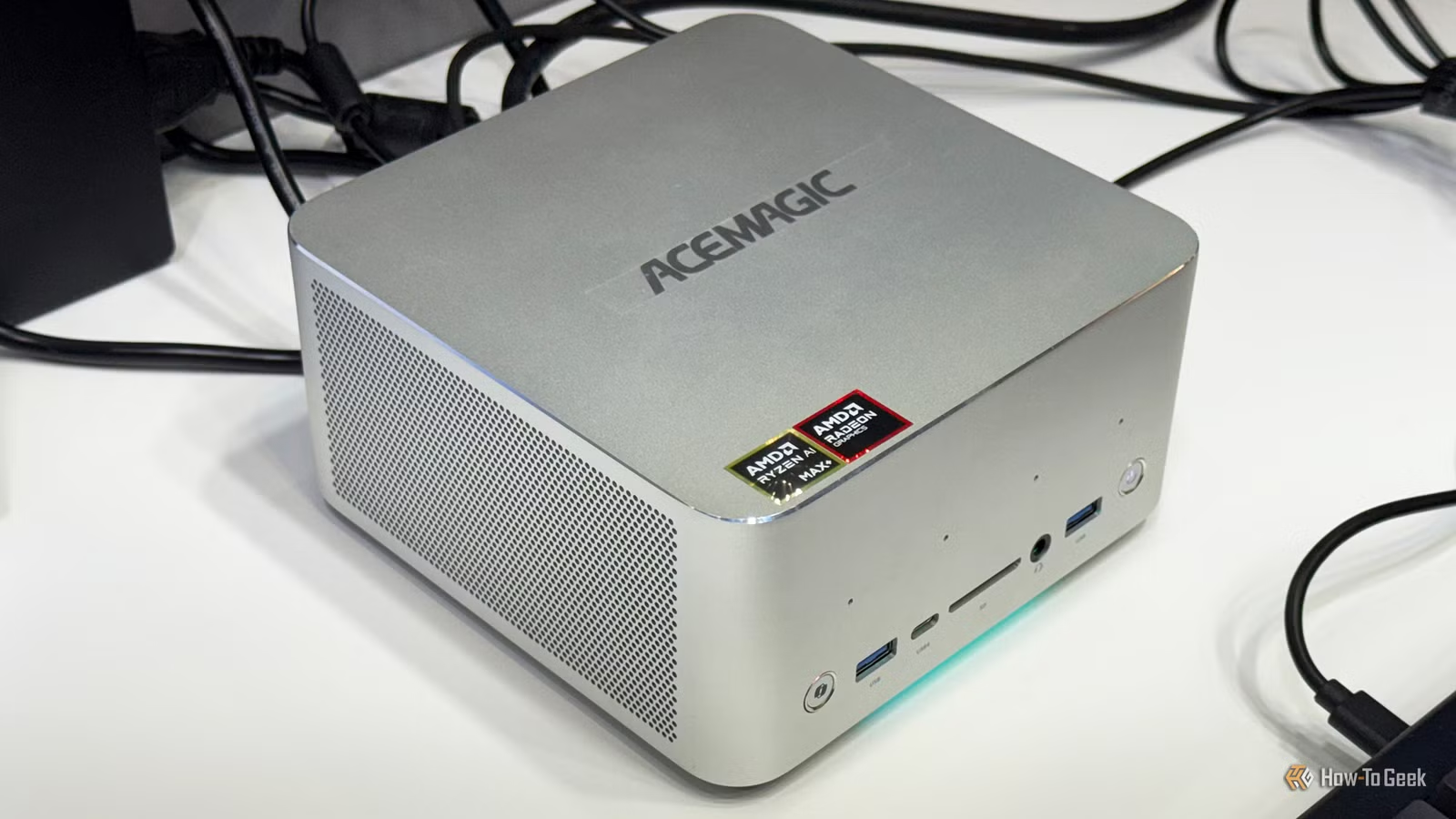
You don’t need to invest in a Mac Studio or RTX Spark system to get a compact PC that shines in AI tasks. Acemagic took advantage of IFA 2026 to unveil a variety of their latest mini desktops, featuring a new workstation equipped with AMD’s Gorgon Halo chip, a high-end model based on Intel’s Panther Lake, and a couple of options that pay homage to classic Nintendo gaming consoles.
The standout workstation, named the F9A, is powered by AMD’s Ryzen AI Max+ Pro 495 processor, which boasts 16 cores, supports a maximum of 192GB of RAM, and includes integrated Radeon 8065S graphics, comparable to mid-range dedicated GPUs. It also features dual SSD slots, with USB 4 connections providing speedy data transfer. For those looking to boost their graphics capabilities, a four-lane OCuLink connection enables external GPUs, ensuring flexibility beyond the onboard performance.
Acemagic highlights that the F9A offers a total computing power of 131 TOPS when combining the CPU, GPU, and NPU. While you may not utilize all that power simultaneously, its unified memory system makes it an excellent choice for running large AI models locally, using minimal energy (140W peak). At IFA, the company demonstrated its capabilities with AI models like Qwen 3.6, and it performed admirably.
Details on pricing and availability are expected soon, including for a more economical version featuring the Ryzen AI Max+ 395 and a reduced RAM of 128GB. However, either configuration is likely to come with a hefty price tag. The new Lenovo ThinkCentre X Ultra featuring the 495 will start at $3,699 upon its November release, with a limit of 128GB of RAM. Acemagic’s offerings are designed for developers and creative professionals who understand the need for a robust CPU and are prepared to invest in it.
Acemagic’s Retro-Style Mini PCs
Nostalgia Over Raw Speed
Acemagic offers an extensive range of mini PCs, including special editions of the G3A Pro (also called Retro X5) and G3B (X3 Mini), both designed to evoke the nostalgia of Nintendo’s 1985 NES console. These models, which were teased earlier, made their debut for hands-on viewing at the event.
The G3A Pro/Retro X5 stands out, featuring powerful chips (up to a Core Ultra 388H) while closely resembling the iconic console. Users can even slide off the top ‘cartridge’ lid to reveal Game Boy-style pixel art indicating access screws. It can support as much as 64GB of RAM and 4TB of storage and is compatible with Linux if Windows isn’t preferred. It’s an attractive option for those who cherish memories of playing classics like Super Mario Bros. and Duck Hunt.
The G3B/X3 Mini, on the other hand, runs on older processors (up to AMD’s Ryzen AI 7 Pro 350 or Intel’s Core Ultra Series 2). While it may not be as nostalgic, it still offers similar upgradeability and operating system options. These models cater to a sense of nostalgia while being adequate for everyday computing tasks.
There are also plans for newer versions of the G3A Pro/Retro X5 featuring Ryzen AI 9 HX 470 and Ryzen AI 9 465 processors, allowing customers to opt for updated processors over Intel. No pricing details are available yet for these new models, but an older X3 Mini is currently priced at $599.
High-End Intel Panther Lake in a Mini PC
A Compact Gaming-Ready Desktop
Among the more modest-looking models at the exhibition was the F2A 358H, which features the Intel Core Ultra X7 358H processor, up to 64GB of RAM, and 1TB of storage (expandable to 4TB). Despite its smaller size compared to the F9A, it manages to deliver enough graphics performance for casual gaming and AI applications.
This model is readily available for purchase, with Acemagic recently releasing one variant with 32GB of RAM and a 1TB drive for $1,399. Although this price is significant, it is still lower than the upcoming Mac mini M6, which will start at $1,799 with the same RAM and storage specifications. The price difference could be appealing for some.
However, Acemagic isn’t the only player in this space. Competing brands like Beelink and GEEKOM also offer high-end mini PCs. Nevertheless, Acemagic stands out with its diverse range and whimsical retro models. For those with limited space looking for either Linux or Windows systems, Acemagic makes a strong case.