Overview
- AIO (All-In-One) CPU coolers tend to be more expensive than traditional air coolers, with mid-range and high-end options reaching prices of $100 or more, outpacing some top-performing air coolers.
- Traditional air CPU coolers are highly effective, providing adequate cooling for all consumer CPUs, including high-end models.
- AIO coolers generally have shorter operational lifespans and more potential failure points compared to air coolers, making air solutions a more reliable choice.
Having built computers for nearly two decades, I have never opted for an AIO liquid CPU cooler, and I don’t plan to. Here’s why.
AIO CPU Coolers Are More Expensive than Air CPU Coolers
Typically, conventional air CPU coolers are significantly more affordable than AIO liquid coolers, even among lower-cost 240mm models.
For example, the Thermalright Phantom Spirit 120SE, one of the top air CPU coolers, is priced around $35.90 and competes with some 240mm and 280mm AIOs regarding cooling efficacy. In contrast, the most budget-friendly 240mm AIO I found, the Thermalright Aqua Elite 240 V3, starts at $45 but underperforms compared to both the Phantom Spirit and the Thermalright Peerless Assassin 120SE.
When excluding budget models from brands like Thermalright and ID-COOLING, the cheapest reliable 240mm AIO cooler is the $75 ENERMAX LIQMAXFLO, which still can’t match the performance of the Phantom Spirit. Mid-range 240mm AIO models typically start at around $100, costing about $60 more than several reputable dual-tower air CPU coolers.
Looking at the high-end market, the Noctua NH-D15 G2 is priced at $179, which may seem steep, but this air cooler outperforms the Corsair H100i LCD (240mm), priced at $200, in both cooling ability and noise levels. Even the original Noctua NH-D15, which costs under $110, surpasses the H100i LCD’s performance, showing how air coolers can provide excellent value compared to AIOs.
For 360mm AIOs, the cost disparity is even more striking. The most affordable reliable 360mm AIO is the Thermalright Aqua Elite 360, available for $53, while quality mid-range options start around $130. Prestigious high-end models with LCD displays often exceed $200, illustrating how a well-performing air cooler can be a better investment.
Air CPU Coolers Are Sufficient for Most Consumer CPUs
Air Cooling is Sufficient
Why invest in expensive AIOs when a sub-$40 air cooler can efficiently handle nearly all consumer-grade CPUs?
Credit: Lucas Gouveia / How-To Geek
The Thermalright Phantom Spirit 120SE even outperforms certain 360mm AIO coolers when cooling newer Ryzen processors, offering performance close to that of a power-intensive Intel CPU with modified power limits. Essentially, a $36 air cooler can adequately control any consumer-grade CPU, with AIOs only being necessary for overclocking or when utilizing high-end processors like the Ryzen 7950X or 9950X for professional workloads.
However, I don’t have any interest in flagship CPUs.
Interest in Mid-Range CPUs
Mid-Range is the Optimal Choice
Currently, I use my desktop for gaming and light tasks that don’t heavily stress the CPU, as I’ve shifted my work to macOS. For these types of tasks, even a basic air cooler is effective.
Credit: Ismar Hrnjicevic / How-To Geek
I currently run an AMD Ryzen 5700X3D cooled by a Scythe Mugen 5 Rev. B, previously used with my Ryzen 5600X, and it continues to work effectively. This $50 cooler, which I purchased over four years ago, remains functional, and I plan to use it for at least seven years more until the AM6 socket is released.
If I choose to upgrade to a high-end X3D CPU, I’ll still use an air cooler since it would be cheaper than an AIO, and I’m confident that an air cooler will adequately manage CPU temperatures, especially considering gaming won’t place as much strain on it as tasks like video editing or rendering.
AIO CPU Coolers Have Shorter Lifespans Than Air Coolers
More Components, Higher Failure Rates
As remarked, my current CPU cooler is likely to last for at least seven years. Even if the fan fails, I can easily replace it with any standard 120mm case fan that is widely available. Conversely, with an AIO cooler, there’s no guarantee it would function for seven years without issues due to multiple potential failure points.
While air coolers typically have one main point of failure (the fan), AIOs incorporate multiple components such as pumps, fans, and are susceptible to leaks and contamination buildup, which can severely compromise performance. Poor quality coolant or bacteria growth within the closed-loop system can lead to pump failure and reduced cooling performance.
In most cases, AIOs may function without issues for six to seven years, but if you purchased a Noctua NH-D15 back in 2014, it’s likely still performing efficiently, given that the one replaceable part has easy accessibility for replacement or upgrades.
Many Air CPU Coolers Fit Smaller Cases
No Need for Bulky Cases
While I’m not using my CPU for intensive tasks, I’ve considered a small form factor (SFF) build. Many mini-ITX cases do not accommodate tall coolers well.
For my use case, focused primarily on gaming, even low-profile air coolers, such as the Noctua NH-L12S, are sufficient for components like the Ryzen 9800X3D with adequate exhaust fans.
If I opt for a more spacious case rather than compact options like the Fractal Terra or Ridge, both of which can only fit compact low-profile coolers, I could select the Thermalright Peerless Assassin 120 Mini, which is capable of supporting virtually any consumer-grade CPU, especially for a gaming environment.
Not Interested in Aesthetic Features
Function Over Form
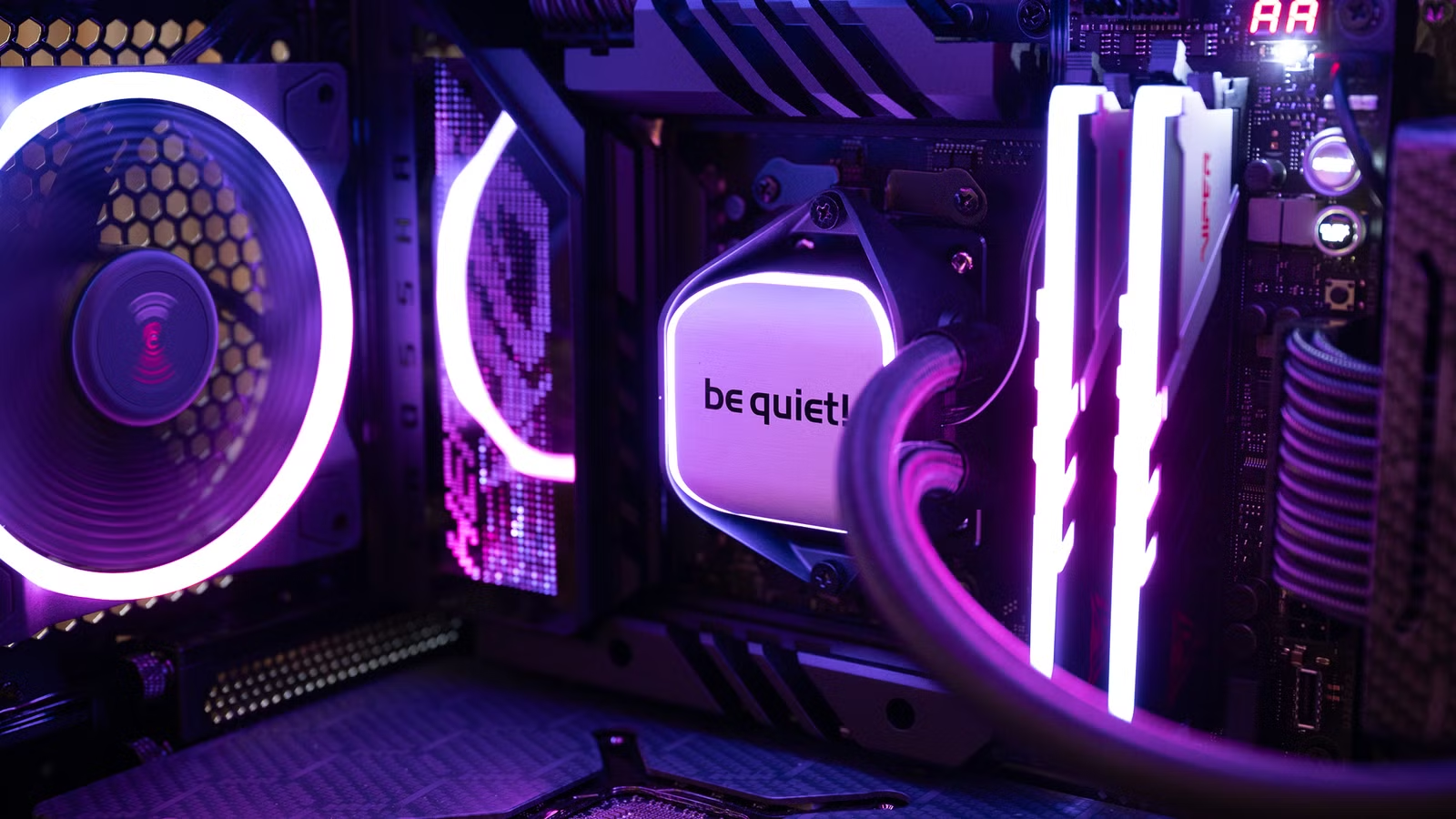
I understand why many PC builders prefer AIOs; they can have aesthetically pleasing designs with features like infinity mirrors or RGB lighting.
Credit: Lucas Gouveia / How-To Geek | Asus
For many gamers, aesthetics may be as crucial as functionality, and if that’s the case for you, then by all means invest in the most extravagant AIO cooler available.
However, I prioritize function over aesthetics. With my desktop located on the floor beside my desk, features such as an infinity mirror or a display showing system stats hold no value for me.
I care primarily about my case’s design; everything inside should perform well and operate quietly. The visual aspects don’t concern me.
Choose a Basic Air Cooler
Air coolers are more budget-friendly, provide ample cooling performance for my needs, and typically have a single failure point along with a longer lifespan compared to AIO coolers. Many compact designs are compatible with ITX cases, and as long as performance and noise levels are satisfactory, the appearance of the CPU cooler is irrelevant to me. Although AIO liquid coolers are trendy in the PC gaming community, unless future CPUs become extraordinarily power-hungry, I will not switch to an AIO.