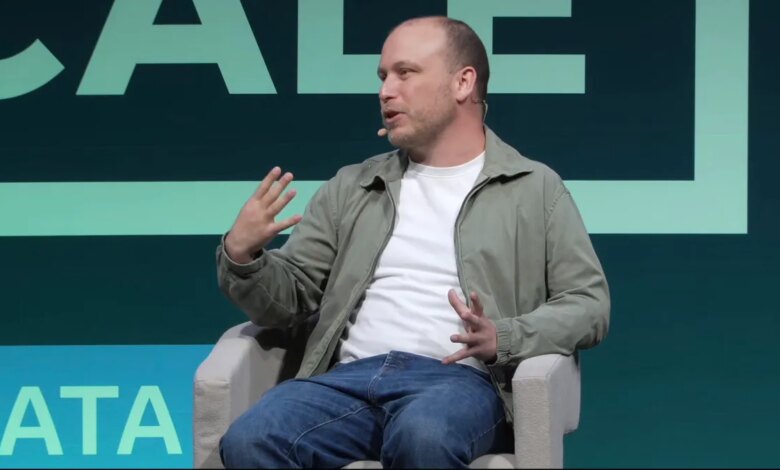
At the recent Meta @Scale conference, Boris Cherny, the creator of Claude Code, addressed a packed audience, with the first question being about the role of loops in AI.
“Are loops just another trend, or do they have real potential?” one audience member queried.
Cherny responded decisively, stating, “They are indeed substantial.”
He elaborated, “Just two years back, coding was done manually. We then moved to having agents generate the code. Now, we are at a stage where agents are prompting other agents, leading to code creation. The evolution from writing source code to utilizing agents was significant, but the advancement into loops is equally pivotal.”
Later in his presentation, Cherny shared specific examples of the loops he employs in his own projects. One agent is dedicated to enhancing code architecture, while another identifies and consolidates redundant abstractions. They make pull requests akin to human coders and continuously evolve as the codebase changes.
This concept is especially powerful, especially with a notable figure like Cherny advocating for it. As the trend toward agentic AI grows, users typically focus on effectively managing their agents: setting clear objectives, monitoring progress, and ensuring they stay aligned with initial prompts. However, loops introduce a new paradigm by allowing multiple agents to operate perpetually in the background. While this represents a leap of faith in AI, the rapid advancements in models could signify a key progression toward having AI take on more substantial tasks.
It’s important to acknowledge that the idea of recursive loops isn’t entirely unprecedented. In introductory computer science courses, recursive functions—where a function calls itself until meeting a termination condition—are standard. Although these loops function on non-deterministic logic—meaning a sub-agent decides when to halt the loop rather than a fixed condition—this fundamental concept aligns with existing programming practices. With the incorporation of AI to assist in various tasks, some form of AI overseeing AI through recursive loops was an inevitable development.
In contrast to traditional computing, agent-based loops can be surprisingly straightforward. One widely recognized method is the Ralph Loop, named after the character from “The Simpsons,” which summarizes all work done by the model, asking if it has achieved its objectives. This technique helps navigate scenarios where AI models become derailed during prolonged execution, effectively bouncing the model back and forth to ensure task completion.
Another perspective on loops is within the broader context of increasing computational power during testing phases. OpenAI researcher Noam Brown noted that modern models can tackle almost any challenge with sufficient computational resources. Therefore, one strategy to ensure problem resolution is to continuously allocate compute resources until completion. This approach is especially effective for tasks like enhancing a codebase, where models can incrementally refine solutions until a designated threshold is achieved. As demonstrated by Cherny, this practice can persist as long as compute resources are available.
That said, this method can be costly. Agentic AI, like prior AI technologies, consumes tokens at a significantly faster rate than standard Q&A systems. The aim of keeping the loop operational at all times means there’s no cap on expenses. For companies like Anthropic that profit from token sales, this might be advantageous; however, it may pose a financial challenge for others.
Nevertheless, depending on the specific issues the agentic loop addresses, and with the right measures in place to oversee resource usage and potential AI complications, the advantages might well justify the investment.