Welcome back to TechCrunch Mobility, your source for insights into the evolving world of transportation and the influence of AI on its future. To receive updates directly, subscribe for free — just click on TechCrunch Mobility!
This week, TechCrunch highlighted several developments that reflect the contrasting dynamics within the autonomous vehicle sector. While the federal government is actively promoting advancements, state and local officials are exercising caution regarding autonomous vehicles.
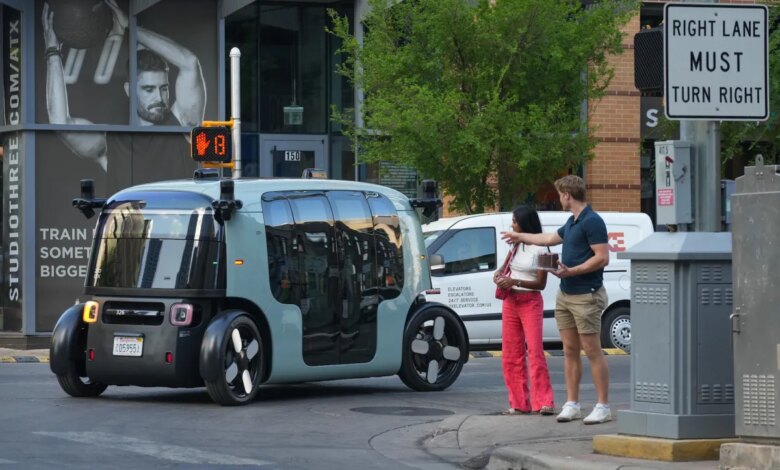
The National Highway Traffic Safety Administration (NHTSA) made significant announcements to reduce regulatory barriers and expedite the advancement and rollout of autonomous technologies. One of the most notable decisions was granting Zoox a temporary exemption from eight federal vehicle safety standards, allowing the company to initiate paid rides using its custom-designed robotaxi.
This exemption is pivotal, as it was one of the last significant regulatory challenges Zoox needed to overcome before delivering a commercial robotaxi service. According to the company, they are set to start paid services in Las Vegas shortly.
In contrast, Waymo and other robotaxi services are under increasing pressure regarding their vehicles’ interactions with emergency services, a growing concern that the industry cannot afford to overlook. Recently, the Mayor of San Francisco, Daniel Lurie, urged state regulators to tighten restrictions on autonomous vehicles after Waymo’s robotaxis became stranded during heavy July 4 traffic, complicating an already congested situation.
This week, Representative Kevin Mullin (D-Calif.) introduced legislation that would require federal authorities to implement minimum safety standards for autonomous vehicle operators.
“There have been a concerning number of incidents where autonomous vehicles unintentionally disrupt emergency responders,” Mullin stated during a press conference that also featured Mayor Lurie.
Thus, we see a dual motion—advancements being encouraged at the federal level, while local authorities are adopting a more cautious approach. The autonomous vehicle industry finds itself caught in the middle of this tug-of-war.
What are your thoughts? Feel free to reach out with your perspective at kirsten.korosec@techcrunch.com.
Recent Developments
Lucid has secured additional investment from Saudi Arabia, including a purchase of over 19 million shares—approximately 5%—from Prince Al Waleed bin Talal Al Saud, a member of the Saudi royal family.
Elon Musk’s tunneling enterprise, The Boring Company, is reportedly negotiating a $4 billion fundraising round with a valuation set at $20 billion.
Terminal, a Toronto-based company specializing in telematics data systems for commercial fleets, raised $20 million in a Series A financing round led by Battery Ventures, alongside investments from Intact Private Capital, Penske, Y Combinator, and Wayfinder Ventures.
Interesting Updates and Highlights
Alaska Airlines CEO Ben Minicucci has joined the board of directors at Lyft.
The emerging drone delivery sector has seen significant activity recently. Walmart and Wing, an Alphabet-owned company, have launched drone delivery services in Central Florida, while Flytrex partnered with the autonomic logistics platform Nash. Notably, DoorDash announced plans to create its drone delivery system, incorporating its own aircraft as part of an initiative by its robotics team.
Ferrari faced substantial criticism for its debut electric vehicle, the Luce, yet this did not hinder its sales, as the company reached this year’s sales target within just two months.
Florida received $200 million from the federal National Electric Vehicle Infrastructure program; however, instead of investing this into electric vehicle charging infrastructure, the funds are being allocated for developing 32 landing pads equipped with charging units for electric vertical takeoff and landing aircraft (eVTOLs).
London is emerging as a new frontier for robotaxis, with Baidu beginning to test autonomous vehicles there in collaboration with Lyft and Freenow. The aim is to allow public access to these robotaxi services by 2027. Other companies are also gearing up for launches; for instance, Waymo has started testing autonomous vehicles with human safety operators, while Uber, in partnership with Wayve, intends to introduce a robotaxi service this year.
Rivian spinoff Also is set to begin delivering its first electric bikes next week, following delays due to supply chain challenges.
Indications of a potential Tesla-SpaceX merger are emerging, with reports suggesting Tesla may consider divesting its operations in China. In parallel, Tesla celebrated the production of its 10 millionth electric vehicle.
Waymo robotaxis are resuming operations on freeways, after halting these drives for more than two months due to concerns about their performance near construction sites.
Final Thoughts
Once, this newsletter was filled with stories about electric vehicles, predominantly focusing on ambitious strategies from U.S. automakers like GM and Ford. These companies invested significantly and formed partnerships for creating battery and EV plants to transition their product lines to electric vehicles. However, as those ambitious plans have slowed, so too have discussions surrounding them.
TechCrunch collaborated with Hudson Labs, a New York finance research firm, to assess how the focus on electric vehicles in GM and Ford’s quarterly earnings calls has diminished since the pandemic. The findings reveal that while both automakers continue to sell EVs and have new models upcoming, their overall focus has shifted, evident from the data. Be sure to explore the full story, which includes detailed interactive graphs.
Purchases made through links in our articles may earn us a small commission, supporting our editorial independence.