Parker Solar Probe’s Latest Sun Encounter, Solar Energy Triumphs, Plus Other Exciting Science Updates

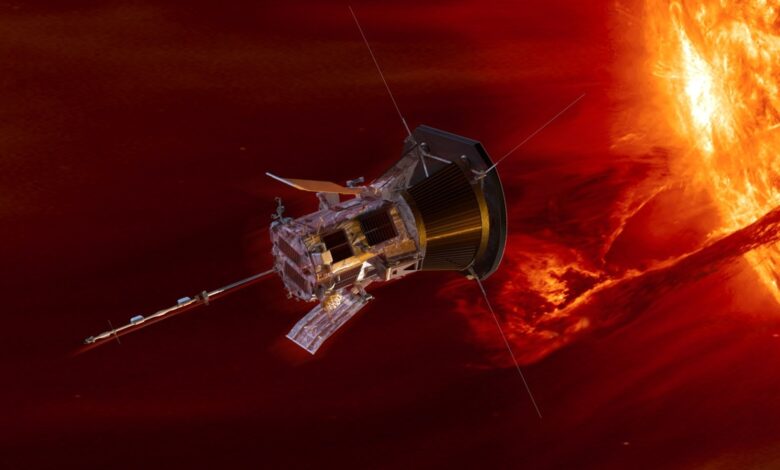
This week, NASA revealed the astronauts who will be part of the Artemis III mission scheduled for 2027. The crew includes NASA’s Andre Douglas, Frank Rubio, and Randy Bresnik, along with ESA’s Luca Parmitano in the role of pilot. Additionally, the Parker Solar Probe completed another close encounter with the sun, solar power production surpassed that of coal for the first time in U.S. history, and more exciting scientific developments emerged. Here’s a summary of the latest in science.
Parker Solar Probe’s 28th Close Encounter
NASA’s Parker Solar Probe successfully made its latest flyby of the sun, coming within 3.8 million miles of the solar surface while achieving speeds of 430,000 miles per hour. This marked the probe’s 28th pass, equaling the record set in December 2024. The probe initiated its recent approach on June 3, and by Thursday, it transmitted a signal indicating everything was functioning correctly.
Launched in 2018, the Parker Solar Probe has spent eight years closely examining the sun, steadily decreasing its distance to the surface. Its first close approach allowed it to come within 15 million miles of the sun, reaching a speed of 213,200 mph. Despite the extreme conditions near the sun, with the heat shield enduring temperatures of around 1,700 degrees Fahrenheit, mission team members report the probe continues to perform well over time. Thermal blankets beneath the heat shield maintain the probe’s internal temperature at a stable level during these close encounters.
“Consistent temperatures are a key sign of the spacecraft’s health,” noted John Wirzburger, a mission systems engineer at Johns Hopkins Applied Physics Laboratory. “If the heat shield were deteriorating, we would observe rising temperatures due to heat leakage.”
The Parker Solar Probe monitors solar winds and activities, studying changes in the sun’s 11-year cycle. It arrived near the solar minimum phase and has documented the transition into solar maximum, confirmed in 2024. This peak period of solar activity leads to increased sunspots, solar flares, and coronal mass ejections. As the solar cycle progresses, activity is expected to gradually decline. The probe has provided invaluable data to enhance our understanding of the sun and its impact on space weather.
Solar Energy Surpasses Coal Generation in the U.S.
A recent report by energy think tank Ember highlighted a significant milestone: in May 2026, solar energy became the primary source of electricity generation in the United States, overtaking coal for the first time. Solar contributed an impressive 12.8% of the nation’s electricity, while coal dropped to 12.2%, marking its fourth-lowest monthly output recorded. The total solar generation for that month hit a new high of 45.5 terawatt-hours (TWh), making it the third-largest electricity source in the country.
Coal production lagged closely behind at 43.4 TWh in May, which represented an 11% decrease from the same month last year. Additionally, coal’s output reached an all-time low of 39.3 TWh in April. Over the past five years, coal’s share of electricity generation in the U.S. has nearly halved, dropping from 19.7% in May 2021 to 12.2% in May 2026. In contrast, the solar sector has more than doubled its contribution from 5.4% to 12.8% during the same timeframe.
Though solar energy still trails behind gas and nuclear power, Ember analysts report that renewable energy sources continue to grow, regardless of policy reversals. In March, renewables collectively provided more electricity than natural gas, marking a historic shift in the U.S. energy landscape.
Stunning Timelapse of the Southern Lights Captured from Space
In a fascinating development, an astronaut aboard the International Space Station recently shared a stunning timelapse video of the aurora australis, or southern lights. Jessica Meir, commander of NASA’s SpaceX Crew-12 mission, filmed the captivating display from a Dragon spacecraft docked to the ISS. “Unlike previous auroras I’ve observed, this one danced gracefully beneath us, offering an impressive spectacle,” Meir shared via social media. “I am in awe of this captivating phenomenon.”
While astronauts enjoy spectacular views of auroras, people on the ground have also been treated to impressive displays. The NOAA’s National Space Weather Prediction Center issued alerts for G2 and G3 geomagnetic storms, suggesting that auroras might be visible in areas beyond their usual range. Predictions indicated visibility across parts of Canada and the northern U.S., while those in Australia and New Zealand had chances to observe the breathtaking southern lights.