NASA’s Perseverance Rover Sets New Milestone for Interplanetary Travel Distance

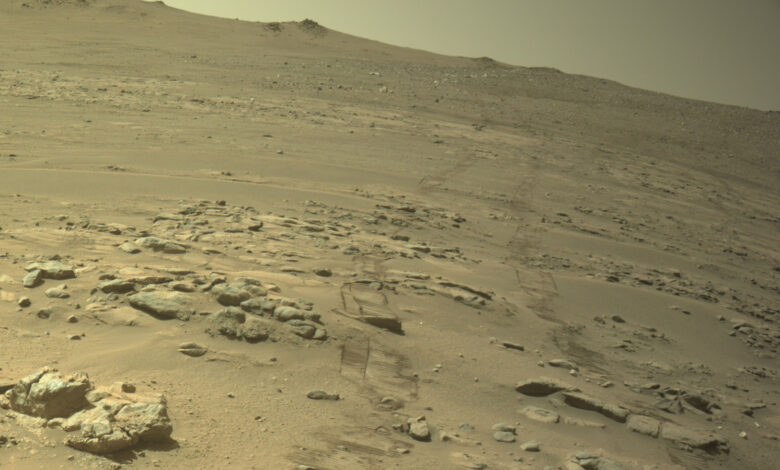
The Perseverance rover from NASA has set a new record for the greatest distance traveled by any vehicle on a different planet, as announced by the agency. This six-wheeled, nuclear-powered rover has traversed a total of 28.10 miles (45.22 km) as of October 11th, surpassing the previous record held by the Opportunity rover, which covered 28.06 miles (45.16 km) on Mars. Perseverance achieved this significant milestone in just five and a half years, while Opportunity took nearly 15 years to reach its total distance.
The last time we checked, Perseverance had completed a distance equivalent to that of a marathon, covering 26.2 miles. Although 28.1 miles may not appear extensive, it’s quite remarkable considering the rover’s top speed is just 0.1 mph. Additionally, the rover has had to navigate challenging terrains throughout its mission, as highlighted in a recent video.
The 2,260-pound rover reached this achievement while journeying to a region named Idubi, where it plans to explore a geological feature called “Lac de Charmes.” This area is known for containing some of the oldest terrain observed in our solar system. According to NASA, “The rocks and landscape of Lac de Charmes are so ancient that their Earthly counterparts have long been eroded away by processes such as erosion and plate tectonics—something Mars lacks.” The science team hopes to uncover signs of ancient hydrothermal systems in Idubi.
The longevity of Perseverance can largely be attributed to its advanced navigation system, known as AutoNav. This feature allows the rover to capture images of its surroundings and identify potential hazards in real time as it travels automatically between designated waypoints. By analyzing 600,000 data points with each scan, the rover has autonomously covered over 90 percent of its total distance.
A recent software upgrade has enhanced Perseverance’s capabilities, allowing it to travel longer distances while reducing the need for steering, thus prolonging its mechanical life. It can now assess its position against orbital maps while in transit. The next challenge for the team is to resolve issues with camera glare caused by sunlight, which affects the rover’s visibility, enabling it to operate for more extended periods.
While Perseverance has outpaced Opportunity, the Curiosity rover continues its mission on Mars and has traveled a distance of 38.15 km (23.7 miles) to date. The next most traveled American vehicles are the lunar rovers from the Apollo 16, 17, and 18 missions, with the Apollo 17 rover being the farthest at 35.74 km (22.21 miles).