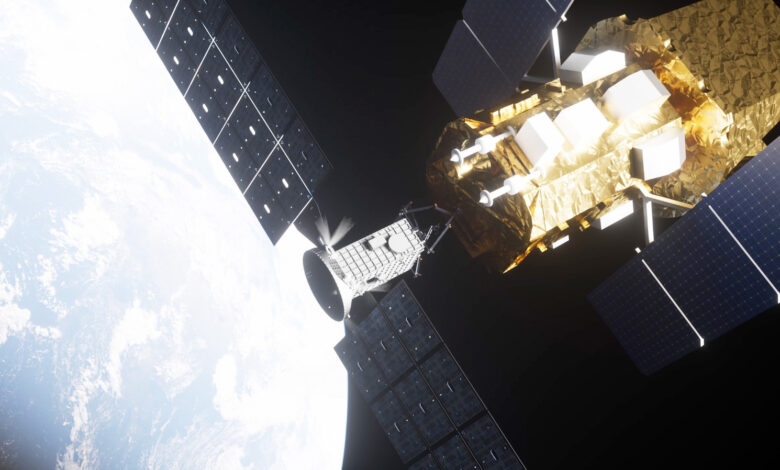
A robotic spacecraft named LINK is set to elevate a telescope to a higher orbit.
The NASA Swift Boost mission successfully launched from the Marshall Islands on July 3 at 4:36 AM Eastern Time, following a few delays. The mission aims to rescue the Neil Gehrels Swift Observatory, which has been descending more quickly than expected. The ground teams have established communication with LINK, the robotic spacecraft created by Katalyst Space, which is responsible for docking with the observatory and towing it back into a higher orbit.
This launch was unconventional; LINK was mounted on a Northrop Grumman Pegasus XL rocket, which was then secured beneath a plane named Stargazer. The plane took off from Kwajalein Atoll, releasing the Pegasus XL rocket at an altitude of approximately 40,000 feet. After a brief free fall, the rocket’s engines ignited, propelling LINK into space.
Contacting LINK was the mission’s primary goal, and that milestone was successfully achieved. LINK has powered on and will undergo a series of health checks conducted by Katalyst over the upcoming weeks to evaluate its propulsion, sensor, and navigation systems. Following these checks, LINK will proceed to survey the Swift observatory.
LINK will then maneuver to capture Swift, using its three robotic arms to dock with the telescope and pull it to an altitude of around 370 miles, extending its operational life by about a decade. This operation is expected to take between 10 and 12 weeks. Due to recent solar activity, the observatory’s orbit has been degrading at an accelerated rate, and without LINK’s assistance, it would likely fall out of orbit by year’s end.
The Neil Gehrels Swift Observatory has been dedicated to studying gamma-ray bursts for over twenty years. Brad Cenko, the principal investigator for Swift, describes these bursts as “brief flashes of high-energy light that emit more energy in mere seconds than the sun will throughout its entire existence.” These bursts are presumed to result from exploding and colliding stars. Cenko notes that data gathered from Swift has confirmed the creation of the heaviest elements in the periodic table, including gold and platinum. Scientists also utilize Swift as a “dispatcher” or “first responder” to collect essential data during unforeseen cosmic events.