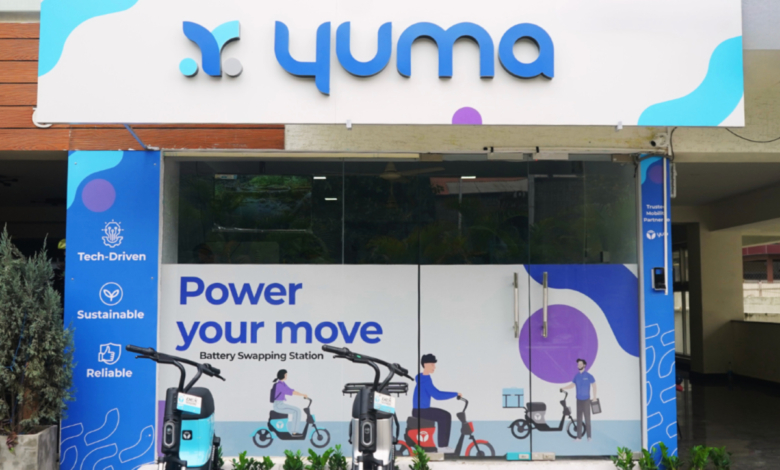
The concept of battery swapping has faced challenges globally, but Canadian automotive parts leader Magna International sees potential for it to thrive in India. The country’s unique economy, driven by millions of two- and three-wheel vehicles and a rapidly expanding delivery sector, creates favorable conditions for this model.
Magna is backing Yuma Energy, a Bangalore-based company that runs a battery-swapping network specifically for electric two- and three-wheel vehicles. Established in early 2023 as an offshoot of Indian mobility startup Yulu, Yuma has successfully completed over 60 million battery swaps to date and currently operates with around 100,000 batteries in its network.
Magna is increasing its investment in Yuma by $35 million, raising its ownership stake from 51%, which was established at the formation of their joint venture, according to Yuma’s managing director, Muthu Subramanian. Consequently, Yulu’s share will be lessened, though Subramanian refrained from sharing the updated ownership details.
Yulu and Yuma represent Magna’s sole startup investments in the Indian market, marking a significant commitment of $77 million to both entities in 2022—$25 million allocated to Yulu and $52 million to their shared battery-swapping enterprise.
Focusing on India’s Gig Economy
The latest funding from Magna largely relies on the growth of India’s gig economy. Delivery personnel often face substantial delays and income loss while waiting for their electric vehicles to charge. Subramanian suggests that only about 10% to 15% of the vehicles used by gig workers in India are currently electric, indicating a significant market opportunity as more drivers transition from gasoline-powered vehicles.
“Given the high mileage that Indian gig workers cover daily, adopting an EV is economically sensible,” Subramanian commented. “Maximizing uptime is essential.”
Yuma aims to serve high-mileage riders, asserting that battery swapping is a more efficient option compared to fast charging. According to Subramanian, a battery can be swapped in under two minutes, while fast charging requires riders to be off the road for 20 to 30 minutes, not to mention needing additional space and power for multiple vehicles.
However, establishing this convenience comes at a cost. Yuma has to maintain its batteries and swapping infrastructure proactively, which is financially demanding prior to achieving sufficient rider traffic. “This is a capital-intensive business, and the unit economics will become apparent at scale,” Subramanian noted.
While Yuma is not yet profitable, Subramanian revealed that some older swapping stations are already achieving positive EBITDA. With over 400 stations and 2,500 charging units, Yuma wrapped up the financial year ending in March 2026 with approximately ₹1 billion (around $10.5 million) in revenue. The company is aiming to reach EBITDA break-even in the next two quarters.
To reach this milestone, Yuma will need to continue building ahead of demand. The company plans to utilize most of Magna’s investment to enhance its swapping infrastructure and to double its fleet of batteries over the next 12 to 18 months.
While Yulu is still the primary contributor to Yuma’s 60 million battery swaps, that reliance is beginning to shift, with about 15% to 20% of recent swaps coming from non-Yulu customers, Subramanian shared.
Yuma has also diversified its customer base, now catering to over five fleets and integrating its batteries with more than 10 vehicle models from brands like Kinetic Green, Motovolt, BGauss, and Quantum Energy. The company anticipates that non-Yulu clientele will account for roughly 25% of its swaps within the next two years, according to Subramanian.
Earlier this month, Yulu secured $93 million to expand its electric two-wheeler fleet, which necessitates that Yuma develop its network accordingly in order to keep up with its largest customer as well as newer fleets that adopt its batteries.
Yuma’s network spans 18 cities in India, including major urban areas like Bengaluru, Hyderabad, Mumbai, and the Delhi region, as well as Jaipur, Lucknow, Indore, Coimbatore, Kochi, and Kolkata. With the new financial backing, the company plans to enter Chennai and Pune next, while also increasing the number of stations in its existing markets.
For at least the upcoming 12 to 18 months, India will remain Yuma’s core focus. Nonetheless, Subramanian mentioned aspirations to eventually expand the model internationally, with Southeast Asian nations such as Vietnam and Thailand, along with areas in Africa, appearing promising due to their large two-wheeler markets, although Yuma has not commenced discussions for entry into these regions.
Unlike many operators that simply run battery-swapping networks, Yuma takes a hands-on approach by designing and manufacturing its own battery packs and charging units. The company produces battery packs at its facility in Chennai and charging units in Bengaluru, ensuring it maintains control over both the hardware and the networks that support them.