Google Unveils Open-Source AI Model Promising Enhanced Hurricane Warning Systems

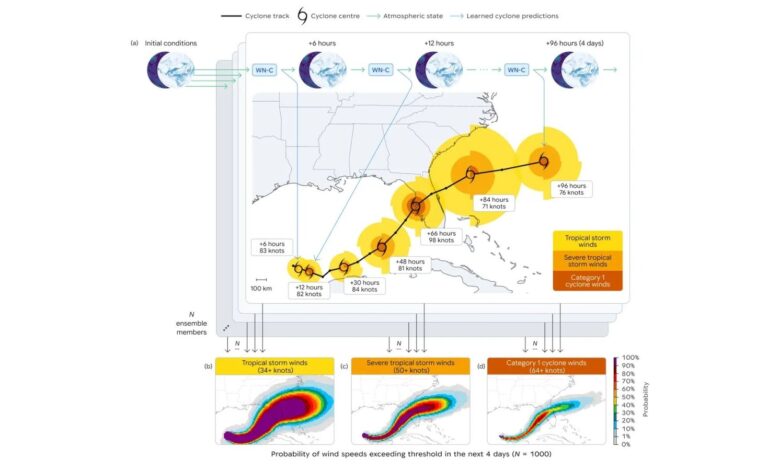
WeatherNext provides a 15-day forecast to predict the trajectory and strength of storms.
Scientists from Google DeepMind and Google Research have collaborated to enhance the WeatherNext AI weather forecasting model, aimed at delivering more accurate cyclone alerts. This initiative has received support from the National Hurricane Center, the Cooperative Institute for Research in the Atmosphere, the UK Met Office, and several global weather organizations. Both the model’s code and its underlying components are being made freely available on GitHub, allowing other researchers to benefit from this advancement.
An article discussing WeatherNext has been published in the journal Nature, along with a more accessible overview provided in a Google blog post. Tropical cyclones, which are commonly referred to as hurricanes or typhoons depending on the region, present significant forecasting challenges due to the complex global atmospheric currents that dictate a storm’s path. Traditional models usually analyze these currents using broader global frameworks. In contrast, specialized local models focus on predicting a storm’s intensity by examining the thermodynamic processes at the cyclone’s heart. WeatherNext has utilized approximately 20 terabytes of global atmospheric data, along with historical records from the International Best Track Archive for Climate Stewardship, to predict both the path and strength of cyclones using a singular model.
The researchers behind WeatherNext stated, “We can now produce a unified 15-day forecast in under a minute on a TPU, enabling forecasters to swiftly assess the probability distribution of potential catastrophic risks.”
Last year, Google unveiled the second generation of WeatherNext. Additionally, the company’s research divisions have been exploring AI applications for predicting flash floods.