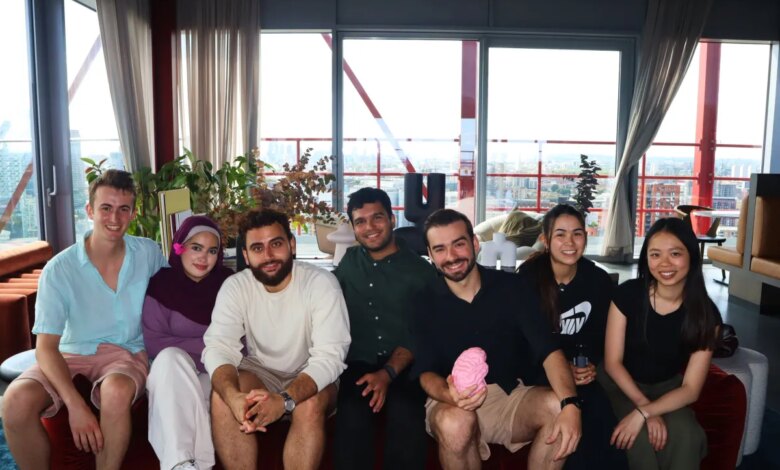
A group of six young entrepreneurs in East London has established what they refer to as the anti-San Francisco hacker house. Their objective is to foster a “holistic improvement in life,” contrasting the fast-paced, deadline-driven approach typical of Silicon Valley, as explained by Rowan Aldean, 26.
Curious about this unique initiative, I spent an afternoon at the house, engaging with its residents and assessing the environment. Upon arrival, Aldean guided me through the neatly maintained pathways of a newly constructed East London locale to the striking six-story building situated alongside the water.
Known as the London Island Founder House, or “Lift House,” Aldean and his wife, Zahraa, 22, who is pursuing a PhD in pharmaceutical research, have been residing there since May, following its official launch in March. Aldean previously sold his startup for millions and now leads an “applied AI” enterprise that aids businesses in adopting efficient agent deployment.
Much like other hacker houses, Lift House serves as both a startup workspace and living quarters. The name reflects its elevator and its mission to elevate tech founders, according to Aldean. It’s one of the few co-living hacker houses in London, especially in contrast to San Francisco, which boasts numerous similar establishments.
Lift House symbolizes a belief that U.K. founders can thrive without replicating the intense hustle culture synonymous with Silicon Valley.
Residents have recounted tales of unconventional San Francisco hacker houses operating from warehouses, hosting extravagant parties, or engaging in grueling work sprints reminiscent of the “996” culture.
“Performative and extravagant events aren’t our style here,” Aldean observed. He pointed to DeepMind, London’s prominent AI firm, which has earned Nobel accolades and pioneered innovations without the spectacle often associated with startup hype.
Lift House is part of a movement dubbed “Londonmaxxing,” where founders strive to leverage the full range of opportunities within London’s tech scene. It may feel less ostentatious compared to Silicon Valley, but the aspirations remain aligned: success, wealth, and market leadership.
In 2026, London AI startups raised a remarkable $12 billion, out of a total of $14.7 billion for all London-based startups, as per Dealroom data. Six companies surpassed the $500 million funding mark: Wayve, Superintelligence, ElevenLabs, Recursive, Ineffable Intelligence, and Isomorphic Labs, with the latter three founded by former DeepMind employees.
The surge in AI has invigorated the U.K. tech landscape, inspiring a new generation of entrepreneurs, like those inhabiting Lift House, to take ambitious leaps.
The Balance of Work and Well-being
Residents enjoy flexible living arrangements—some stay for a month, others plan for at least six. They buy groceries individually, but often prepare meals together and share ingredients. Cleaning duties are distributed among the members, though details about their rent remain undisclosed.
The residents of Lift House embrace a balanced approach to ambition, a concept largely foreign to San Francisco’s startup culture.
Every Sunday, the group journals together, a practice initiated by David Amor, 28, who leads a brain coaching business that helps founders maximize their mental capacities to boost performance. Journaling focuses on tracking time spent outdoors, diet quality, and physical activity throughout the week.
“I’m eating better, exercising more, and getting sufficient sleep,” remarked Luke, 27, who runs an AI marketing company and has started prioritizing lunch since moving in. Tuesday evenings feature volleyball, where the founders participate in a local league.
On other evenings, Wan Ying L, 25, who recently departed from an AI startup to explore new ventures, might entertain with piano performances. The residents also enjoy board games like Catan or outings to art shows together.
Presence Plumb, 25, a tech strategist, enjoys hosting dinner parties on the rooftop, serving dishes that reflect the diverse heritages within the house—including Iraqi and Spanish cuisines—while inviting fellow entrepreneurs, researchers, and investors to converse about industry trends.
“It feels calmer and more authentic here,” she stated, in reference to the London tech climate. “There’s less of the typical tech bro culture. People desire more balance.”
Each founder adheres to distinct schedules. Amor rises at 8 a.m. and begins work promptly, setting goals for the morning before distractions set in. After his focus time, he takes a cold shower to jumpstart his motivation.
Luke typically wakes around 8:30 and starts the workday at 9 a.m. with his co-founder, Varun, 27, who frequently collaborates at Lift House.
In contrast, Aldean seldom rises before 10 a.m. unless there’s a pressing obligation, like a critical investor call. When asked what distinguishes their house from a typical wellness-focused space in Silicon Valley, he humorously remarked, “We bond over tea, unlike the coffee culture in SF.”
More seriously, Aldean discussed the unique pressures that British startups face, such as a cultural reluctance towards risk and a humility that can hinder bold success. Unlike in Silicon Valley, there is a cultural phenomenon known as “tall poppy syndrome,” where rising stars attract media scrutiny and criticism, often leading to a reluctance among founders to showcase their successes.
Nevertheless, Luke believes London is an attractive hub for early-stage startups. The city offers a robust network, accessible early-stage investment prospects, and a lifestyle beyond just technology. He feels it compares more to New York culturally than to Silicon Valley.
“London is incredibly diverse and there’s always something engaging to do,” Amor added, whether it’s a founder-fueled group or wellness events.
Luke and Varun have used the U.K. government’s SEIS/EIS schemes to minimize reliance on venture capital, making it an advantageous place to launch their startup as the tax liabilities are similar to regular income tax.
Aldean feels the London startup environment fosters collaboration rather than cutthroat competition. He contrasts this with his experience in hacker houses in the Bay Area, where the atmosphere often felt overly secretive and performance-driven.
“Gossip isn’t prevalent here,” Aldean said. In the U.K., people are less inclined to spread negative stories for personal gain.
Aldean also highlighted how U.K. startups generally target larger, slower corporations, allowing them to grow without needing to ingratiate themselves to the startup community.
Varun and Luke added that while the U.S. venture market is brisk, with quicker customer wins, the U.K. offers longer-lasting relationships once those customers are secured.
The Path to the U.S.
Ultimately, many U.K. startups eye opportunities in the U.S.
Founders enjoy access to a wealth of skilled talent from prestigious universities and benefit from a time zone that facilitates working across Europe, the Middle East, Asia, and North America. However, the U.S. presents the allure of the largest economy coupled with an abundance of investors willing to provide substantial funding.
“It operates like a factory line,” Varun noted, “where you start in one region and expand to another.”
American investors are also enticing British talent by suggesting relocation. One founder recounted how an investor refused to back her startup unless she moved to the U.S., a decision she made while choosing to maintain residency in the U.K. for her family.
“Similarly, we faced interest from a Miami investor who expressed the same conditions,” Luke mentioned, noting that moving to the U.S. is a common trend among startups. They have already initiated their U.S. expansion, though they remain fond of London and have not completely dismissed the idea of relocating to be closer to clients.
This tension reflects broader challenges in the U.K. tech landscape. “I work with many individuals dedicated to nurturing the European ecosystem,” Plumb remarked.
However, Aldean highlighted that while enthusiasm for London is prevalent, many founders reconsider when presented with relocation opportunities.
The lease for Lift House will end in about a year, and residents hope to extend their stay as long as possible. The venue is one of the few like it in London, alongside various short-term meet-ups, such as the Solana Hacker House series. Some hacker houses in London are part of international networks, such as The Residency from San Francisco, which recently debuted in London, and BaseJump, which is set to launch a similar program soon.
In 2024, two founders attempted to create an alternative to Lift House called “The London Founder House,” which aimed for a more intense, high-pressure environment, and while it closed last year, it left a lasting impact on the local ecosystem.
For those interested in Lift House, its criteria include demonstrating an interest in fitness and having hobbies outside of work, reflecting the message prevalent in the London tech scene: one can indeed achieve a balanced life.
“The objective is to create enduring success,” Aldean emphasized, “rather than burning out in pursuit of fleeting trends.”