Apollo Atomics Aims to Cut Nuclear Power Costs by Streamlining a Neglected Component

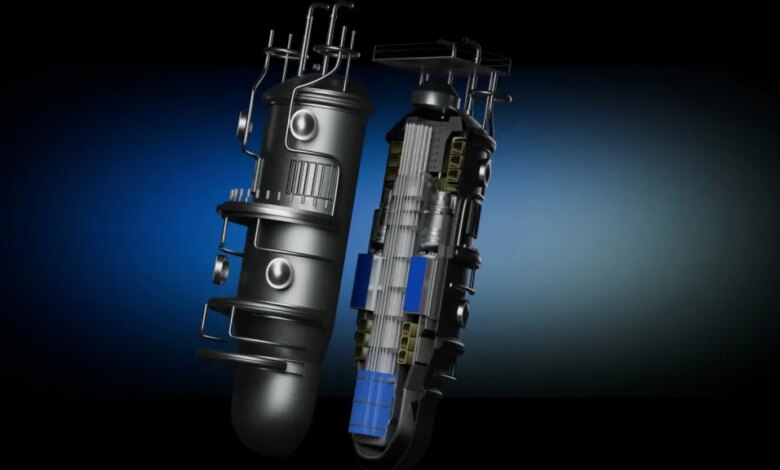
The nuclear energy sector is experiencing a revival, with various startups securing investment to create innovative reactors aimed at reducing costs. However, recent forecasts suggest that these new reactors may not be financially viable in the near future.
Assil Halimi and Drew Walker, the co-founders of Apollo Atomics, believe that the industry’s focus has been misguided. Rather than concentrating on new reactor designs, Apollo is innovating in how thermal energy is transformed into electricity.
“Our emphasis is on the steam generator, the largest component in the system,” Halimi, the CEO of the startup, explained. “We’ve managed to reduce its size and create a more compact system than any competitor.”
Steam generators play a crucial yet often overlooked role in power plants by producing steam from the coolant loop, which drives turbines. While traditional steam generators are typically custom-built and can be several stories tall, Apollo claims theirs can be mass-produced and sized similarly to a human. This compact design enables them to create reactors that are drastically smaller compared to those utilizing conventional steam generators.
To facilitate the construction of a demonstration reactor with an aim for commercial deployment by 2028, Apollo has recently secured a $26 million seed funding round, which includes $5 million in debt. The reactor’s design is grounded in research conducted at MIT.
Halimi anticipates that an Apollo power plant could produce electricity at a cost of 3 cents per kilowatt hour. “We’re not interested in making minor improvements in nuclear energy; our goal is to outperform natural gas,” he stated.
Halimi pointed out that traditional steam generators have significant room for advancement. Many existing designs are adapted from coal and natural gas power plants, but these fossil fuels possess much lower energy density than nuclear fuels like uranium. “You have a high-potential fuel, yet you’re only leveraging a small fraction of it,” he noted, criticizing the inefficiency of current generators.
Standard steam generators circulate reactor coolant through large tubes surrounded by water, which produces steam. In contrast, Apollo’s generator would integrate the two fluid loops within a compact metal block filled with ultra-narrow channels, enhancing heat transfer efficiency and allowing for a reduced footprint.
With the generator’s compact design, Apollo intends to manufacture both the reactor and steam generator in a factory setting rather than assembling them on-site, which is the current norm for nuclear power plants. Due to the savings in labor and size, Halimi predicts that a 300-megawatt power plant could be constructed in under two years, with the reactor costing four to five times less than current models.
Apollo has already developed a small, 40-kilowatt reactor at MIT to showcase its technology. The company plans to offer reactors in three scales, ranging from 10 megawatts to 300 megawatts.
The funding round was led by FCVC, with participation from Telesoft Partners, Y Combinator, Alumni Ventures, Robinhood Ventures, Nucleation Capital, Pelion VC, Duke Capital Partners, New Era Ventures, Orange Collective, Stanford University, E14 Fund, and Neutron Power Ventures. Apollo was part of Y Combinator’s Spring 2026 cohort.