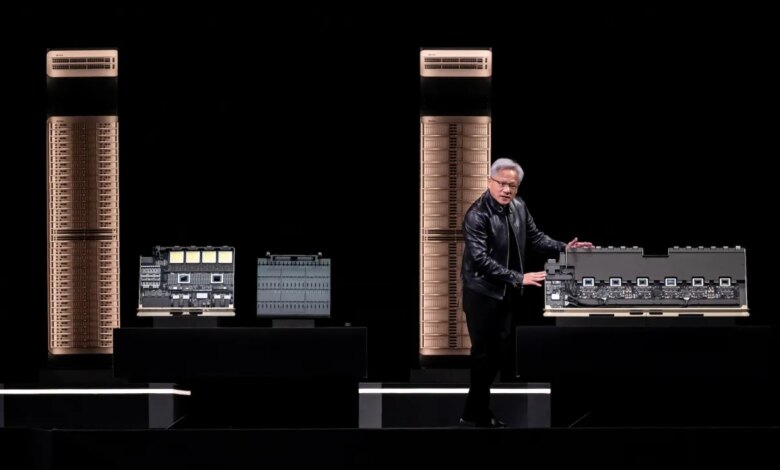
Amazon and Nvidia have strengthened their collaboration significantly. On Wednesday, they announced an enhanced partnership, which includes a plan to introduce an additional 2 million Nvidia GPU chips into Amazon’s data centers.
These GPUs are optimized for the heavy computational requirements associated with training and operating AI models, featuring Nvidia’s Blackwell Ultra, Rubin, and Rubin Ultra chips. They will be integrated into Amazon Web Services’ data centers in 2027 and 2028.
This news, revealed during Nvidia’s earnings call, follows Amazon’s agreement five months ago to utilize over 1 million Nvidia GPUs within its AWS framework starting this year. Nvidia stated that the demand witnessed thus far has surpassed initial forecasts.
While financial specifics of the deal were not disclosed, it is anticipated that Nvidia stands to gain tens of billions from this venture, based on the cost of GPU units.
This partnership is significant not just for its scale but also because it extends beyond merely Amazon purchasing more Nvidia chips. It unfolds simultaneously as Amazon works on developing its own AI chips that could rival Nvidia’s offerings.
Along with the GPU supply, Nvidia confirmed that its technology—including networking hardware linking multiple GPUs, as well as its open models, CPUs, data processing software, and robotics platforms—will also be involved in AWS operations.
The two companies cited a surge in demand from startups, large enterprises, AI laboratories, and government entities as a key factor driving the deepening partnership.
As Amazon accelerates its AI chip initiatives, particularly in CPUs—essential processors for servers—this collaboration comes to the forefront. Amazon has been developing its own chips to reduce reliance on Nvidia and compete directly with the tech giant. AWS is reportedly discussing the possibility of offering its Trainium chips, which rival Nvidia’s H100 and Blackwell processors for deep learning tasks, to other businesses for data center applications. Additionally, Amazon’s Arm-based Graviton CPU is emerging as a competitor to established server chips from Intel and AMD.
Amazon has recently elaborated on the rapid growth of its custom chip segment, having achieved a $25 billion annual revenue run rate, buoyed by $225 billion in commitments from AI firms like Anthropic and OpenAI.
Nevertheless, Nvidia continues to lead the market in AI chips.
The integration of the 2 million GPU chips into AWS is set to commence in the third quarter, while Nvidia plans to dispatch a certain quantity of Vera CPUs, some of which will be integrated with Rubin, according to Nvidia’s CFO Colette Kress.
Nvidia CEO Jensen Huang expressed ambitious goals for the company’s Vera CPUs, highlighting a newly identified $200 billion total addressable market.
Beyond AWS, Kress indicated that Nvidia envisions Vera being utilized by every significant hyperscaler, AI lab, and system original equipment manufacturer, with deployment already underway to primary partners including Oracle and SpaceXAI.
The enhanced collaboration will also extend to Amazon’s warehouse robotics and enterprise solutions.
Kress noted that Amazon intends to integrate Nvidia’s comprehensive AI framework to enhance its robotic fleet. This framework includes Omniverse (for simulation and digital twin applications), Cosmos (world modeling), Isaac (robotics development), and Jetson (hardware for robotics and edge AI). Nvidia has unveiled a new Jetson version aimed at making robotics computing more accessible for entry-level edge AI.
On the enterprise side, AWS will host Nvidia’s Nemotron collection of open models on Amazon Bedrock, its managed foundation model platform, as well as SageMaker, its cloud-based service.
In its recent earnings report, Nvidia announced second-quarter sales of $96.2 billion, surpassing analyst projections. A substantial portion of these sales—$89 billion—stemmed from data center revenues, representing a 117% increase compared to the previous year.
Nvidia forecasts third-quarter revenue to reach $108 billion, partially driven by sales of the next-generation Rubin GPUs, which have entered production this quarter. Investors are closely monitoring the sales of these new GPUs in Q3 for indications of sustained demand as Nvidia prepares its next hardware generation.
The company plans to invest $279 billion to secure supply and manufacturing capabilities for both current and future data center initiatives, representing a significant increase from last quarter’s commitment of $119 billion. This financial plan encompasses $92 billion set for the current fiscal year and an additional $87 billion earmarked for fiscal year 2028.
“What truly matters for the industry is that AI is now actively engaged in productive and valuable work,” Huang remarked during the earnings call. “AI is generating profitable outcomes… The more computational power we acquire, the more profitable results we can produce, leading to increased profits for our services. We’re currently at a pivotal phase, which is why stakeholders are intensifying their involvement.”
Investors are keen to see if enhanced computational power will indeed translate into greater profits, as AI companies continue to invest heavily in infrastructure.