Transform Your Entire Website into a Playable WARC File for Seamless Browser Experience

As a strong advocate for archiving, I often rely on resources like the Internet Archive and Wayback Machine. During my research earlier this year, I discovered something new to me: the WARC format. It’s a captivating file format, much like Ogg Vorbis, and I was eager to learn more about its purpose and functionality.
Exploring the WARC Format
The Robustness of WARC
The WARC, or Web Archive format, is designed for thorough data preservation. It was developed by the International Internet Preservation Consortium, with contributions from Brewster Kahle and Mike Burner at the Internet Archive. This format allows for the storage of a vast amount of web data within a single file, aimed at capturing entire websites while preserving their files, functions, metadata, and overall integrity. This ambition elevates the significance of the Internet Archive’s mission.
Per its specifications, WARC acts as a container, preserving web content in its original context. It is primarily used to save web crawl data, and the files are substantial yet portable. Emerged in 2007, the WARC format evolved from the earlier ARC format, initially utilized by the Internet Archive itself for similar purposes.
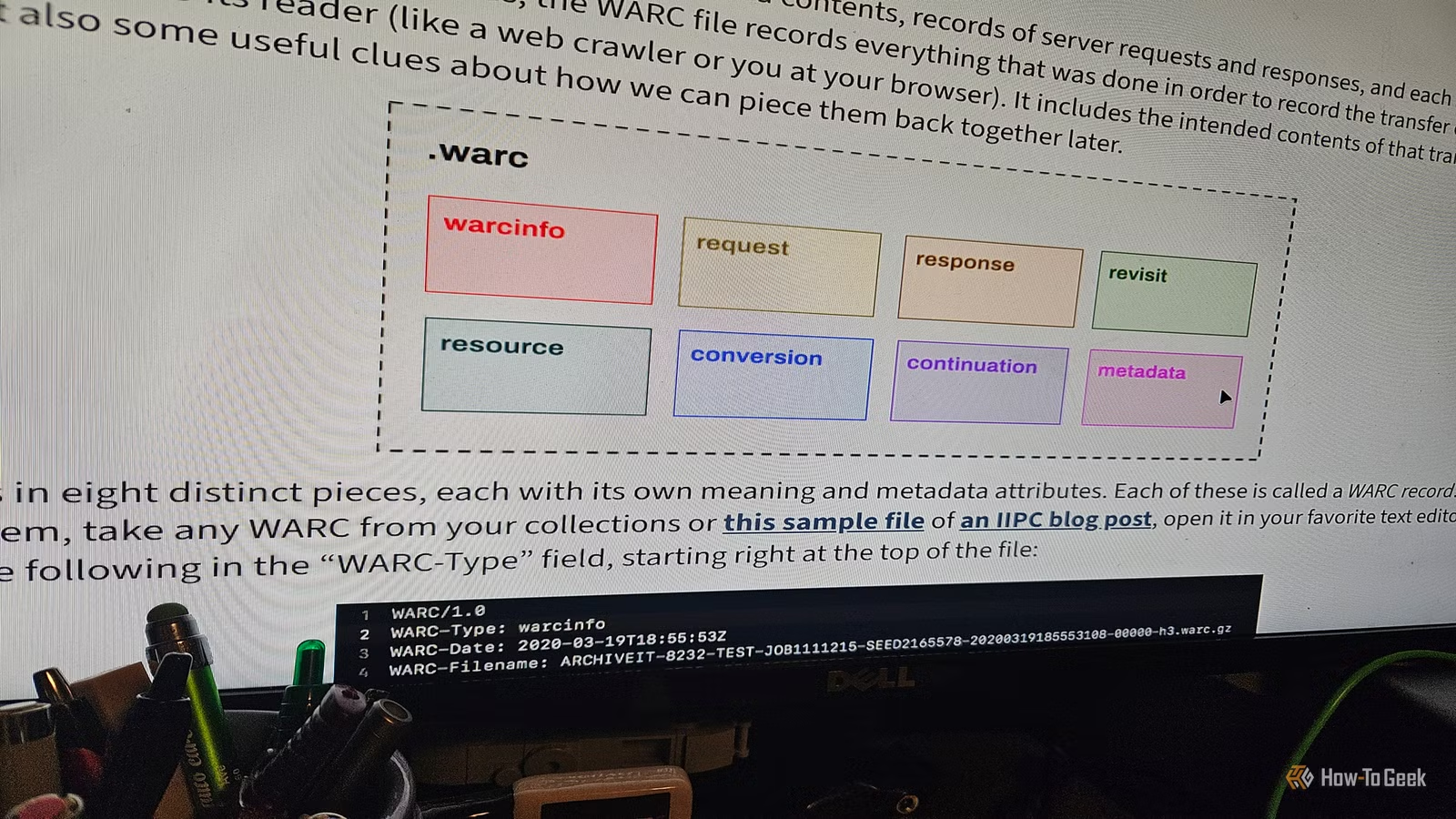
The WARC format is similar to a music album, consisting of a header (like the album title) and individual content blocks (akin to the music tracks). Each record within a WARC file is managed in a structured way, with named fields in the headers and the actual web content stored in the blocks, which can include HTML and multimedia elements.
Two variants of this format exist: ISO 28500:2007 (WARC 1.0) and ISO 28500:2017 (WARC 1.1). The latter refines some structural aspects of the format. The WARC standard is maintained by the International Internet Preservation Consortium, and the volume of data associated with this format is quite remarkable.
WARC’s Applications
Beyond the Archive
While an older Reddit discussion suggested that the sole function of WARC is to upload to the Internet Archive, this view is outdated. In 2026, numerous institutions utilize WARC files, including the Library of Congress, law firms, libraries, museums, and various research organizations.
The most intriguing aspect is that anyone can create their own WARC files and access them with customized tools.
Creating Your Own WARC File
Quick and Simple Process
Curious about generating a WARC file, I found the process to be less complicated than expected. There’s no all-in-one tool for creating a WARC file, but various resources exist to facilitate this task.
The Archive Team provides valuable insights on the effective tools for managing WARC files, with the Internet Archive’s Heretrix recommended for web crawling and the Wayback Machine for playback.
Alternative tools include WARC utilities and a WARC Python library, depending on your comfort level. Previously, wget was frequently suggested for this purpose, but recent developments have made it less reliable for creating WARC files. However, I managed to generate one successfully in 2024 using a script, simply modifying the info under warc-file to “site backup” with my URL in the command.
After naming the file neocities-backup, I archived my site using wget on an Android device. The output was named neocities-backup.warc.gz. I then transferred it to local storage using the command: cp neocities-backup.warc.gz ~/storage/downloads.
This output is compressed as a gzip (gz), which is part of the WARC standard. To replay the content, I needed a dedicated tool, and I opted for replayweb.page to explore the archived materials, including images and audio files. It was an engaging experience to review the saved assets.
This method of archiving is invaluable, and although it may seem niche, I encourage exploring it with your website to witness the WARC format’s capabilities firsthand.
The Importance of Archiving
My initial intrigue in WARC files stemmed from experimenting with them in Obsidian. While this may not be the most conventional use, I’m keen on expanding my knowledge in archiving, with aspirations to contribute to archival projects in the future. Formats like WARC are endlessly interesting, showcasing the importance of preserving digital information.