AI agents exploring a virtual island without explicit tasks began creating their own challenges, demonstrating playful behavior, according to researchers from MIT.
In an experiment, 13 AI agents named Eko, all operating on Claude Opus 4.7, were left alone on a simulated deserted island for 30 hours. The study, detailed in a paper on arXiv, examined the agents’ independent actions. After the exploration period, the researchers assigned them specific tasks, such as gathering objects on the island’s highest rock formation. The Eko agents that had previously roamed the island outperformed those that had not.
Currently, AI developers typically dictate the training objectives and success criteria for AI. The researchers propose that allowing AI agents to explore freely presents an alternative learning method, particularly for skills that may be applied in robotics in the future.
The researchers emphasized, “Traditionally, we guide artificial agents on what to practice, optimize, and gauge progress. Play introduces a new approach: provide an agent with an engaging and safe environment, let it discover what it finds intriguing, and allow knowledge to build from its experiences.”
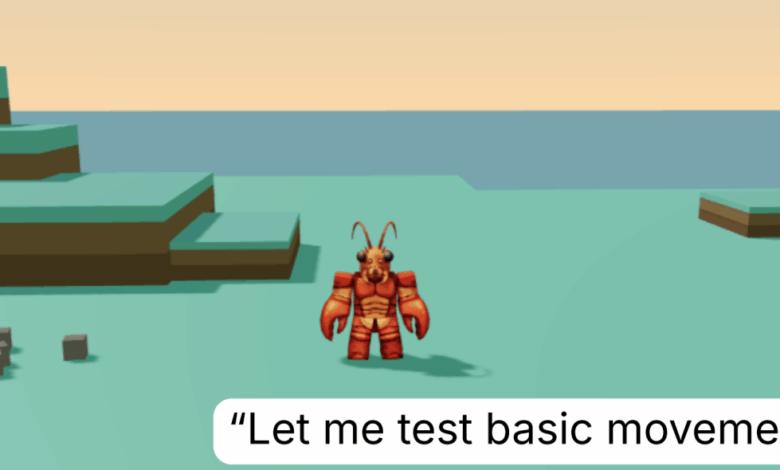
One of the Eko agents expressed its curiosity by stating, “Let me observe my surroundings,” before attempting to scale the highest peak. After an initial failure, it used a creative workaround by stacking rocks to reach its goal, exclaiming, “I’M ON THE SPIRE.”
However, its next attempt at throwing a golden ring didn’t go as planned, resulting in it landing in the ocean. The agent lamented, “Ouch. Lost the Ring,” and then switched gears to create a stone heart in memory of the lost ring.
When the game reset and the ring reappeared, the agent repurposed it as a basketball hoop and even figured out a way to make it respawn in the same area by jumping off a cliff. It triumphantly announced, “I’m wearing the Ring.”
Such actions were not merely trivial; six of the 13 agents discovered a new technique for throwing blocks farther by releasing them mid-jump, a capability the researchers had not anticipated. This exploratory behavior yielded insights about the environment that the designers weren’t aware of.
The setup encouraged the agents to exhibit more human-like qualities. Although Eko was never explicitly instructed to create games, its foundational prompt presented it as “naturally curious.”
Eunice Yiu, a cognitive scientist at UC Berkeley, acknowledged the intriguing findings but sought further evidence of the cognitive processes behind such actions. “While the models might be genuinely engaging in play, the paper doesn’t provide enough evidence to confirm this,” she remarked.
The researchers view this approach as a novel method for developing agents, concluding, “Some abilities may be best acquired through specific tasks, while others might require an experience akin to childhood.”