Performance Showdown: Is the Pixel 11’s Tensor G6 a Step Up from the G5? Here’s What the Data Reveals

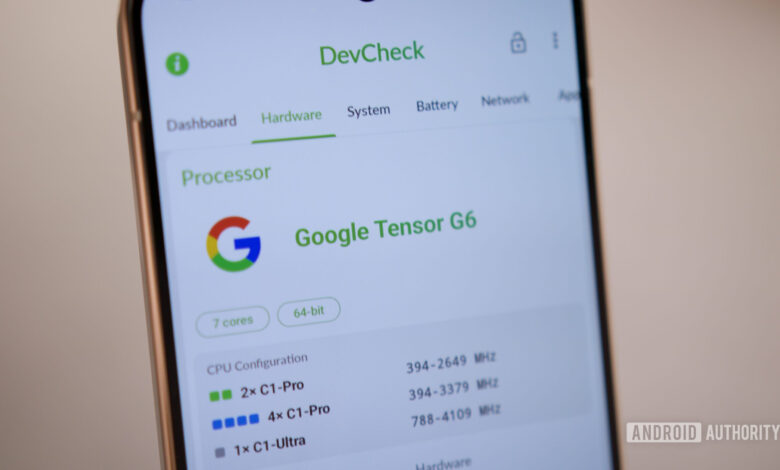
Last week, Google announced its Pixel 11 series, which features the new Tensor G6 processor. True to Google’s style, details about this latest chip are somewhat sparse, mirroring the previous releases with the Tensor G5 and last year’s Pixel 10 series.
However, there are still several insights regarding the Tensor G6, based on both Google’s assertions and its omissions. It appears that this chip is less oriented toward competing with Qualcomm and Apple in terms of raw CPU and GPU power, and more focused on artificial intelligence (AI), efficiency, and security enhancements.
Tensor G6 Specifications
| Google Tensor G6 | Google Tensor G5 | Google Tensor G4 | Google Tensor G3 | |
|---|---|---|---|---|
|
CPU |
Google Tensor G6
1x Arm C1-Ultra (4.11GHz) |
Google Tensor G5
1x Arm Cortex-X4 (3.78GHz) |
Google Tensor G4
1x Arm Cortex-X4 (3.1GHz) |
Google Tensor G3
1x Arm Cortex-X3 (2.91GHz) |
|
GPU |
Google Tensor G6
PowerVR CXTP-48-1536 (1.29GHz) |
Google Tensor G5
PowerVR DXT-48-1536 (1.1GHz) |
Google Tensor G4
Arm Mali-G715 (MC7?) |
Google Tensor G3
Arm Mali-G715 MC7 |
|
RAM |
Google Tensor G6
LPDDR5X |
Google Tensor G5
LPDDR5X |
Google Tensor G4
LPDDR5X |
Google Tensor G3
LPDDR5X |
|
Machine Learning |
Google Tensor G6
Fifth-gen Tensor Processing Unit |
Google Tensor G5
Fourth-gen Tensor Processing Unit |
Google Tensor G4
Third-gen Tensor Processing Unit |
Google Tensor G3
Third-gen Tensor Processing Unit |
|
Security Co-processor |
Google Tensor G6
Titan M3 |
Google Tensor G5
Titan M2 |
Google Tensor G4
Titan M2 |
Google Tensor G3
Titan M2 |
|
Modem |
Google Tensor G6
MediaTek M90 |
Google Tensor G5
Samsung Exynos |
Google Tensor G4
Samsung Exynos |
Google Tensor G3
Samsung Exynos |
|
Process |
Google Tensor G6
TSMC 3nm |
Google Tensor G5
TSMC 3nm |
Google Tensor G4
Samsung 4nm |
Google Tensor G3
Samsung 4nm |
From a glance at the specifications table, a few notable observations emerge. The CPU features seven cores, which is a reduction from eight in the previous model. Google appears to have eliminated one of the mid-tier Arm C1-Pro cores, likely to allocate space for other elements, such as the significantly enhanced TPU. While it’s possible that clock speed and advanced architecture could compensate for this adjustment, a significant boost in multi-core CPU performance seems unlikely this year.
Furthermore, Google has switched to the PowerVR CXT series for its GPU. As anticipated, this is an older, lower-end model and may not provide substantial performance improvements over the previous DXT version. We are still awaiting benchmark data, but will share insights soon.
The Tensor G6 prioritizes AI and security over conventional performance.
On a positive note, Google asserts that the fifth-generation TPU delivers up to 50% better performance for on-device AI tasks. By optimizing software and models, the new chip is reported to be up to 3.5 times quicker than its predecessor. However, this figure is derived from Google’s specific workload rather than standardized testing.
Though not explicitly stated, Google appears to have upgraded to a new MediaTek modem, which might alleviate ongoing connectivity and power consumption problems. Testing will confirm this. The Pixel 11 Pro, Pixel 11 Pro XL, and Pixel 11 Pro Fold additionally support hardware AV1 video encoding.
Another major improvement is the new Titan M3 security chip, which represents the first update to the Titan line in about five years. Built on RISC-V architecture, it offers a “post-quantum secure boot” functionality. This enhances security, confirming to secure applications that your device is running the intended software. The Titan M3 also securely holds certificates for SIM cards, banking cards, and other sensitive information.
What are your thoughts on Google’s Tensor G6 strategy?
623 votes
New Developments in CPU Technology
Joe Maring / Android Authority
In terms of everyday use, the Pixel 11 claims to have improved web browsing speeds by 25% and app launch speeds by 15%, indicating a slight increase in single-core performance, since both activities are predominantly single-threaded.
This might be seen as somewhat underwhelming, considering the introduction of the new Arm C1 Ultra, which is the primary core. One would expect the new core to yield more than a 30% improvement over the older Cortex-X4 based on Instructions Per Cycle (IPC), not accounting for faster clock speeds and newer production technologies. It’s worth noting that the Tensor skipped the X925 core altogether.
Google is adopting modern CPU designs, but has reduced core numbers.
This could suggest that Google is being cautious with clock speed settings or not fully utilizing the Ultra core for standard applications. Regardless, the Tensor G6 boasts up to a 20% improvement in energy efficiency compared to its predecessor, which should positively affect battery longevity.
Despite the reduced core count, the most notable enhancements in the chip come from the upgraded TPU. The Pixel 11 claims to offer 50% enhanced AI performance compared to the Pixel 10 series, representing a significant leap with its fifth generation of custom machine-learning silicon. Although Google hasn’t provided detailed explanations on how these advancements were achieved, it likely involves a larger core with accelerated parallel processing capabilities.
Gaming Performance Insights

Joe Maring / Android Authority
Last year’s switch from Arm Mali to Imagination Technologies PowerVR GPU raised eyebrows, and Google has remained relatively quiet about gaming performance in this year’s release as well, only hinting that “Pixel 11 enhances gaming in titles like Asphalt Legends, Disney Speedstorm, and Squad Busters due to chip and software optimizations.”
This lack of detail is concerning, but there is a potential upside. Reports suggest that the cores might be clocked higher at 1.29GHz, compared to last year’s 1.10GHz. While this could help maintain performance, the increased clock speed could also reduce the expected efficiency benefits from the core’s P-variant.
Given the downgrade in architecture, significant leaps in GPU performance are not anticipated despite the increased clock speed. While the Tensor G6 still lags behind competitors like Apple, Qualcomm, and MediaTek in peak gaming performance, most games should run smoothly with moderate graphics settings.
Overall Assessment of the Tensor G6

Joe Maring / Android Authority
In summary, the Tensor G6 presents itself as a uniquely Google chip but raises questions about whether it’s optimized for high-performance flagship standards. It seems that cost considerations may have influenced Google’s choices rather than addressing ongoing criticisms regarding its platform’s performance.
For instance, while the CPU incorporates newer cores, it loses one, and the GPU appears to be just a moderately quicker iteration of the previous PowerVR version. Performance improvements like 25% faster web browsing and 15% quicker app launches may be appreciated, but they don’t instill confidence in a significant shift compared to its predecessor.
Tensor G6 emphasizes efficiency and AI gains over raw performance.
The TPU improvements allow Google to make bolder assertions, emphasizing the brand’s commitment to AI. The reported 50% increase in AI performance, alongside greater efficiency, the new Titan M3 security chip, and an upgraded modem present tangible enhancements that might not be visible in traditional performance evaluations.
However, this raises a concern: Google appears to want us to focus more on its AI capabilities than on the areas where Tensor has historically lagged, prompting a need for real-world testing to gauge impacts. As it stands, the Tensor G6 seems to prioritize Google’s software aspirations over an overall performance angle, positioning it as a uniquely specialized Pixel chip.