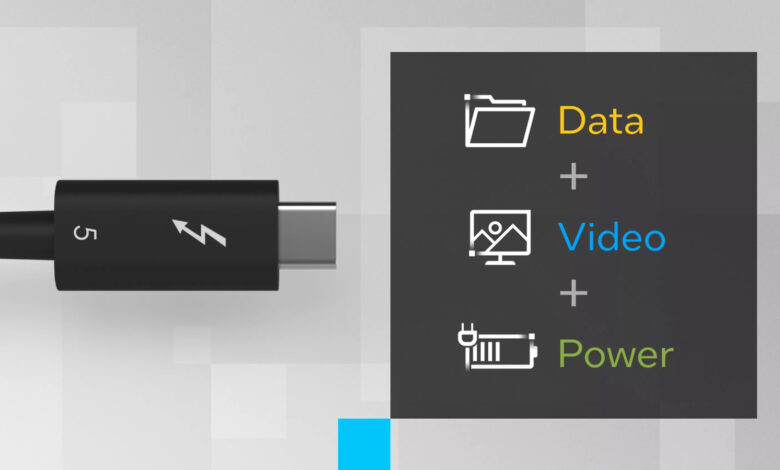
Thunderbolt may resemble USB-C, but there’s much more beneath the surface.
Thunderbolt cables are not only rapid and versatile but also pricey. The latest version, Thunderbolt 5, can be significantly more expensive than standard USB-C cables. Given their identical ports, the stark price difference may raise questions. Here’s a brief explanation.
The advanced technology inside

Each Thunderbolt cable contains sophisticated technology. Thunderbolt 5 can achieve a staggering 80 Gbps of bidirectional data transfer, and in boost mode, it can hit 120 Gbps while receiving 40 Gbps. This speed can transfer 1TB of data in just a few minutes, whereas using USB 2.0 could take hours. Meanwhile, Thunderbolt 4 offers a solid 40 Gbps.
Certified Thunderbolt 5 cables support 140W charging, with some enabling up to 240W via USB Power Delivery. In comparison, Thunderbolt 4 cables typically support up to 100W.
If you’re looking for a single cable to handle data and power, Thunderbolt is the solution. However, due to the high speeds, even slight interference can disrupt the signal. As a result, longer cables often utilize “active” technology, incorporating integrated circuits to maintain signal integrity over distance. This includes retimer chips that enhance and refresh the signal as it travels.
Though the cable carries the signals, the Thunderbolt controllers in connected devices handle the heavy tasks. The cable must be designed to transmit these signals faultlessly.
Comparatively, many basic USB-C cables only support USB 2.0 speeds, while USB 3.2 Gen 2 maxes out at 10 Gbps, which suffices for simple tasks but is nothing compared to Thunderbolt’s capabilities.
Thunderbolt 5 can connect to multiple 8K displays or high-refresh-rate gaming monitors (up to 540Hz), and it also supports DisplayPort 2.1 and PCI Express Gen 4, making it suitable for external GPUs (eGPUs) and high-speed SSDs. Moreover, Thunderbolt cables can daisy chain multiple devices, explaining part of their higher costs.
Things become murkier with USB4, which is partly built upon Thunderbolt 3 technology. USB4 can reach 40 Gbps, parallel to Thunderbolt 4, and USB4 V2 can hit 80 Gbps, similar to Thunderbolt 5. The main distinction comes next.
Certification costs
Thunderbolt is overseen by Intel, which developed the standard in collaboration with Apple. The first consumer cable appeared in 2011. Intel ensures that any cable labeled with the Thunderbolt name must pass a demanding certification process, which contributes to retail prices.
This certification confirms that cables meet their advertised speeds, charge safely at the specified wattage, and maintain backward compatibility.
While you can find unofficial cables that might perform comparably, they lack the guarantee that comes with Intel’s testing. If you’re not in need of the full Thunderbolt capabilities and are seeking to save, a reputable USB4 cable could meet your high-speed data and charging needs.
The pricing dynamics
Most users only require standard USB-C cables. Contrary to what enthusiasts might assert, the average consumer doesn’t need to run multiple high-resolution displays or attach eGPUs. This creates a market filled with slower, simpler cables suited for basic charging and data transfers, which are cheaper due to higher demand and manufacturing efficiencies.
When you combine these economic factors with Thunderbolt’s advanced technology and certification costs, the reasoning becomes clearer. Now, you’re better informed about the significant price difference if you opt for the faster, versatile cable adorned with the lightning logo.