YouTube Music Unveils Innovative Labels Amid Surge of AI-Generated Sounds on Streaming Services

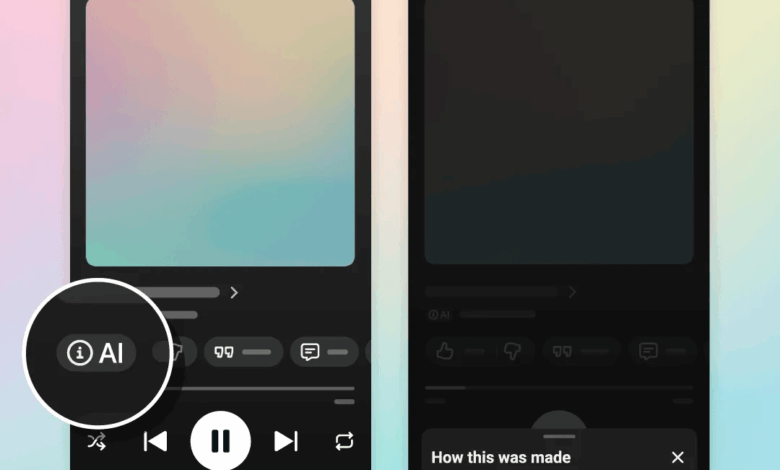
On Wednesday, YouTube Music revealed a new labeling initiative designed to enhance clarity regarding songs produced with generative artificial intelligence. This update will enable listeners to easily recognize tracks developed with AI technology, including contributions to both composition and vocals.
The new label will be visible on the player page, and clicking on it will provide further details about AI’s specific contributions to the song’s development.
Importantly, these labels will also be incorporated into the main YouTube application.
YouTube has collaborated with numerous music industry partners and employed its own detection methods to identify AI-generated music. According to their support documentation, creators using YouTube can declare their music’s relationship with generative AI through three distinct categories: Fully Gen AI, Partly Gen AI, or No Gen AI.
“Fully Gen AI” is designated for tracks entirely produced by AI, whereas “Partly Gen AI” applies to works where artists have integrated AI-generated elements alongside live contributions. Tracks that utilize pitch-correction software such as Auto-Tune fall into the “No Gen AI” classification.
This initiative comes at a time when AI-generated music is on the rise across various streaming platforms, each adopting its own distinct strategies. For example, Apple Music plans to roll out “Made With AI” labels as part of its upcoming AI Transparency Tags later this year. Spotify has also implemented labels for AI content along with a spam filter for music.
Deezer has taken a firmer approach, disclosing in July that it was witnessing almost 90,000 entirely AI-generated submissions per day. The platform actively labels this content, excludes it from algorithm-driven recommendations and curated playlists, and refrains from paying royalties on fraudulent streams. They are also developing a feature that allows users to filter out AI-generated music entirely.
TIDAL similarly identifies tracks as fully AI-generated, permits listeners to opt out of these recordings, and excludes them from royalty calculations.
In contrast, YouTube emphasizes transparency over outright bans. Their new labeling system aims to educate listeners about the role of AI in music creation without rendering AI-influenced tracks ineligible for monetization. YouTube is also exploring AI in music composition, including their Dream Track tool, which enables selected creators to generate soundtracks featuring AI-rendered versions of the artists’ voices.