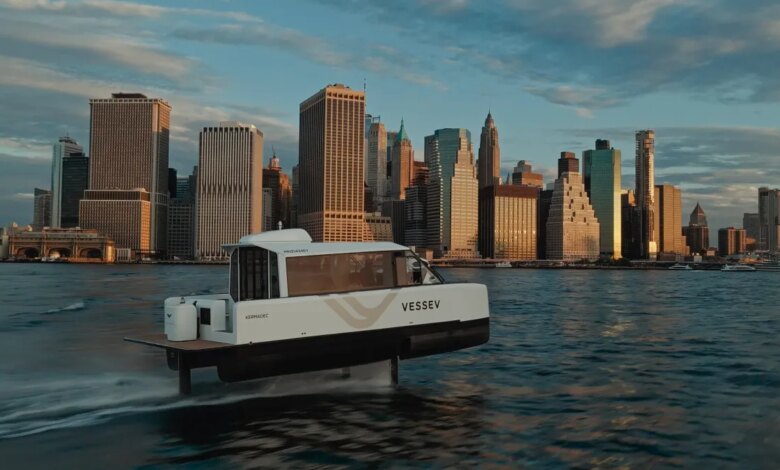
“When will we start flying?” I inquired of Eric Laakmann, the co-founder and CEO of Vessev, as we departed from a marina in Brooklyn aboard the startup’s VS-9 electric ferry. “We already are,” he replied.
To be honest, I felt a hint of disappointment. I had imagined that the transition from typical boat sailing to the almost airborne sensation of hydrofoiling would be a more exhilarating experience.
Having traveled on various boats, ranging from large ferries to small sailboats, I was eager to experience what it would feel like to glide over the water on a hydrofoil during a quick voyage from Brooklyn Marina to Governors Island across the East River in New York.
However, instead of the feeling of flight, it felt more akin to cruising in a high-performance sports car.
Traditional vessels of comparable size—around 30 feet—begin to bounce and create noise as they accelerate. In contrast, a hydrofoil begins to work at that moment.
At first glance, the VS-9 appears similar to other catamarans. However, beneath its hull are two wing-like structures that lift the vessel as they cut through the water. Computerized underwater flaps ensure a smooth and stable ride. In the case of the VS-9, the front foil is responsible for most of the lift—about 80%—while the rear foil contributes the remaining 20%.
The rear foil also houses the electric motor, which Vessev manufactures in-house. Why not rely on outsourcing? Laakmann explained that keeping costs manageable is crucial; they would eventually need to bring production in-house, so it makes sense to do so early in development. The only components Vessev does not produce are the batteries, which Laakmann referred to as “commoditized.”
By lifting the hull above the water, hydrofoils operate with greater efficiency than conventional boats. This is particularly significant for electric vessels, where conserving every kilowatt-hour is essential.
For more than a century, shipbuilders have explored hydrofoil designs, benefiting from lower drag and enhanced ride comfort. The unassuming shift I experienced aboard the VS-9—transitioning from sailing to nearly flying—highlighted just how smooth a hydrofoil can be.
Despite their advantages, hydrofoils aren’t without limitations. This design functions best in water depths sufficient for the boat to sail on its foils—approximately 2.5 feet or 0.75 meters for the VS-9. If waves exceed this height, they start to impact the hull, compromising the smoothness of the ride and diminishing efficiency. While hydrofoils may not be suitable for open ocean conditions, they are ideal for lakes, rivers, and bays.
Vessev, which secured $19 million in Series A funding last August, is initially targeting transit operations. Laakmann believes that the synergy of electric propulsion and hydrofoils can reduce operational costs for smaller vessels while enhancing comfort, making them viable additions to urban mass transit systems.
For cities like New York, such vessels could facilitate quick transport to areas like Brooklyn or Queens without necessitating extensive new infrastructure.
Hotels and tour operators are also potential early adopters of this technology, and public demonstrations, like the one I attended, have gathered interest from affluent individuals seeking luxury experiences, Laakmann noted.
Currently, the version of the VS-9 I experienced is unique, but Laakmann indicated that Vessev plans to construct additional units. In the future, the company may even pivot to produce electric hydrofoil kits, enabling other boat manufacturers to create their own vessels based on this innovative technology.