Many Linux distributions are designed with practical purposes in mind, aiming to enhance user experience by making computing simpler, safer, or faster. However, there are instances where the community displays creativity—or perhaps mischief—by developing operating systems with unusual intentions. In my quest to find the most peculiar Linux distros, I’ve come across some remarkably strange options.
Suicide Linux
A humorous idea that turned serious (and shouldn’t have)
This entry might not qualify as a distro in the traditional sense, but hear me out. Suicide Linux originated as a humorous concept in 2009, introduced by programmer qntm. The core idea was a startling thought experiment: What if Linux transformed every erroneous command into the devastating “rm -rf /”?
The implication was simple yet terrifying. Anytime a command was mistyped, the system would interpret it as an instruction to erase everything on the hard drive. Just one misplaced character would lead to total data loss—an exciting yet morbid idea.
qntm framed it as a game—the challenge being how long one could operate the computer without losing all data. He admitted the idea had no technical basis, which is a big part of its appeal, as it resonates with a fear familiar to many Linux users, who’ve perhaps had close calls of their own in the terminal.
Clarification arrived in 2015: the autocorrect function described was not a feature of standard Linux. Yet, the fascination with the concept led to a Debian package’s creation by December 2011. However, the results were less thrilling than anticipated—the system didn’t perform with grand error messages; instead, it quietly self-deleted.
A user on GitHub, known as tiagoad, later developed the idea into a Docker image. This container typically ensures your local files remain safe, although it offers a “danger mode” that can mount your host filesystem. A mere typo here could have significant consequences. The inspiration for the concept also led to various iterations, one being Unalive Linux which began in 2025, gradually corrupting functionality with a series of harmful commands.
In practical terms, Suicide Linux serves little purpose. However, for those who thrive on risk or enjoy pushing boundaries, it may provide a unique experience.
Red Star OS
North Korea’s Mac-inspired OS built for surveillance
While Suicide Linux is humorously dangerous, Red Star OS poses threats of a different magnitude. As a political science enthusiast, I was both eager and apprehensive to test this system; it proved to be the most challenging of the three to run. This is North Korea’s official operating system, based on Fedora and designed to mimic Mac OS X visually—an aesthetic choice that notably changed with Version 3.0 in 2019, moving away from the previously Windows XP-inspired Red Star 2.5.
Beneath this familiar interface lies a system meticulously crafted for control. Security researchers revealed concerning features such as a watermarking system that tags every document and media file, whether accessed or not. During initial tests, inserting a USB with a DOCX altered the file’s checksum, indicating the watermarking incorporates hardware data like disk serial numbers.
This system was implemented to combat unauthorized sharing of foreign media, enabling authorities to trace files back to their origin on Red Star devices. The software also has the capability to recognize and delete unwanted files, and if a user attempts to disable security features, the OS simply reboots itself.
Despite this sophisticated technology, there’s uncertainty about how widespread Red Star OS is within North Korea, as reports suggest many local computers still operate on Windows XP. Nonetheless, it effectively illustrates how open-source code can be manipulated for strict control.
Among the distributions discussed, this is one I would recommend against installing. It’s laden with potential malware typical of a North Korean software product, so taking precautions like disabling all network access if you choose to experiment with it would be wise.
Hannah Montana Linux
The pink Kubuntu themed meme that persists
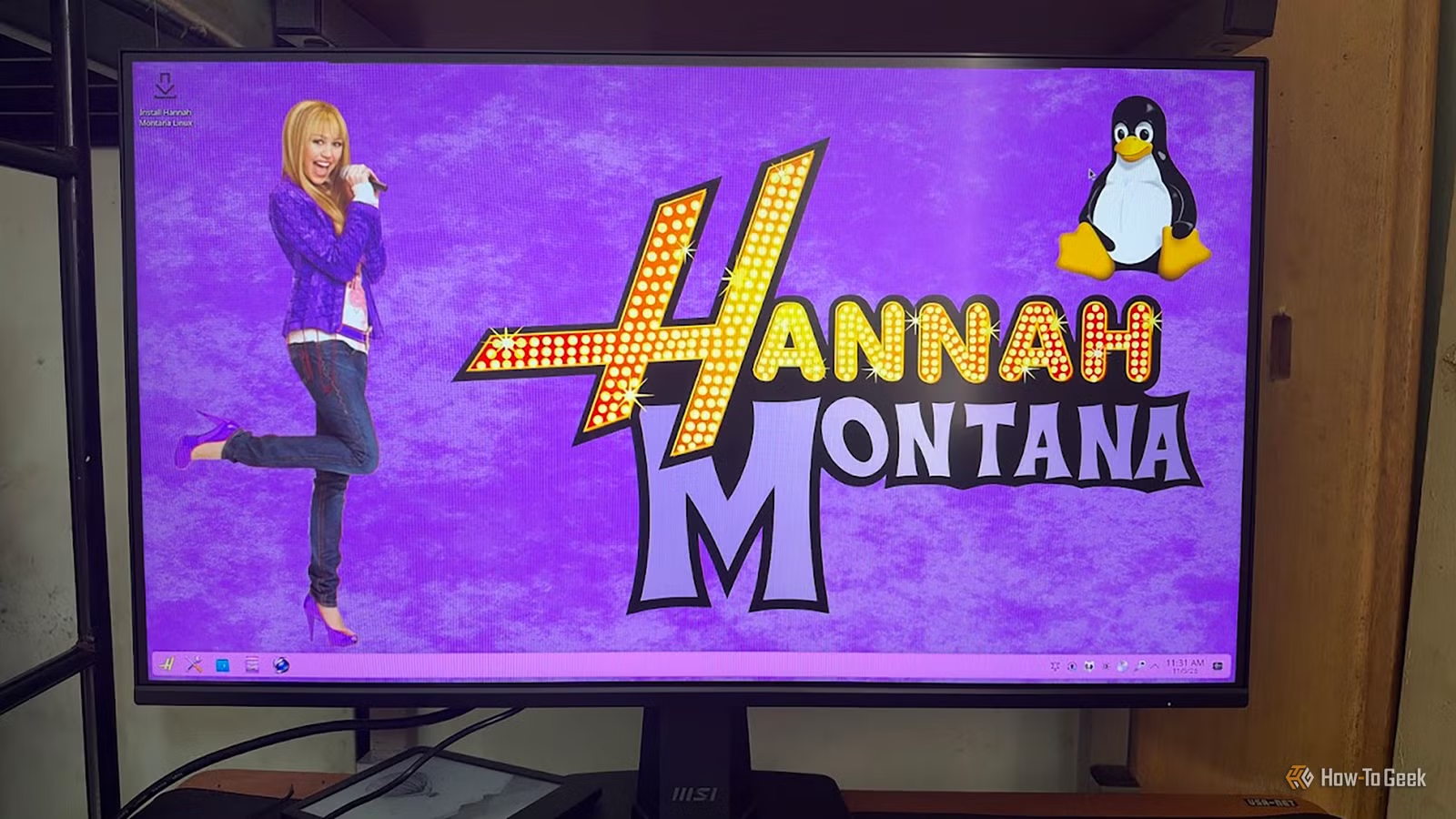
Not every odd Linux distro is inherently harmful; some are just perplexing. Hannah Montana Linux, for example, emerged in 2009, built on Kubuntu 9.04 and KDE 4.2, wrapped in vibrant Disney branding. Its creators aimed to attract young users to Linux, marketing it as fast, stable, and capable—qualities that were accurate, as it was fundamentally a version of Kubuntu.
While the changes were primarily cosmetic, they were extensive. The distro featured a themed boot sequence, login interface, icon set, color scheme, and wallpapers, with half of the Oxygen icons tinted pink or purple. Crucially, it utilized the same foundational tools as any other Kubuntu, allowing it to run compatible packages. In essence, it was a fully functional system dressed in excessive flair.
What truly sets Hannah Montana Linux apart isn’t what it accomplishes, but rather its remarkable journey. Little is documented about its initial development or subsequent abandonment, yet it became a longstanding joke within the Linux community—a common response when someone inquires about which distro to use.
This joke transformed in 2026 when developer Noah Cagle released Hannah Montana Linux v26.0, a modern remaster based on Debian and featuring a reimagined KDE Plasma desktop. The new version includes an updated wallpaper based on the original 2009 design, resized for modern displays, complete with a recreated glitter effect, and employs the contemporary Calamares installer.
The project documentation clearly indicates that the version is essentially a reskin of Plasma based on altered Breeze themes, advising users not to view it as a serious operating system. However, nearly two decades later, this quirky distro runs on a modern kernel, which is remarkable in itself.
The creative freedom of Linux knows no bounds
The openness of Linux is its most commendable aspect, and these three distributions exemplify that. Each serves as a unique reflection of the platform’s versatility, demonstrating that Linux can embrace both the bizarre and the serious.