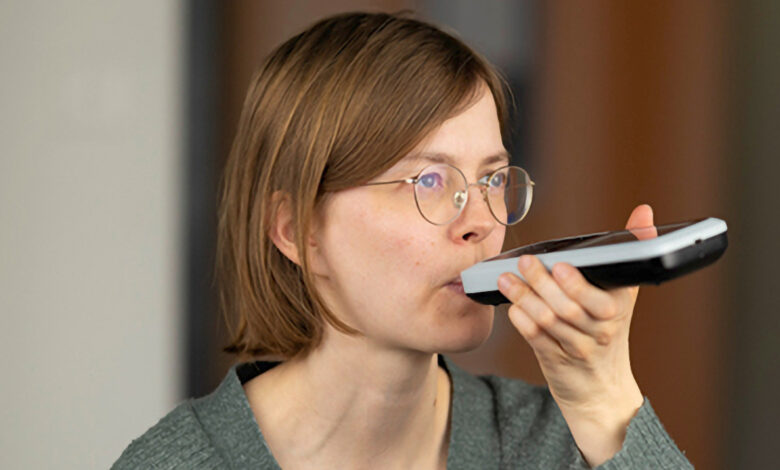
A new breathalyzer measures acetone in your breath to check if your body is in a fat-burning state.
While many smart devices, such as scales and smartwatches, estimate body fat using bioelectrical impedance, it offers a quick but sometimes imprecise assessment of body composition. In contrast, accurately gauging when the body transitions to burning fat is more complex, making recent advancements in a handheld device for this purpose particularly exciting.
In research published in the journal Device and highlighted by New Scientist, a team led by Andreas Güntner has developed a handheld breathalyzer that detects fat burning by assessing acetone levels in the breath. The study involved 12 participants and tracked their fat-burning states across various dietary and exercise situations, demonstrating that the device’s readings closely aligned with conventional laboratory results.
Ketosis, the metabolic state where fat is used for energy, can be identified by measuring either blood ketones or breath acetone—both of which are byproducts of fat metabolism. As noted by New Scientist, acetone testing usually yields the most reliable results in controlled lab environments where factors like humidity and breathing patterns are monitored. The research team addressed these challenges by engineering a breathalyzer that minimizes moisture and impurities, supported by a companion app that guides users through the required breathing technique. The app can help users modulate their breath pressure and timing to ensure the measurement closely reflects what would be observed through blood tests.
The device, named Nutrion, operates on principles akin to an earlier device called Lumen, which aimed to track fat burning through carbon dioxide output instead of acetone. Regardless of the method, regular metabolic assessments could be beneficial in various health contexts, from evaluating the effectiveness of GLP-1 treatments to helping athletes optimize their metabolic rates.