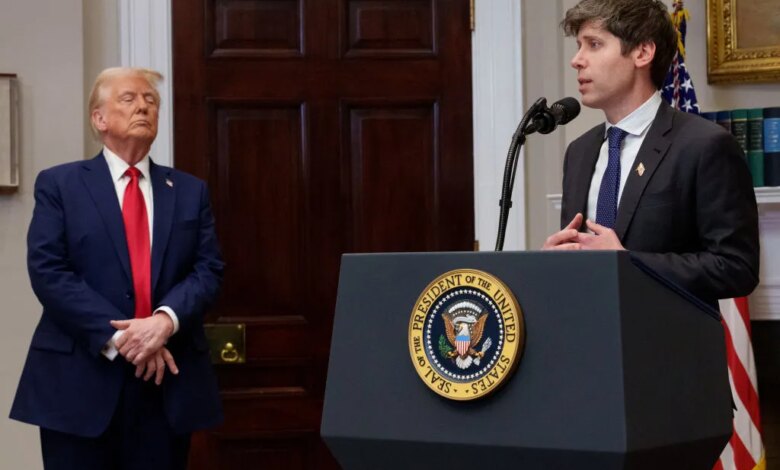
Sam Altman, CEO of OpenAI, has suggested allocating 5% of the company’s shares to a U.S. sovereign wealth fund, as reported by the Financial Times on Thursday, based on insights from two sources. This initiative would also encourage other AI firms to contribute similar equity amounts, although many details remain unclear.
The purpose of this proposed donation is to foster positive relations with the government and to mitigate any political backlash, according to the FT.
In June, CNBC reported on analogous discussions, which were later acknowledged by former President Trump. He mentioned exploring ideas where segments of equity could be shared with the American populace, effectively transforming them into stakeholders in these companies. However, no specific figures regarding the equity stakes had been disclosed at that time.
These discussions are still in the early phases, and, as stated by the FT, any formalized steps would likely need approval from Congress, adding layers of complexity to the initiative.
Altman has also publicly floated the concept of a public AI fund, with OpenAI becoming more specific in its proposals for how such a fund might operate. Most notably, a policy document titled “Industrial Policy for the Intelligence Age,” issued by OpenAI in April, advocated for a public wealth fund that would invest directly in AI laboratories and companies implementing AI advancements.
According to the document, “Returns from the Fund could be distributed directly to citizens, enabling broader participation in the economic benefits of AI-led growth, regardless of one’s initial wealth or capital access.”
A bolder version of this policy was introduced by Senator Bernie Sanders (I-VT) in June, proposing a one-off 50% tax on the stock of AI firms. The shares garnered from this tax would be redirected into a public wealth fund. This legislation, dubbed the American AI Sovereign Wealth Fund Act, would target all “systemically significant” AI companies, including those involved with data centers, infrastructure, or robotics. Under this proposal, companies like Google and SpaceX that incorporate AI as a partial aspect of their operations would be permitted to separate their non-AI divisions to evade taxation.
As of now, the bill has yet to move forward in committee.