U.S. data centers consume between 17 to 19 billion gallons of water annually for cooling purposes, a figure projected to triple within the next five years, according to the Water Foundation.
This situation presents a costly and politically sensitive challenge for investors who are pouring substantial funds into the expansion of AI. One solution to reduce water usage lies in improved monitoring of cooling fluids, currently a time-consuming process that requires samples to be sent to laboratories for multi-day testing.
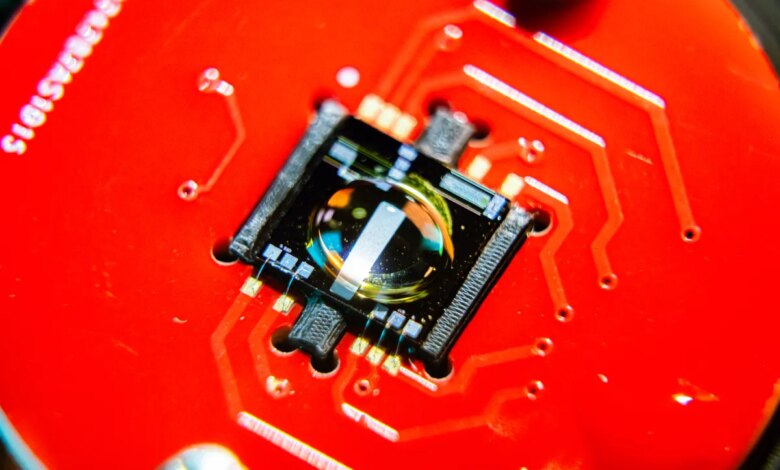
In response to this challenge, Omen AI was established in 2024. The company is developing a real-time sensor that can detect valve failures or bacterial growth that could impede water flow. After securing $31 million in a Series A funding round in June, Omen is now entering into an acquisition of rival Aquatic Labs for $16 million in cash and stock.
The acquisition materialized after Omen’s founder, Zach Laberge, was introduced to Aquatic Labs’ CEO Allan Adams through an investor within the filtration industry. Both startups had been working on real-time water sensors that utilize complementary technologies: Omen focuses on identifying elements in the water, while Aquatic Labs measures its alkalinity.
Combining these technologies into one sensor will provide a “much richer picture of the water and the fluid,” as Adams explained, while also streamlining the automation of what has traditionally been a slow, manual process.
This merger joins two distinctive types of founders: Laberge, who left high school to launch his first company specializing in fluid analysis for hydraulic-dependent construction machinery, and Adams, an academic with a physics background who dedicated his career to the development of advanced ocean sensing technologies as a professor at MIT and a researcher at the Woods Hole Oceanographic Institute before founding his startup.
With Adams now serving as the chief science officer, the merged teams are focusing on integrating their technologies into a unified sensor, anticipated to enter the market by early next year. Omen’s initial sensors are expected to monitor chips consuming between 250 to 300 MW of power by the year’s end, valued at around $5 to $7 billion, with plans to be implemented on the equivalent of 1 GW of chips by the conclusion of 2027.
The significant advantage lies in operational uptime: When fluid systems are malfunctioning, data center operators often resort to draining the water to prevent damage to their costly equipment, causing costly downtimes. Continuous monitoring allows operators to utilize the same fluid over extended periods, thus reducing cleanup expenses.
Adams envisions that their technologies could also extend beyond data centers. He remarked that “water enters data centers, gets treated, and is then discharged into municipal water systems; ensuring this entire process is safe and responsible requires proper measurement.”
While AI companies once projected a $4 trillion expenditure on AI infrastructure by 2030, some investors have recently expressed doubts about this outlook, leading to significant drops in hyperscaler stocks. Nevertheless, the Omen team remains unfazed by changing perceptions, as their efforts target facilities post-construction.
“We’re engaging with clients on projects they’re currently building or have already completed, which insulates us from current market fluctuations since these ventures were financed a year ago,” Laberge stated. “We believe that, even with potential tightening, this remains one of the largest markets in human history, even if it were to be halved.”