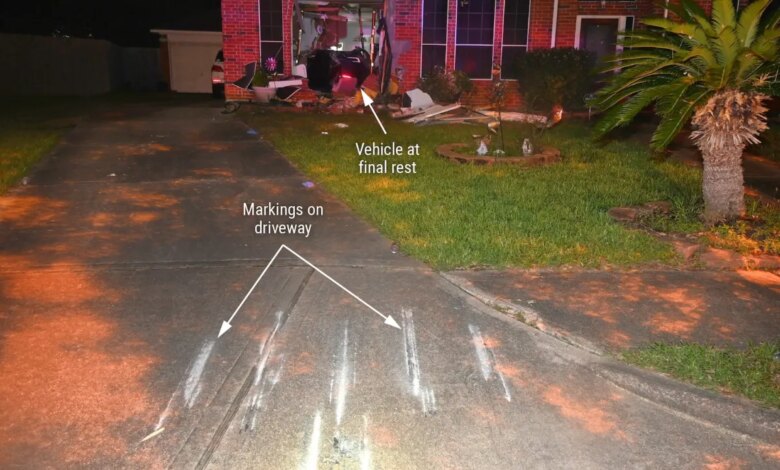
On Wednesday, the National Transportation Safety Board (NTSB) revealed that the driver involved in a June crash, which resulted in a Tesla colliding with a home, had pushed the accelerator to its maximum, bypassing the vehicle’s Full Self-Driving (Supervised) system.
Data retrieved from the vehicle indicated it was traveling over 70 miles per hour when it struck a residence in Katy, Texas, leading to the death of 76-year-old Martha Avila. The victim’s family has filed a lawsuit against the 44-year-old driver, Michael Butler, and Tesla, citing negligence. Butler faces manslaughter charges as well.
This information was disclosed in a preliminary report as part of the ongoing investigation by the NTSB, which is also being examined by the National Highway Traffic Safety Administration.
The findings align with Tesla’s initial statements following the incident, where the company aimed to clarify that its advanced driver assistance technology was not responsible for the crash. Tesla CEO Elon Musk commented on social media shortly after the incident, emphasizing that the claim against the technology was illogical, as the Full Self-Driving system is designed to operate cautiously in residential areas.
According to the NTSB, Butler was utilizing the Full Self-Driving (Supervised) feature on Rose Hollow Lane, a residential street that has a speed limit of 30 miles per hour, before the accident. Surveillance footage captured by investigators outlined the vehicle accelerating through an intersection, veering off the road, and colliding with the home. Conditions at the time were noted as clear, with a dry road and daylight.
Tesla mandates that drivers using the Full Self-Driving (Supervised) feature remain attentive and ready to take control when necessary. Butler reportedly told authorities that he had “passed out” while utilizing the assistance system. Further investigations revealed his internet search history included queries about Tesla’s driving behavior, suggesting dissatisfaction with the system’s responsiveness.