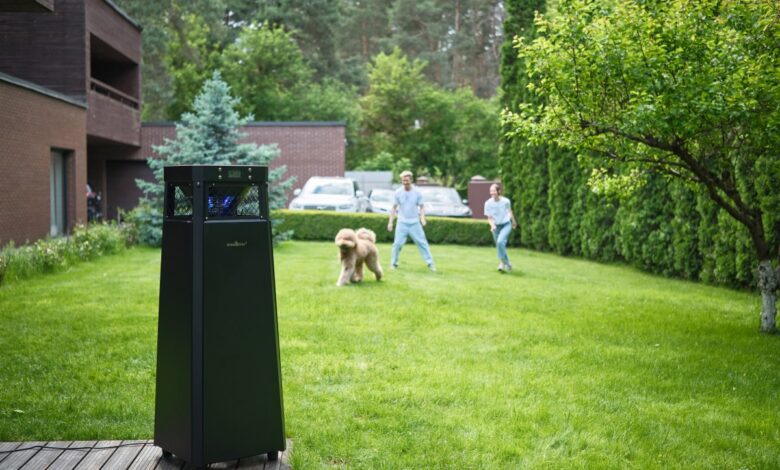
The spread of mosquitoes and the diseases they transmit is encroaching into new regions. Factors like rising temperatures, altered rainfall patterns, and increased global travel are transforming the habitats where these disease-carrying mosquitoes can flourish, according to the World Health Organization. The number of global dengue cases has surged dramatically, jumping from 6.5 million in 2023 to an unprecedented 14.6 million in 2024.
A startup based in Pennsylvania, called Mosqitter, believes that addressing this issue requires more than just exterminating mosquitoes. They have developed chemical-free devices that attract and trap female mosquitoes by simulating human heat, scent, and breathing patterns.
Anastasiia Romanova, the co-founder and CEO of Mosqitter, emphasized that their mission is to provide more environmentally friendly mosquito control solutions in a market still heavily dependent on chemical methods. Romanova noted that the company’s devices are now operational in over 5,000 locations across five continents, a significant increase from just over 250 devices in 2022. The startup aims to evolve its traps into an AI-driven monitoring system to identify mosquito species, monitor population changes, and provide early alerts regarding potential disease threats.
Founded in Ukraine in 2019 and launching its business officially in 2021, Mosqitter initially focused on understanding mosquito behavior. Female mosquitoes, which are the only ones that bite, search for blood to lay their eggs, typically depositing 100 to 200 eggs every three weeks.
“We recognized an opportunity: if we could capture the female mosquito right before she lays eggs, we could effectively reduce their population and hinder its growth,” Romanova explained. “We incorporated heat, similar to human skin temperature; scent that mimics human odors; and light. Our Grand model, which is our premium version, also includes CO2 to replicate human breathing.”
During their presentation at TechCrunch’s Startup Battlefield in San Francisco, Mosqitter demonstrated how they leverage AI to identify caught mosquitoes. Their computer vision system examines biological traits to categorize different species, as shared by Romanova.
The identification process involves passing an image through a neural network, cross-referencing with existing datasets, and having entomologists verify the results. A confidence score is then generated based on alignment with these evaluations.
“You can think of it like three judges reviewing a case and coming to a decision,” Romanova said.
Furthermore, Mosqitter incorporates environmental metrics—such as weather conditions, wind patterns, and humidity—into their data analysis. They assert that as they amass more data, they will be able to predict shifts in mosquito populations and associated health risks.
Currently, Mosqitter’s product range includes two devices: Mosqitter Grand, intended for larger public spaces, and Mosqitter Mini, which caters to smaller residential areas and can serve as a portable monitoring device. Next month, the startup plans to unveil its Febris Monitoring System, enhancing monitoring capabilities for mosquito populations and assessing potential disease propagation.
“It’s crucial to note that Febris does not diagnose diseases,” Romanova clarified. “We cannot definitively state whether a specific mosquito carries dengue. However, we can identify particular species, which helps gauge the risk of the diseases they may transmit.”
The company is seeking B2B partners worldwide, especially distributors with established networks connecting to governments and retail sectors, according to COO and co-founder Olga Diachuk. Unlike Mosqitter’s hardware, Febris primarily targets institutional clients such as government bodies, public health agencies, and municipalities requiring continuous mosquito surveillance.
Brazil, a country significantly affected by dengue, is an example of Mosqitter’s geographic expansion, as they have established local manufacturing and sales frameworks there. They also see the U.S., Greece, India, Ukraine, and Nigeria as vital markets, each approached differently.
In Greece, Mosqitter collaborates with an established pest control enterprise, while in the U.S., they market the Mini device directly to consumers via platforms like Amazon and their website. The company is also partnering with the UK Health Security Agency to deploy Febris at major airports, recognizing that international travel can facilitate the spread of mosquitoes and diseases from other regions.
“We anticipate that this segment of our business could grow significantly with the Febris Monitoring System, as governmental bodies are major purchasers of mosquito surveillance data,” Romanova noted.
The Mosqitter Mini is priced at $199, while the larger Grand system is available for $1,999. The company generates revenue from its hardware sales, while Febris provides ongoing income through monitoring services and data analytics.
Mosqitter is projected to surpass $1 million in revenue by 2026, with forecasts indicating that their data service could bring in over $3.5 million in the upcoming year based on current contract negotiations.
The startup is currently seeking to raise $5 million in two stages, beginning with $1 million followed by an additional $4 million, contingent upon meeting specific milestones with the Febris Monitoring System. To date, Mosqitter has successfully raised $1.9 million.
Interestingly, the name “Mosqitter” is derived not from a blend of ‘mosquito’ and ‘quitter,’ but rather from ‘mosquito’ and ‘eater,’ reflecting the company’s original focus on trapping mosquitoes.