Inherent Emerges from DeepMind Alumni: AI ‘Teammate’ Surpasses Anthropic and OpenAI in Research Replication

Inherent, an artificial intelligence lab in London founded by former Google DeepMind employees, claims its AI agent has surpassed larger models from Anthropic and OpenAI while being significantly smaller.
Among the startups created by alumni of Google DeepMind, Inherent has not garnered as much attention. However, as better-funded competitors have yet to present tangible outcomes, this London-based group is beginning to unveil its developments.
Recently emerging from stealth following a $50 million seed funding round, the British firm announced that its newly launched AI agent, named Faraday, has outperformed larger, well-known models in a specific task: autonomously replicating the findings of published scientific research without prior access to the answers.
While this might seem trivial given Inherent’s ambitious aim of creating AI that can generate new scientific insights, replicating research is a common training exercise for human scientists as well. Co-founder and chief scientist Edward Hughes emphasized, “Many PhD students start their journey by doing this.”
According to Hughes, the primary focus was not merely on outperforming other AI systems. Instead, they found value in the methodology: “What fascinated us was not just beating those leading agents—though we appreciated that—but the approach we took to reach this point.”
Investors might find this particularly intriguing: when compared to Anthropic’s Claude Opus 4.8 and OpenAI’s GPT-5.5—both of which are considerably larger systems—Faraday operates on a relatively small model known as Qwen 3.6, consisting of just 27 billion parameters. (Parameters can be seen as a measure of both a model’s size and the associated training expenses.) Inherent also set a higher benchmark than just achieving accuracy; they wanted Faraday to exhibit “research taste”—an instinct for identifying valuable experiments and designing them effectively.
Instilling something as elusive as taste is challenging, which is where reinforcement learning becomes essential. This training technique rewards an AI system for successful outcomes rather than dictating specific rules. Inherent opts for this reward-based strategy instead of focusing primarily on the mechanics of scientific inquiry, hoping it fosters greater adaptability for their long-term goal of creating agents that contribute across various scientific domains.
“We are consistently driven by the ultimate goal of developing an AI scientist agent endowed with taste,” Hughes remarked. This aim has also influenced the company’s development choices. Rather than creating its own coding tool, it has had Faraday utilize OpenAI’s GPT-5.5 Codex, resembling the way human scientists rely on existing software solutions.
Inherent aspires to avoid creating agents that simply cater to users’ preferences. Hughes explained that their vision is akin to having a collaborative teammate who comes back with experimental findings and asks, “I was intrigued by this, and here are my results; what are your thoughts?”
This collaborative spirit extends within the company as well, as its team of twelve works together from an office in King’s Cross—a once-neglected area of London that has transformed into a leading AI center, in part because of Google DeepMind. “We firmly believe London is the best location for us,” said Hughes.
Hughes is optimistic about the concentration of AI talent in London, yet he has voiced concerns regarding the practice of “garden leave” in the UK, which restricts departing employees from pursuing rival opportunities for months post-resignation. This limitation is not typically faced by American researchers, creating an advantage for U.S. startups in talent recruitment. Hughes commented, “This is my personal perspective, but I’ve been affected by the garden leave issue.”
Hughes eventually navigated this obstacle and co-founded Inherent with two other former DeepMind employees and a fourth partner. The startup shows no signs of slowing down, planning to expand its team to approximately 20-25 individuals by year’s end. With broad ambitions in world models and changes at DeepMind making some staff uncertain, Inherent may become an attractive option for former DeepMind employees considering career shifts.
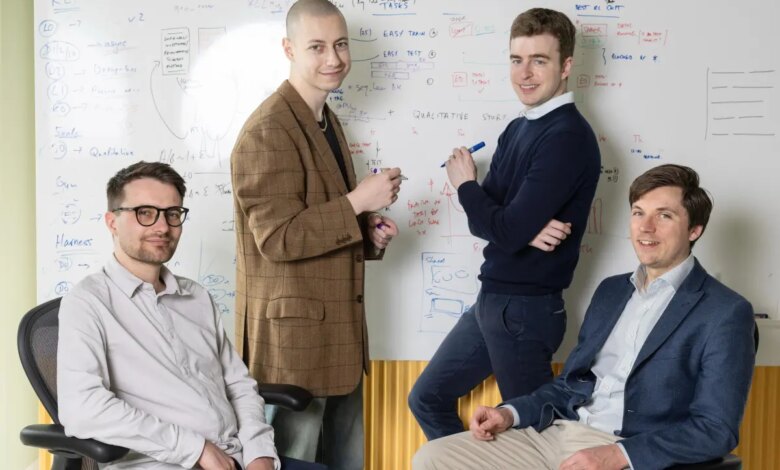
Pictured from left to right: Inherent co-founders Louis Kirsch, Kaloyan Aleksiev, Tantum Collins, and Edward Hughes.