How to Prevent Meta from Utilizing Visual Data from Your Smart Glasses for AI Training

The privacy setting impacts whether users can permit access to photos and videos taken with your glasses.
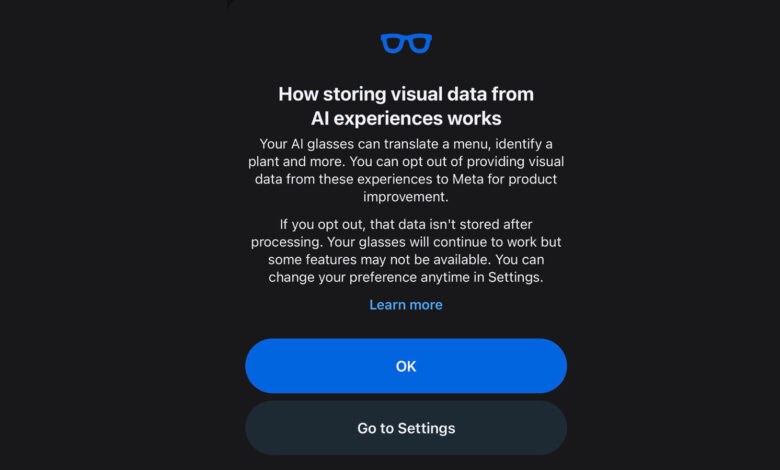
Your smart glasses’ users can now select a new setting that enables them to opt out of allowing Meta to utilize the “visual data” collected for AI training purposes. This feature has begun to appear in the Meta AI application.
Meta is actively alerting owners of the glasses about this modification through a pop-up notification in the app. The message states, “Your AI glasses can translate a menu, identify a plant, and more. You can choose not to share visual data from these functionalities with Meta for product enhancements. If you opt out, that information will not be retained after processing.”
The notification guides users to the appropriate settings page. Alternatively, users can access it directly by going to the glasses’ settings, selecting “Meta AI,” and then navigating to “store visual data from AI experiences.” To adjust this setting, the glasses must be out of their case and connected to a phone. Users with multiple pairs will need to complete this process for each set of glasses.

Meta
Meta indicates that opting out might restrict access to certain functionalities of the glasses. This includes features like “visual reminders,” which allow users to look at an object and instruct Meta AI to remind them to purchase it later. It’s unclear if there are additional features that may be impacted.
In conjunction with the new setting, Meta has also released a comprehensive description of how they handle “visual data” within a help center article, which mentions the potential for human oversight. The company elaborates, “When utilizing AI functionalities on your Meta glasses—such as inquiring about an object you are viewing or employing live AI—Meta retains the resulting visual data, which may be used to enhance the functionalities of the glasses and develop Meta’s offerings. This includes processes for training and refining AI models, whether automated or reviewed by people.”
Furthermore, the company clarifies that it only saves “visual data” captured during the use of specific AI features, including Live AI, and that this data does not consist of “photos and videos captured with your glasses when the capture LED is active.”