Four Real-Time AI Agents Surpass Claude Opus 4.8 in Enterprise Coding Challenges

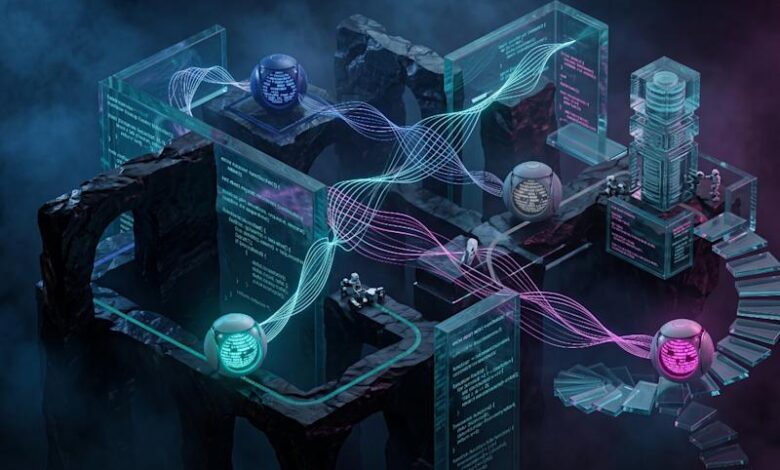
As enterprise codebases expand, AI agents designed to evaluate them often struggle with complex tasks that involve numerous interactions and tool usage. While distributing these responsibilities among a team of agents may seem like a viable solution, it comes with a significant drawback: most multi-agent systems lack the capacity for agents to effectively coordinate in real-time during tasks.
To address this issue, researchers from Coral AI Labs and various academic institutions have developed AgentRadio, an asynchronous message-passing layer that enables agents to communicate during their execution processes without disrupting their main tasks. In scenarios where subtasks are closely linked, this innovative setup allows agents to adjust their strategies on the fly, rather than continuing along misguided paths until a subsequent review phase occurs.
In benchmark tests focused on long-horizon inquiries over production repositories, a team of agents utilizing AgentRadio achieved nearly double the accuracy of four Claude Code agents working in isolation. This approach also surpassed individual agents utilizing more sophisticated models. For AI professionals, AgentRadio illustrates that an effective coordination framework can outperform sheer computational power and model size.
The Complexity of Codebase Analysis
Agents powered by large language models (LLMs) are increasingly adept at tackling long-term tasks that necessitate interaction with various tools and environments. Understanding a codebase epitomizes a particularly challenging aspect of this domain, requiring an AI agent to compile software, execute it, trace execution paths across multiple files, and gather evidence over an extended period.
Under these circumstances, single-agent systems generally encounter what is termed the “coverage problem.”
“A single agent follows a singular path through the repository,” noted Xinxing Ren, Caelum Forder, and Peter Carroll, co-authors of the AgentRadio paper. As context expands, “the original plan becomes more difficult to revise, and discoveries made late in the inquiry don’t always filter through.” Although a model can manage individual tasks, the “real challenge lies in maintaining every obligation, dependency, and conflicting piece of evidence active during a lengthy investigation.”
A benchmark often used to evaluate AI performance on extensive codebases is SWE-Atlas QnA, which consists of intricate, natural-language questions related to live production repositories. These challenges cannot be resolved merely by exploring the code; AI agents need to execute the software and perform multiple commands to uncover answers.
In tests by the research team, a single Claude Code instance using Opus 4.6 managed to resolve merely 32.3% of these tasks. Even an upgrade to a more advanced model like Opus 4.8 only improved this rate to 57.2%.
A common solution to enhance performance is to share the workload among several agents, enabling each to focus on a more manageable context. Multi-agent setups can yield significant performance improvements when tasks are amenable to clear separation and can be addressed independently before being combined.
However, codebase analysis is seldom free from complexity. Subtasks tend to be interdependent, meaning a pivotal configuration file or bug identified by one agent can completely alter another agent’s exploration trajectory. Thus, agents must communicate, negotiate, and share intermediate findings in real time.
Despite this necessity, asynchronous communication among multi-agent systems is still uncommon. Researchers highlight that traditional systems usually fall into three flawed categories:
-
Parallel but isolated: Agents operate simultaneously without any communication.
-
Parallel but synchronized: Agents can communicate only at predetermined synchronized intervals, leading to delays in sharing vital discoveries that could influence other agents’ paths.
-
Asynchronous in limited forms: These systems may offer some async capabilities but lack robust channels for peer communication, forcing agents to pause their work to read updates.
The research emphasizes the main limitation of current multi-agent systems: “an agent that is engaged in work cannot also be attentive.”
The researchers state, “To our knowledge, no existing system allows concurrently working agents to remain aware of each other through a lateral, natural-language communication channel.”
How AgentRadio Functions
To resolve the conflict between working and listening, the researchers have designed AgentRadio, an asynchronous message-passing framework that integrates seamlessly with existing coding-agent systems.
AgentRadio provides agents with three fundamental functionalities:
-
The create_thread function initiates a dialogue between participating agents.
-
The send_message function adds a message to a thread and allows the sending agent to continue its process without being blocked.
-
The wait_for_mention function halts the process until a reference to the calling agent is received, delivering the message along with an overview of all threads for instant context.
This trio grants agents a state of “passive awareness,” enabling them to pursue their primary tasks while still exchanging messages and updating their knowledge in the background.
Designed to be lightweight, AgentRadio’s code can be accessed under the Apache 2.0 license and doesn’t necessitate substantial modifications to existing agent frameworks like Claude Code or Codex CLI.

The architecture has two primary components:
-
The message server: A standalone system functioning as the central hub, managing all active threads and messages for the agents.
-
Integration with agent harness: Agents engage with the server using three straightforward shell scripts, correlating to each of the aforementioned functionalities.
The only requirement for functionality is that the agent harness must be capable of executing shell commands as background tasks. Agents are instructed to maintain a watcher running, send messages via provided scripts, and utilize the background wait_for_mention script, which lets them continue their tasks while receiving updates asynchronously.
To incorporate this into an existing setup, a simple adapter is needed to initialize the agents, assign them identities, link them to the shared server, and orchestrate final synthesis.
AgentRadio in Practical Use
To gauge the practical applications of AgentRadio, the researchers evaluated it using 124 tasks drawn from the SWE-Atlas QnA benchmark, covering various domains such as system design, root-cause analysis, security, and API integration.
The assessment involved models like Claude Opus 4.6 and DeepSeek V4 Pro. They explored configurations ranging from a single Claude Code agent to several agents collaborating with classic task distribution, up to a full AgentRadio-enabled team functioning spontaneously.
The experimental outcomes indicated that AgentRadio’s communication framework eclipsed both naive multi-agent strategies and raw computational scaling.
While a sole Claude Code agent with Opus 4.6 could only resolve 32.3% of tasks, the complete AgentRadio configuration improved this statistic to an impressive 62.1%, surpassing the single agent running on Opus 4.8, which only achieved 57.2%. Furthermore, DeepSeek V4 Pro’s performance rose from 29.0% to 50.8%.

One concrete illustration of this impact in enterprise scenarios involves a MinIO system, where checking server logs per request became necessary—something not anticipated during initial planning.
In a collaborative setting lacking asynchronous communication, two agents identified the need for these logs while conducting commands. However, since they could not share their discovery in real-time, one agent discreetly halted its process, while the other neglected to propose the need for logs. In the review phase, they collectively concluded incorrectly, missing five critical elements.
With AgentRadio, upon discovering the necessity for logs, one agent immediately shared this information in the shared work log. The other agents, having passively listened, absorbed this new information right away. This real-time synchronization converted what could have been a failing score into a perfect 16 out of 16.
“The key distinction lies in timing,” the researchers stated. “The team didn’t require additional agents or another review round; it needed the discovery communicated promptly to have operational value.”

The same dynamics appear in enterprise incident management. For instance, if one agent uncovers evidence that contradicts the hypothesis set by another, sharing that information enhances the investigation’s accuracy. Waiting until both complete their tasks can lead one agent down a wrong path.
The Cost and Complexity of Coordination
Implementing AgentRadio necessitates a designated multi-agent team budget, which naturally escalates token costs. The researchers admit that this cost increase is significant, noting that the average API expenditure rose from $2.96 for a single Opus agent to $19.45 for the complete AgentRadio setup.
Nevertheless, raw scale alone does not guarantee success. In tests where costs were matched, six independent Opus runs only managed to resolve 37.9% of tasks, compared to 62.1% with AgentRadio. This implies that AgentRadio’s design provides a structural advantage over mere scale increases. Teams should remain cognizant of the potential for communication to detract from an agent’s focus, as it can both redirect an agent toward more fruitful evidence and distract them from valid paths.
A fixed multi-agent approach shouldn’t be the standard response to all engineering tasks. A more meaningful evaluation criterion for multi-agent setups is to assess the existence of “responsibility breakpoints.” These are moments that an adept engineer would recognize as requiring collaboration due to crossing ownership boundaries or the need for independent verification.
“Coordination is beneficial when the task can be separated, remaining interdependent, where single-agent success is unreliable, and where incomplete results carry significant downstream consequences,” the researchers asserted. Examples encompass comprehensive architecture inquiries, troubleshooting unfamiliar legacy systems, multi-service incident resolution, security assessments, dependency updates, and refactorings across multiple modules.
Conversely, utilizing a single agent is preferable for “bounded, localized, and reversible tasks,” such as changes within a single file or the generation of boilerplate code.
“Employ one agent as long as it can genuinely maintain ownership of the task,” the researchers noted. “Introduce another agent’s responsibility only when necessary to capture important evidence, cross an ownership boundary, or independently verify impactful conclusions.”
From Research to Commercialization: Coral Code
While AgentRadio functions as a structured research implementation utilizing a defined four-agent team and a five-phase protocol, the foundational principles are being adapted into a commercial solution called Coral Code.
In contrast to a rigid multi-agent protocol applied uniformly, Coral Code is designed from the ground up. Engineers engage with their existing coding agents, and Coral integrates repository-specific investigations, designated responsibilities, and communication only as necessary based on unfolding evidence. “Coral focuses on streamlining operational concerns around current tools used by engineers, enhancing repository context, specialist roles, communication, and evidence management surrounding the harness rather than within it,” the researchers explained.
This flexible approach aims to enhance cost efficiency by targeting the relevant metric: the expenditure needed to achieve a conclusive, reviewable outcome.
The Future of Autonomous Software Development
Despite the advancements made with AgentRadio, there are still obstacles to tackle. One significant limitation identified by the researchers is “attention governance and verification.”
“While passive awareness facilitates communication during execution, it does not determine which agents should function, which discoveries necessitate urgent attention, who should receive information, or when the evidence is sufficiently compelling to modify plans,” the researchers explained. An environment where all agents receive every update risks increasing noise; if multiple agents share a flawed assumption, rapid communication may amplify the error.
In a case study involving the Grafana platform, for instance, several rubrics needed to reach negative conclusions to fulfill their requirements. However, despite conducting tests, none of the agents formulated the necessary negative hypothesis, leading all configurations to fail.
“Passive awareness can propagate an idea produced by an agent, but it is not capable of creating a concept that has not emerged within the group,” they noted.
As the duration of tasks stretches, effective communication and coordination become crucial. “The next wave of systems will require advanced responsibility assignment, evidence-based routing, conflict management, explicit cost constraints, clear permissions, recovery mechanisms, and designated human escalation points,” the researchers stated. Most importantly, robust tracking of claims will be essential for accountability, ensuring that engineering leaders can scrutinize which agent made a claim and the rationale behind an action being authorized.
“As tasks extend over longer durations, communication grows more vital while making accountability increasingly challenging to fabricate,” they concluded.