Exploring Potential Successors to Jensen Huang: A Playful Look at Who Might Step In

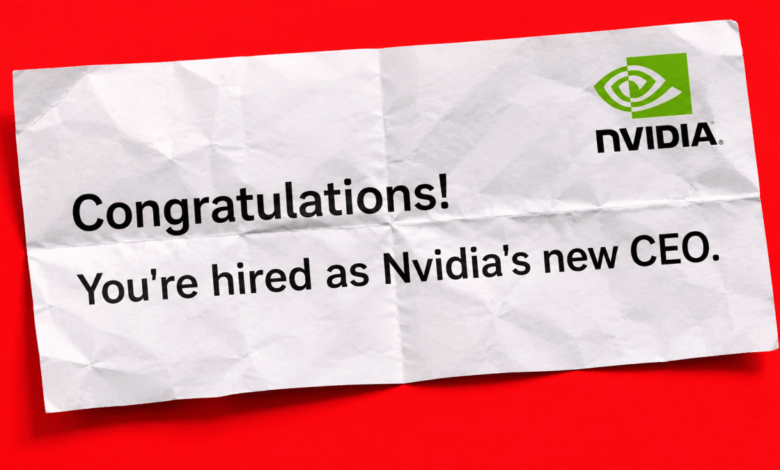
The potential dismissal of Nvidia’s CEO Jensen Huang seems unfathomable, yet it is becoming increasingly likely. According to Kalshi, the chances of Huang retaining his position this week stand at a mere 30%. Despite his role in creating one of the world’s most valuable companies, the situation has shifted dramatically against him. He has admitted to an extramarital affair, but as of now, it’s unclear whether he was referencing Alice Huang, the Chinese executive suspected of espionage, or Kimberly Powell, an Nvidia executive reported to also be involved with him, as per several sources.
Even if Huang is removed from his role as CEO, the board members he has benefitted financially are unlikely to sever ties completely. They might keep him on as chairman, a position that doesn’t exist at Nvidia currently. However, the company will still require leadership, and the lack of a succession plan leaves us guessing about the future. While his 60 direct subordinates scrutinize the situation, let’s explore a few potential candidates for his replacement:
Lisa Su. As the CEO of AMD, a rival to Nvidia, Su’s involvement has been suggested this week, but it raises the question of why she would leave her current successful position. AMD could gain from Nvidia’s distractions caused by ongoing investigations and political inquiries. It might be wiser for her to extend her best wishes and remain at her present company.
Eric Schmidt. Proposed by Jeffrey Sonnenfeld from Yale, Schmidt’s experience suggests he could successfully take charge of Nvidia. He previously led Google and has been involved with government commissions on AI, now working with a space company. However, Schmidt also brings past personal controversies, which may complicate his candidacy.
Lip-Bu Tan. The CEO of Intel, currently facing struggles due to fluctuating revenue in the industry, might see taking a role at Nvidia as a favorable transition. With rising chip prices negatively impacting the PC market—Intel’s main revenue source—this could be an appealing opportunity for him as Nvidia continues to thrive in the AI sector.
Bret Taylor. Taylor, who has served as co-CEO of Salesforce and chair of OpenAI, has an extensive background in leading major tech companies. He could be the experienced and composed leader Nvidia might need. His familiarity with clients across the industry may be an added advantage.
Ian Buck. For a more internal choice, Buck, Nvidia’s VP known for developing crucial software that contributes to its success in AI, has been mentioned as a potential successor. Although not yet widely recognized, his qualifications may align with the board’s desire for a strong leader who can collaborate with Huang should he remain in a chairman role.
Someone else down the hall. Andrew Bell, a senior VP at Nvidia since his initial hire as a rookie engineer, could be a candidate too. While Kress is often mentioned as a potential successor, her vision could be questioned compared to Bell’s extensive chip engineering knowledge.
An unexpected possibility is Lori Huang. Although her name hasn’t emerged in discussions, her long-standing partnership with Jensen Huang, from before Nvidia’s inception, could qualify her. With her engineering background and her role in managing family trusts, she may provide continuity alongside a fresh approach if the board seeks someone close to Huang.
The next developments are anticipated shortly.