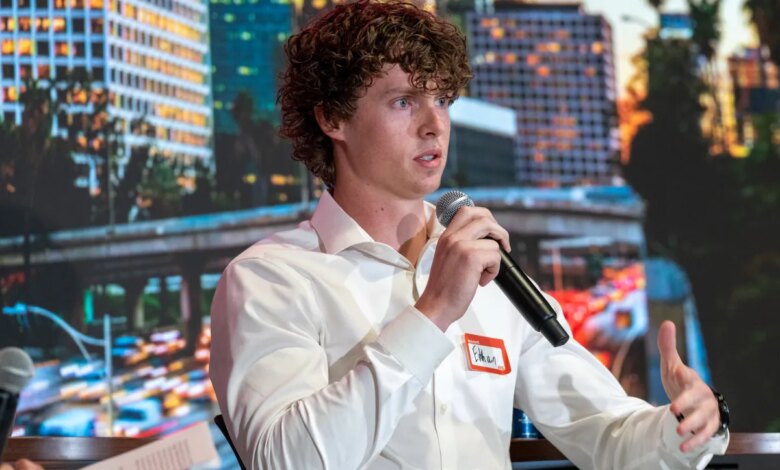
Ethan Thornton left MIT at the age of 19 to venture into weapon development. His initial project, a hydrogen-powered system made from components sourced from Home Depot and Amazon, was unsuccessful—“hydrogen was just a bad bet in general,” he mentioned at last week’s TechCrunch StrictlyVC event in Los Angeles. Fast forward three years, his venture, Mach Industries, now operates six weapon programs and recently secured $300 million in a Series C funding round, attaining a $1.8 billion valuation. To date, the startup has raised around $485 million.
Raised in Burnet, Texas, a small town with about 6,500 residents, Thornton comes from a family with significant military backgrounds. Around 2017-2018, during his early teenage years, he became increasingly worried about the rise of China and anticipated great power conflicts. This concern evolved into a firm belief that unmanned systems would transform warfare and that the U.S. was falling behind.
As of mid-2026, Mach Industries is executing six diverse weapons programs and has opted for a broad focus rather than concentrating on a single project. Thornton acknowledges that this approach leaves some uncertainty for outsiders. “It’s very hard,” he admitted on Thursday evening. However, he believes that the defense sector does not favor the singular focus required for projects like rocket launches. “It’s a chess game against an adversary,” he elaborated, highlighting the necessity for multiple products to ensure national security. “Focusing on just one could mean losing the game.”
Mach is developing complex systems including a vertical-takeoff strike aircraft, a long-range anti-ship missile, two high-altitude systems, an inexpensive surface-to-air interceptor designed for drone elimination, and a new 40-foot, 4,000-pound Navy aircraft capable of vertical takeoff and reaching over a thousand-mile range with a payload of up to a thousand pounds.
This latest aircraft represents a significant leap for a company whose largest previous aircraft measured only about 13 feet. None of these six projects are in full production yet. Thornton stated that Mach has secured around 13 government contracts, most of which are in the mid-stage of defense procurement—after initial design but prior to the lower manufacturing rate that few programs industry-wide achieve.
He anticipates that several systems will be operational by the end of this year and aims to transition three of the six into mass production around the same time—potentially scaling from hundreds of units per month to hundreds of thousands at a factory that Mach plans to establish soon.
This ambitious timeline is layered atop an already bold strategy. Mach’s fundamental belief is that the U.S. cannot outproduce China, thus it must rely on innovation to achieve first-mover advantages, similar to Ukraine’s approach against Russia, despite lower production numbers. “I don’t think we’re going to outmanufacture China,” Thornton remarked. “America’s strength lies in creativity and productization.”
Thornton and other defense tech startups assert that the primary bottlenecks are not the platforms being developed but rather the underlying supply chain. “The real challenge is getting the materials into production,” he stated, citing vital components like jet engines, rocket motors, and radar systems. In a remarkable feat, Mach developed and tested two jet engines from scratch in about eight months—a process traditionally taking four years. Furthermore, in May, the company acquired Exquadrum, a 24-year-old solid rocket motor manufacturer, for $50 million, outbidding approximately eight other interested parties. Currently, selling components contributes to around half of Mach’s revenues.
Mach’s model is markedly different from some competitors. Shield AI, established in 2015, focused on a single product for years before introducing a second platform last October—a deliberate strategy which has proven fruitful, as evidenced by its recent $2 billion funding round. Similarly, Saronic, founded in 2022, only constructs autonomous surface vessels, emphasizing a unified autonomy framework. Both companies have seen substantial success from their focused approaches.
In contrast, Mach’s strategy is reminiscent of Anduril, a more established and larger defense tech firm that serves as a benchmark for various startups. Thornton himself makes this comparison but emphasizes a key difference: “Anduril’s strategy has been top-down, emphasizing software. We operate bottom-up, beginning with hardware and then layering software.”
While this distinction is notable, Mach still operates under Anduril’s significant influence. Anduril recently raised $5 billion at a valuation of $61 billion, overshadowing Mach’s market position, and in March secured a substantial multi-year Army contract. Despite Thornton’s ambitions, Anduril has paved the way years in advance with considerable investments.
Thornton insists the defense sector is not a zero-sum game. He underscores the vastness of the challenge: with reports indicating that China produces around a thousand cruise missiles daily, while the U.S. manages roughly one every three days. “Multiple companies could develop these technologies, and it still wouldn’t suffice to meet the demand,” he stated. He also believes the Pentagon is unlikely to allow a monopoly, intentionally maintaining several competitors in each sector instead of choosing a single winner.
Whether this is an optimistic view of the competitive landscape is debatable. Notably, Palmer Luckey, Anduril’s co-founder, has not publicly addressed Mach. Thornton remains unfazed, describing Luckey with respect and asserting they share a common mission to ensure Western sovereignty.
For investors, including prominent firms like Sequoia, Khosla Ventures, and Ribbit Capital, the overarching narrative is less about the individual backstory and more focused on the potential of Thornton’s innovative initiative.
Thornton acknowledges that the demands of leading Mach shift every six months—moving from engineering to sales, and now to large-scale manufacturing, which he anticipates will fill the next year. He carves out four to five hours daily to contemplate and “war game the future,” often drawing colleagues into these discussions, which he admits can occasionally be frustrating for them.
When asked about who challenges him—who keeps a rising founder grounded—Thornton emphasizes that the most candid feedback often comes not from investors or his executive team, but from the employees executing daily tasks. He described regular company forums initiated by his COO, where employees can ask him anything, highlighting his belief in fostering open dialogue. “I essentially stand there for an hour,” he said, “fielding challenging questions from the team.” He appears to welcome this exchange.