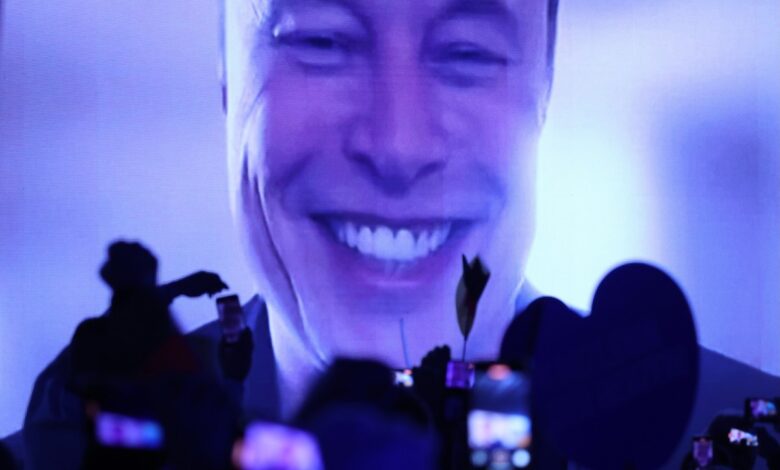
During SpaceX’s inaugural earnings call as a public entity, Elon Musk made bold predictions regarding the company’s trajectory, while other executives tempered these ambitious statements, hinting at future developments in the realm of rocket launches and satellite communications.
The call took place on Tuesday and marked another instance of Musk presenting grand visions that his team had to clarify for investors, reminiscent of his approach at Tesla. Recent evaluations have indicated that Musk is increasingly captivated by futuristic concepts, while his colleagues focus on the concrete aspects of their automotive business.
One of the most striking assertions made by Musk was his expectation that SpaceX’s Starlink service could potentially “provide the majority of the world’s internet” within the next decade. This remark was made in the context of the upcoming launch of upgraded “V3” Starlink satellites, which promise significantly enhanced bandwidth.
Musk stated:
“It’s challenging for people to fully grasp, but it’s not unreasonable to think one day Starlink could deliver most of the world’s internet, especially in countries where we can operate, which encompasses a large number of nations. This isn’t just a distant expectation; it’s less than a decade away.”
Shortly after, SpaceX’s Chief Operating Officer, Gwynne Shotwell, provided a more measured comment, saying:
“The considerable capacity we’ll gain from the V3 satellites will allow us to enhance our service, which is already quite good, while serving a growing number of customers globally. In the years to come, we anticipate that Starlink will account for a notable portion of global internet traffic.”
While still ambitious, Shotwell’s statement was more cautious in its phrasing.
The call also showcased CFO Bret Johnsen discussing SpaceX’s expanding focus on cloud computing for artificial intelligence applications, a venture that has generated substantial revenue for the company.
Johnsen highlighted a key financial target, carefully constructed to excite investors while allowing space for contingencies:
“We foresee persistent high demand across all our business sectors, particularly in cloud services. The positive economic dynamics in our agreements suggest a payback period of less than a year for our new capital investments in this area. As of early Q3, we’ve secured an additional $6.7 billion in cloud services revenue for a six-month period starting in October. We believe this positions us favorably to hit $100 billion in annualized revenue by year-end, based on December’s anticipated revenue.”
In a subsequent remark, Musk amplified this target:
“I want to clarify that reaching the $100 billion mark in December is a certainty. That’s what we’d achieve if we essentially did nothing. I believe it could be even higher.”
Musk also updated SpaceX’s revenue projections, moving the aim of reaching a trillion dollars from 2031 to 2030, with a slight possibility of accomplishing this even sooner:
“We’ve adjusted our internal projections; we now anticipate reaching a trillion dollars in revenue by 2030, initially slated for 2031. There’s also a chance we could achieve this in 2029.”
Throughout the call, Musk’s passionate visions continued to unfold. He asserted that SpaceX’s Starship rocket, designed for NASA’s Artemis moon missions, could be operational for crewed flights by the end of next year. He also claimed that SpaceX might be able to launch Starship rockets daily or even more frequently within a year.
Following Musk’s enthusiastic claims, Shotwell reiterated that SpaceX remains committed to meeting NASA’s established benchmarks, stating a broader timeline: “We aim to land humans on the moon by 2028.”
However, achieving these goals requires SpaceX to demonstrate that the Starship can fly reliably and, crucially, be fully reusable. A vital element to successful reusability is the heat shield, which protects the Starship during reentry into Earth’s atmosphere. The latest test flight yielded promising results for this component, yet Musk boldly declared, “I consider the heat shield issue resolved at this moment.”
Historically, Musk has made numerous ambitious promises about SpaceX’s future that have not materialized, including a 2016 statement about sending humans to Mars within six years. The difference now is that SpaceX operates as a public company, which subjects it to regulatory scrutiny and potential penalties if it makes unfeasible claims.
Nonetheless, enforcement actions from the Securities and Exchange Commission and the Department of Justice have decreased significantly. Even if SpaceX fails to fulfill Musk’s lofty assertions, investors may find it challenging to pursue legal actions, as the company has largely safeguarded itself against these lawsuits by registering in Texas.