California’s MyFirstEV Offers a $3,500 Instant Discount for New Electric Vehicle Buyers

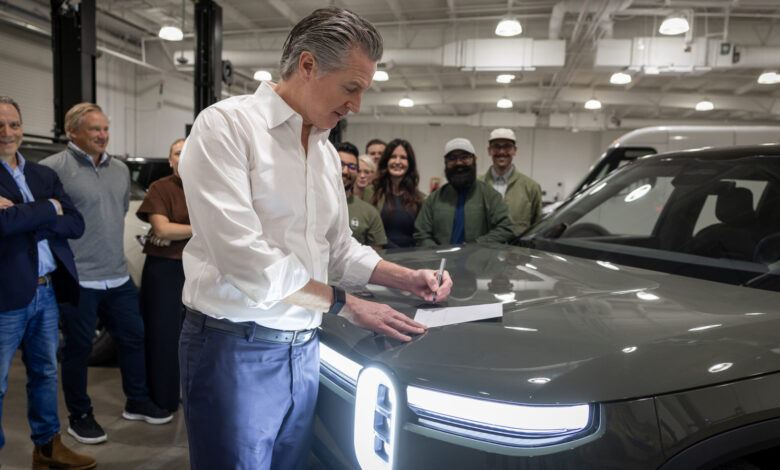
The federal government’s decision to eliminate the electric vehicle tax rebate last year has led to gaps in the transition to electric vehicles. In response, Governor Gavin Newsom has initiated an alternative program in California, offering instant rebates of up to $3,500 for first-time electric vehicle buyers.
This initiative, known as the MyFirstEV program, is part of a broader $600 million effort by California to enhance its clean transportation sector. The rebate program will be funded by $270 million, with half drawn from the state budget for 2026-2027 and the other half financed by participating automakers.
Californians interested in the rebate should be aware of certain criteria. Eligibility is limited to zero-emission vehicles, specifically fully electric cars, excluding hybrids. To qualify for the full $3,500 rebate on a new car, its manufacturer’s suggested retail price (MSRP) must be below $50,000. For those considering used electric vehicles, a rebate of $1,750 is available for cars priced under $25,000. Notably, the rebate is exclusively for individuals purchasing their first electric vehicle.
Despite these requirements, many popular models remain within reach, such as the Nissan Leaf, Tesla Model 3 and Model Y, Hyundai Ioniq 5, and Ford Mustang Mach-E. While Rivian’s latest electric vehicles may be priced too high, the upcoming R2 model will start at $45,000 when it launches next year. Moreover, the rebate can be applied as an immediate discount at dealerships, ensuring buyers can reduce their costs upfront without further paperwork later.
In addition to the MyFirstEV program, California’s $600 million investment in zero-emission transportation includes $150 million allocated for the Community Air Protection Program, $135.5 million for the Clean Truck and Bus Voucher Incentive Project, and $130 million designated for replacing vehicles with heavy-duty pollutant engines. Furthermore, to assist residents in rural areas, the state is committed to increasing the number of charging stations for electric vehicles.