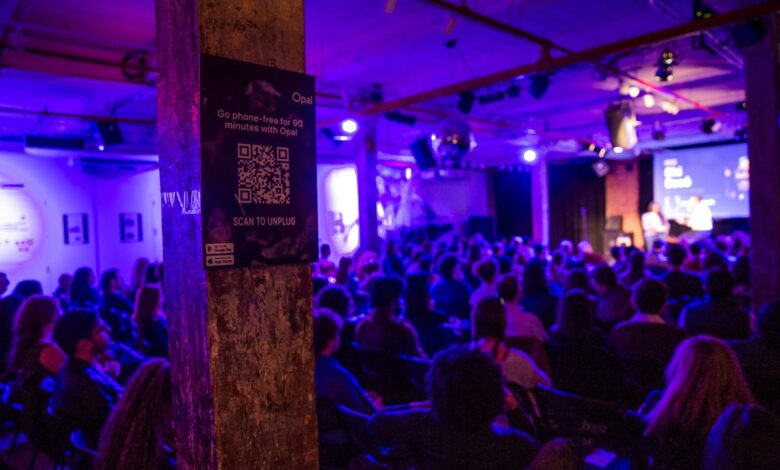
On Thursday night, I donned my bright yellow heels and a floral mini dress, ready for a midterm election gathering in New York. Surrounded by media professionals, tech enthusiasts, and policy influencers, I entered a Brooklyn warehouse illuminated in soft blue and was taken aback by the crowd already forming.
The event was organized by Newsreel, a media company established by former journalist Jack Brewster. The speakers included Kenneth Schlenker, co-founder of the productivity app Opal, who discussed “the state of attention,” and Aryan Banjan, creator of the campaign management software Barza, who provided insights into midterm trends. I played the role of moderator for a panel focusing on data centers.
Brewster expressed his aim for attendees to engage authentically and discuss the election just five days away, without the distraction of their phones.
As the night unfolded, one theme dominated the discussions: the intersection of AI, data centers, and the rising opposition to an increasingly technocratic society.
As a tech journalist, I’ve observed increasing tensions between the tech community and the general public. While I frequently converse with those excited about AI’s potential, it often slips my mind how daunting these technologies might appear to outsiders. Issues like data centers and AI have escalated into significant points of concern that could impact the upcoming elections on November 3.
A recent analysis indicated that nearly $200 billion in data center projects faced delays or cancellations due to public and political opposition in the first half of 2026. Several states, including Pennsylvania, Georgia, Texas, New York, and Virginia, are now working on regulations to ensure greater oversight and transparency in the swift expansion of data centers. Virginia, often dubbed the “data center capital of the world,” alone has plans for hundreds of new facilities.
A discussion with New York City Council member Chi Ossé set an insightful tone prior to my panel. By the end of the talk, Ossé mentioned that he hardly uses AI, suggesting he was not firmly in support or against the technology. His primary concern revolved around increased accountability for tech executives and taxing the wealthy, including names like Elon Musk. He highlighted the need for corporate leaders to come before Congress when discussing technologies with far-reaching implications.
Next, I led a conversation with Maia Woluchem, a researcher in technology and human rights, and Hilary Flint, a public health advocate focusing on environmental issues. As I began, I gauged the audience with a question: “How many of you support AI data centers?” The response was a chorus of boos. Our discussion revealed various sentiments, particularly frustrations regarding major tech firms allegedly striking secretive agreements with local governments to erect costly data centers. Many zoning laws obscure what is being developed, leaving little room for public input.
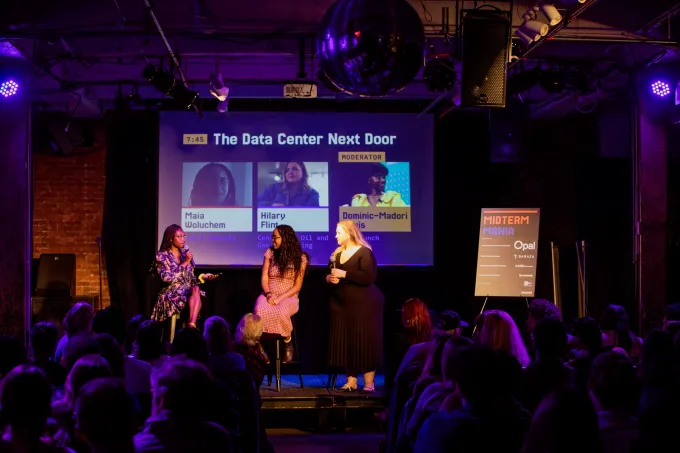
The audience also echoed concerns over the increasing cost of living, stressing a collective effort to preserve their piece of the American Dream, while tech executives speculate about AI’s capacity to replace jobs and even humanity. People expressed frustration over their perceived loss of control in their neighborhoods and their anxiety regarding potential environmental and health impacts. The panel concluded that data centers epitomize the public’s discontent and fears towards rapid technological growth.
Flint poignantly questioned, “What is a life worth?” in response to claims about the benefits some communities have experienced from data centers, indicating that protests persist because residents prioritize their lives over any temporary financial incentives.
The subsequent panel was led by NewsNation’s Batya Ungar-Sargon, alongside political strategist Morris Katz and Vox’s Astead Herndon. Their discussion, initially aimed at exploring the direction of the Democratic Party, quickly reverted to data centers. Ungar-Sargon pointed out that some labor unions favor data centers for the jobs they create, even though many of these positions are temporary, vanishing once construction concludes.
“There used to be pride among Rust Belt communities in the large factories in their vicinity because those buildings represented stability and a brighter future for their children,” she remarked, recalling my earlier comments about the unappealing architecture of data centers. “That’s no longer the case.”
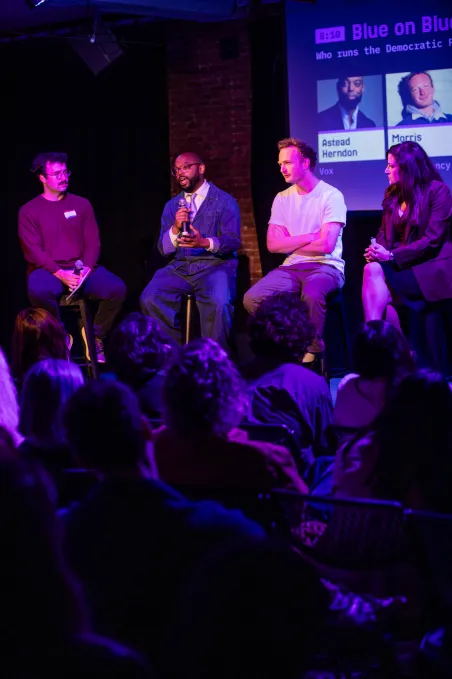
Herndon mentioned a recent incident where Vivek Ramaswamy faced backlash in Ohio for expressing a similar sentiment. “The absence of consent is notable,” he reflected, noting that this applies to Republicans as well. Katz echoed this concern, asserting that the same entities responsible for job losses in unions are now returning to claim remaining opportunities.
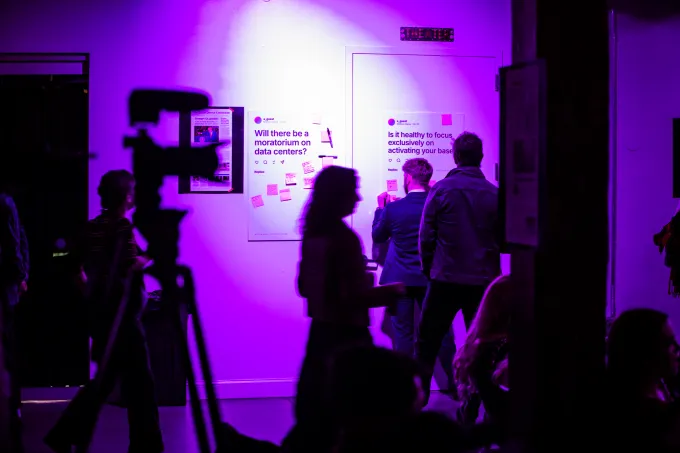
Adorning the warehouse walls were sticky notes responding to inquiries like “Will we ever be able to take Big Money out of politics?” One response read, “God, I hope so.”
As the panel concluded, attendees flocked to the bar, energized by techno music. Small groups formed, once again pivoting to discussions about AI and data centers, but in a more intimate setting. I inquired with Brewster if he was surprised by the prevalence of these topics.
“It was a consistent theme throughout the discussions, and it emerged frequently in the responses from those who RSVP’d,” he noted, adding that even in a city like New York, where data centers are less visible, they are a hot topic. “AI has transitioned into a significant issue for everyday voters,” he explained. “In rural areas, it triggers feelings of displacement, while in places like Brooklyn, it raises questions about wealth distribution.”
Before departing, I engaged attendees about the most surprising tech developments they’d encountered this year. Two startup founders highlighted an AI assistant venture called Instinct, while a non-tech individual mentioned Sam Altman.
Another attendee voiced concerns over deepfakes and AI-generated art, suggesting this trend signals a perception of diminished value. This could explain why luxury brands are veering away from AI in favor of handcrafted artistry, as seen in Prada’s holiday campaign featuring drawn illustrations and Hermès’ promotion of artisans on social media.
As I exited, I chatted with a software engineer who shared an unusual encounter where someone dyed their nails orange for Halloween, raising curiosity about a tech IPO. I recounted my own experience of donning a burnt orange dress and humorously recalling the moment.
She also mentioned that her hometown in Southern California is seeing data centers emerge. For the first time, I pondered how I would react if a similar establishment opened in my own neighborhood. She grew up in a community of Chinese immigrants, where locals have been expressing their discontent about data centers, even placing signs featuring dragons constricting such facilities in their yards.
These signs have since been translated into various languages, illustrating a community-wide opposition.