Supports can be both annoying and essential in the realm of 3D printing. They allow for the creation of intricate overhanging structures, but often lead to wasted material and unsightly blemishes on the finished product. While many users are familiar with traditional or tree-like supports, another innovative alternative—fins—has yet to be widely incorporated into slicers.
Supports Are Essential for Optimal Print Orientation
Enhancing Strength with Strategic Orientation
Most 3D printing aficionados prefer to avoid supports whenever possible, often repositioning their models to eliminate overhangs. While this approach can seem ideal, the orientation of a print on the bed is crucial for its strength. 3D printers construct objects layer by layer, which creates inherent weaknesses at these layer lines.
To boost durability, it’s important to place prints in a way that minimizes these stress points, which frequently means utilizing supports. This is particularly the case for right angles; for instance, positioning a cube on its edge can lead to layer lines running diagonally through the print.
Commonly, users defer to their slicer for support placement, which can result in messy and inefficient solutions. For example, a cube set on its edge in Bambu Studio with tree support enabled might turn out poorly, featuring numerous contact points.
This can create excessive contact points for a simple design. Although reducing the threshold angle may help, it might lead to warping or failed prints. An alternative solution could involve incorporating supports directly into your model with what are known as fin supports.
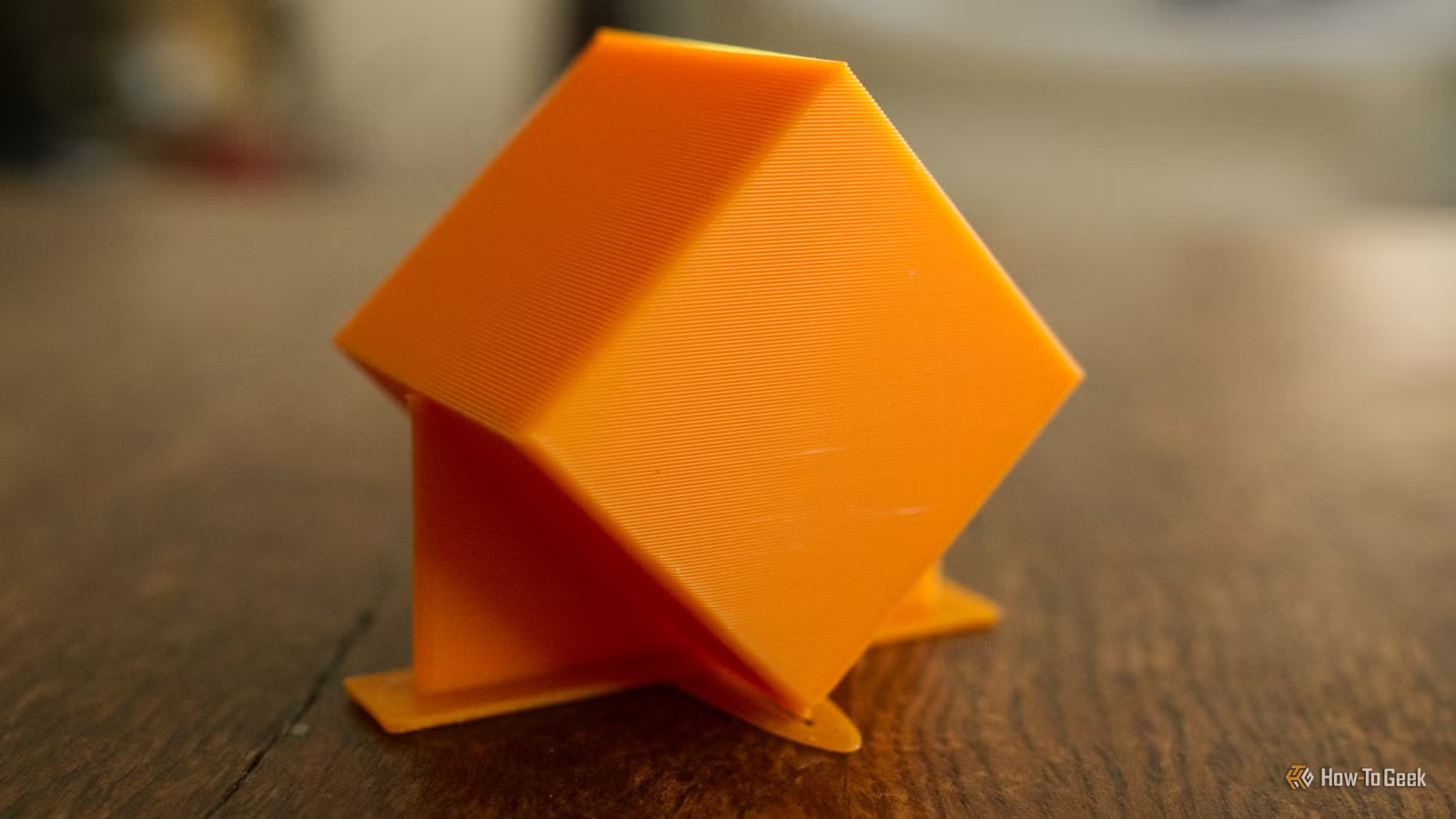
Essentially, this technique adds robust, straight supports at the print’s edges where reinforcement is needed. These thin connectors—called tines—run parallel to the layer lines, resulting in stronger support with fewer contact points and enhanced printing efficiency.
While this method seems advantageous, not all users are enthusiastic about modeling their own supports. Luckily, there’s a user-friendly solution.
Streamlined Fin Addition with a Simple Upload
PrintFins is a complimentary web application that automatically integrates fins into your models. Simply upload an STL or 3MF file, adjust the orientation for your specific needs, export the modified file, and then open it in your slicer to benefit from built-in fin supports.
Keep in mind, when importing the file, your slicer may alert you about the absence of a print profile. This is usually minor since the 3MF file comprises only the model’s geometry. Just ensure you disable any auto-generated supports before slicing.
Here’s how the cube looks once we employed fin supports instead of the automatic slicer variants:
The tool provides options for both automatic fin addition and manual configuration, along with a calculator to help determine optimal orientation and whether fins are actually needed. For those who prefer, there’s a possibility to run the project locally as a self-hosted service based on provided instructions.
The developer is also working on plugins compatible with popular slicers.
Fins Serve More Purposes
Facilitate a Secure and Snug Fit
The concept of support fins was popularized by a YouTube 3D printing creator known as Slant 3D. The PrintFins developer references this channel, highlighting that although the technique isn’t new, it previously required manual CAD design each time.
Additionally, Slant 3D has discussed employing fins for improving fit between two printed parts. This approach is beneficial in addressing the variabilities that may lead to components being either too tight or too loose. It accounts for potential errors in measuring and material shrinkage.
Grip fins utilize small cutouts to introduce flexibility, allowing for tight tolerances knowing that the model will flex at joints due to the fin structure. This method, while ingenious, must be integrated into design from the outset.
For further insights, consider exploring Slant 3D’s informative videos.
Ultimately, fins are particularly beneficial when structural integrity demands an unconventional print orientation, although they aren’t the panacea for all 3D printing needs. It’s advisable to seek additional strategies to limit support usage, especially for models that don’t require extreme strength.