Liux’s Bold Microcar Ventures: Championing Sustainability Against Chinese Competitors


European cities are seeing smaller cars than ever as the demand for microcars increases. While the charming Italian ‘yoghurt pots’ once dominated this market, they are increasingly being replaced by compact Chinese electric vehicles (EVs). Notably, the Smart brand, known for its ultra-compact designs, has relocated its manufacturing to China.
Liux, a new Spanish startup, believes it can make a mark in this competitive landscape with an eco-friendly microcar.
Following the examples set by the Swiss Microlino, Liux aims to establish itself with its forthcoming model, the Liux Big. The name is a playful contradiction; while the car is compact enough to park parallel to the curb, it symbolizes the company’s ambitious vision.
“The notion of a distinctly European car is a myth,” remarked Antonio Espinosa de los Monteros, Liux’s co-founder. This perspective, especially from a startup claiming to produce vehicles in Spain, underscores the company’s broader vision.
Liux has launched Spain’s first new car manufacturing facility in over three decades. However, Espinosa and co-founder David Sancho noted during our meeting in their stylish showroom that achieving a completely independent supply chain is unrealistic. Instead, they are aiming to balance practicality with sustainability as their guiding principle.
While Liux’s batteries are not manufactured in Europe, they support home recharging, even from solar energy sources. The vehicle is designed for ease of maintenance, combating rapid obsolescence often seen in modern cars. A standout feature is its body, made from a new biocomposite based on linen that can be recycled after use.
“Recycling should not just be a lab experiment. It’s about how something is constructed that determines its recyclability,” Espinosa explained. “Preserving the material’s and components’ integrity is crucial for prolonging their lifecycle.”
Espinosa comes with experience in sustainability, having previously co-founded Auara, a B Corp focused on bottled mineral water that is both recycled and recyclable. After a larger company acquired Auara, he teamed up with Sancho to launch Liux.
Sancho, with his expertise in automotive engineering aimed at low emissions, is spearheading Liux’s efforts. His last significant project was the Bóreas, a hybrid supercar revealed at the 2017 24 Hours of Le Mans. After parting ways with his previous partners, he joined forces with Espinosa to create Liux.
Their initial prototype, known as the Animal, was a fully electric five-seater constructed mainly from recycled and plant-based materials. However, they soon realized after its 2022 debut that pursuing a smaller vehicle would increase their chances of meeting regulatory requirements.
Now, as of 2026, Liux has achieved Europe-wide homologation for the Liux Big, which they plan to begin selling in the first half of next year. The company has grown to a team of 65 and is preparing to expand production across three facilities in Spain.
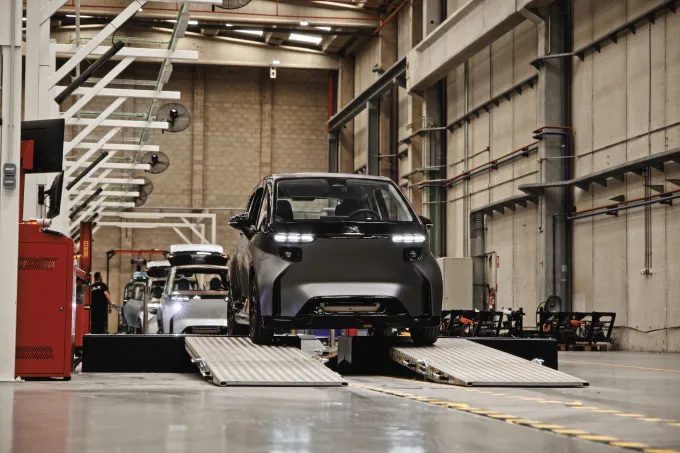
The manufacturing plant in Azuqueca de Henares, just over an hour from Madrid, has a small footprint by design, following Toyota’s lean management principles and focusing on finalizing assembly. Nonetheless, Liux claims it could produce up to 20,000 cars annually by 2030.
While it’s too early to assess the market interest, over 7,500 individuals have already signed up for a Liux Big, with no fee necessary to join the waiting list. This move has provided Liux with valuable insights into its potential customers, mainly middle-aged urban dwellers. The startup will likely position the Liux Big as a secondary vehicle for many households.
This might quell expectations that microcars could disrupt conventional car ownership patterns, but Espinosa emphasizes the need to strategically select their battles. Rather than making predictions about market trends, the startup is open to collaborations with businesses managing fleet services and exploring autonomous vehicle technologies.
For Espinosa, the Liux Big presents an opportunity for a sustainable and affordable vehicle option. Although the exact pricing is yet to be determined, the company estimates it will start at under €18,000 (around $21,000) before any EV incentives, positioning it as one of the pricier options among microcars but with aspirations to perform well in the market.
According to Celso Fernández Llorens, Liux’s R&D head, restrictions regarding size and weight are significant challenges in this automotive segment. He argues that most microcars are similar, even as regulations differentiate between ultralight four-wheelers and slightly heavier variants. Nevertheless, Liux has navigated these limitations effectively to maximize its L7e regulations.
Thanks to numerous small decisions, the startup has successfully integrated a 260-liter trunk into the vehicle. However, their primary focus remains ensuring the Liux Big provides a driving experience akin to traditional cars, particularly in terms of safety—avoiding a lightweight design that compromises crash resistance or stability during turns.
With these considerations in mind, despite the absence of mandatory crash testing for their category, Liux has been rigorously assessing the Liux Big’s performance through slalom and braking tests, showcasing some of these capabilities during a test drive.
The Liux Big will offer two battery options: 15 kWh and 20 kWh, with plans for a cargo variant as well. With Sancho’s expertise, aspirations of creating a supercar linger in the background. The company has clarified it does not aim to be “a one-car brand.”
For now, Liux is channeling its initial €16 million funding (around $18.5 million, partially from European sources) to launch the urban version of the Liux Big through a network of dealerships across Europe.
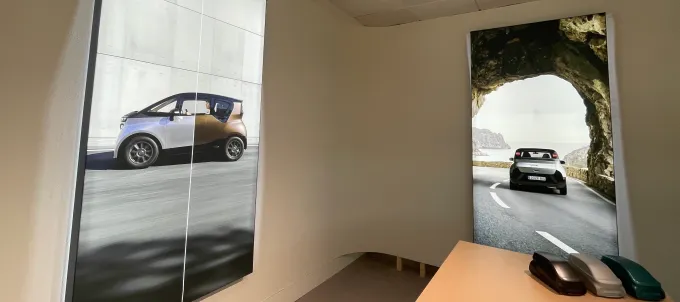
The showroom we visited hints at the future retail experience Liux envisions, as described by Head of Brand Ana Terrado Leyva. The use of textile screens, 3D models highlighting the Liux Big’s color options, and linoleum flooring reflecting linen material symbolize a distinctive identity aimed at setting it apart from Chinese rivals.
This may indicate that the concept of a European car is, indeed, valid.